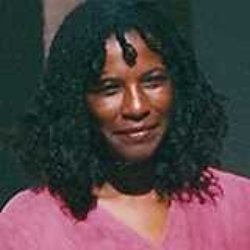
Joyce Carol Thomas, (1938-2016), poet, playwright and the author of more than 30 books for children and youth
Joyce Carol Thomas was one of nine children born into a cotton-picking family in rural Oklahoma. She died last month on the 16th in Berkeley, California.
Ms. Thomas started out writing poetry and plays and then moved on to young adult fiction. Her first young adult novel, Marked by Fire, was published in 1982 and won the National Book Award in 1983.
She said in one interview, “I know of black boys and girls who squirm uncomfortably in their desks at the two-dimensional, unrelenting portrayal of young people as either victims of slavery or perennial do-rag wearers hanging out on a stoop next to a garbage can. There are black American stories somewhere between slavery and ghetto that also deserve telling.” Her work explored issues of identity and the experience of black lives in rural areas.
In addition to the National Book Award, she won the American Book Award, the New York Times Outstanding Book of the Year Award, Outstanding Woman of the 20th Century Award, three Coretta Scott King Honor Awards, the Center for Poets and Writers’ Poet Laureate Award, Kirkus Reviews Editors’ Choice, the American Library Association Best Book for Young Adults, Book of the Month Club Selection, and others. She received her undergraduate degree from San Jose State and a master’s from Stanford University and taught at several colleges.
Because I am dark, the moon and stars shine brighter.”
Her poetry collections included The Blacker the Berry and Brown Honey in Broom Wheat Tea, which both received the Coretta Scott King Book Award.
This slideshow requires JavaScript.
When the berries in the jar
Are biscuit ready
I fix a cup of tea
Then spoon out biscuit jelly
For biscuit brown me
Joyce Carol Thomas
With the holiday’s coming sooner than we’d like to think: her books make great gifts for children and youth. Her board books are charming.
May Sarton (1912-1995), American poet, memoirist and novelist
“The creative person, the person who moves from an irrational source of power, has to face the fact that this power antagonizes. Under all the superficial praise of the “creative” is the desire to kill. It is the old war between the mystic and the nonmystic, a war to the death.” May Sarton, Mrs. Stevens Hears the Mermaids Singing
Eleanore Marie Sarton – nom de plume, May Sarton – was born in Ghent in Belgium to an English portrait-artist and interior-designer mother, Mabel Eleanor Elwes, and George Alfred Leon Sarton, a chemist and historian renown as the father of science history.
When the German invasion of Belgium began in August 1914 the family escaped to Mabel Sarton’s mother’s home in Ipswich, England. From there they traveled to America and settled in Boston so George Sarton could teach at Harvard University. May came from a family of gentle nonconformists and her maternal grandfather was among the original Fabians.
“Perhaps every true poem is a dialogue with God … when we are able to write a poem we become for a few hours part of Creation itself.” May Sarton in The Practice of Two Crafts, Christian Science Monitor (1974)
May Sarton’s parents did not belong to any church but she seemed to feel that her parent’s views were not inconsistent with those of the Unitarian Church.
Interviewed in The World in 1987, she told Michael Finley, “My father and mother believed that, though Jesus was not God, he was a mighty leader, and the spirit of Jesus, the logos of him, is the worship of God and the spirit of man.
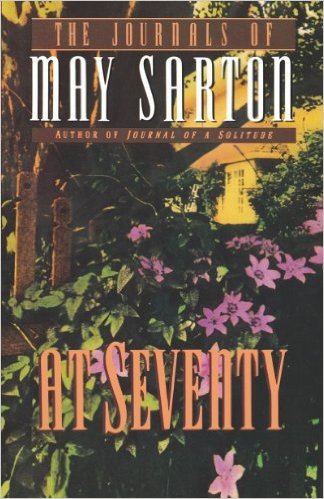
“At the age of ten May was introduced to the Unitarian church by her neighborhood friend Barbara Runkle, whose family attended the First Parish in Cambridge. May was impressed by the minister, Samuel McChord Crothers, whose sermons she thought “full of quiet wisdom.” One sermon in particular, she recalled in her memoir At Seventy, 1984, “made a great impression on me—and really marked me for life. I can hear him saying, ‘Go into the inner chamber of your soul—and shut the door.’ The slight pause after ‘soul’ did it. A revelation to the child who heard it and who never has forgotten it.” The Encyclopedia of Unitarian and Universalist Biography
May began writing early and her first poems – sonnets – were published in Poetry magazine in 1930. Her other love was theatre and she abandoned a scholarship to Vassar to study theatre and to eventually found a theatre company. However, in I Knew a Phoenix, Sketches for an Autobiography she wrote that when her first collection was published she focused on writing and “never looked back.”
Her novel Mrs. Stevens Hears Mermaids Singing is considered a “coming out” book and her work was then labeled lesbian and featured in women’s studies classes. She regretted the label seeing it as limiting, which it is. May Sarton wrote about the experiences, fears and other emotions that are part of being human. Journal of Solitude, for example, is a meditation on aging and the changes aging brings to life, on solitude ( a frequent theme in her work), on love affairs and creativity. May Sarton’s true gifts are poetry and memoir and not to be missed. Her novels – as she knew and admitted – were good but not top-notch.
“Loneliness is the poverty of self; solitude is richness of self.” May Sarton, Journey of Solitude
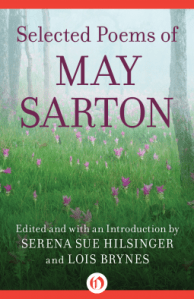
The following poem, Sisters, My Sisters, is one of May Sarton’s most well know poems. She reads it herself in this video. It was originally published in Kenyon Review in 1943 and is in Selected Poems of May Sarton.
If you are reading this in email, you’ll likely have to link through to the site to view it.
“Nous que voulions poser, image ineffaceable Comme un delta divin notre main sur le sable” – Anna de Noaille
Dorothy Wordsworth, dying, did not want to read,
“I am too busy with my own feelings,” she said.
And all women who have wanted to break out
Of the prison of consciousness to sing or shout
Are strange monsters who renounce the measure
Of their silence for a curious devouring pleasure.
Dickinson, Rossetti, Sappho — they all know it,
Something is lost, strained, unforgiven in the poet.
She abducts from life or like George Sand
Suffers from mortality in an immortal hand,
Loves too much, spends a whole life to discover
She was born a good grandmother, not a good lover.
Too powerful for men: Madame de Stael. Too sensitive:
Madame de Sevigne, who burned where she meant to give
Delicate as that burden was and so supremely lovely,
It was too heavy for her daughter, much too heavy.
Only when she built inward in a fearful isolation
Did any one succeed or learn to fuse emotion
“Does anything in nature despair except man? An animal with a foot caught in a trap does not seem to despair. It is too busy trying to survive. It is all closed in, to a kind of still, intense waiting. Is this a key? Keep busy with survival. Imitate the trees. Learn to lose in order to recover, and remember that nothing stays the same for long, not even pain, psychic pain. Sit it out. Let it all pass. Let it go.” ― May Sarton, Journal of a Solitude
A reminder to join us – The Bardo Group Bequines – at The BeZine for 100,000 Poets (and other artists and friends) for Change (100TPC): on September 15th for the Zine and on September 24th for the 100TPC virtual event, which is celebrated from our blog. The themes for both are Environment and Environmental Justice. Since this is a virtual event, you can participate from anywhere in the world.
Michael Dickelis the Master of Ceremonies for our 100TPC virtual event.
These are worthy efforts to:
help steer public discourse in a productive direction,
define issues and suggest possible solutions,
encourage consensus for the environmental and social good, and
connect people and raise the general consciousness.
Please do participate. All work will be archived on site and at Stanford University.
Zine submissions should be sent to bardogroup@gmail.com. Please read submission guidelines first. The deadline is September 10th.
Reader participation on the 24th for the virtual event is by way of the comments section or Mister Linkey. Michael will provide direction in his blog-post that day.
Also of note, Michael Rothenberg, cofounder of the 100TPC global initiative, reminds everyone today that it is not too late to register as an organizer of an event. While ours is a virtual event, people all over the world in 120 countries are sponsoring 500+ events to be held in homes, schools, places of worship, cafés and restaurants, parks, community centers and other sites where people gather. Link HERE to register.
By way of warm-up, this Wednesday, I’ll post a prompt on The Poet by Day related to the themes.
In the Spirit of Peace, Love and Community
and on behalf of The Bardo Group Beguines, Jamie
Thank you for sharing your love of words. Comments will appear after moderation.
So many of us are enchanted by Alexi Pappas, the Greek-American, poet, film-maker and Olympic champion. She’s not only wholesome, bright-spirited and hard-working, she’s a talent who, by virtue of interest and ethnic heritage, links the historic roots of the Olympics with the modern event . . . and she’s drawing attention to our primary love, poetry. This is altogether a lovely package.
Scary Things
The thing about scary things
like spiders
is that they do not scare me
nearly as much
as the things I want the most.
The want things creep and stay
live in my mind–
a much harder place to reach and find
cannot be killed
will grow instead
unlike the spider in my bed
the scary want inside my head
is not afraid
and will not flee
rather than boo
says come and get me.
– Alexi Pappas
We couldn’t let this week go by without acknowledging Alexi Pappas, who has dual citizenship – U.S. and Greece. She explains here why she chose to run for Greece, but she was born in the States and her hometown is Alameda, California.







 Jamie Dedes' THE POET BY DAY Webzine