Maya Angelou was an American poet, writer, and civil rights activist. She published seven autobiographies, three books of essays, and several books of poetry, and was credited with a list of plays, movies, and television shows. She received dozens of awards and more than fifty honorary degrees.
Maya Angelou is best known for her series of seven autobiographies, which focus on her childhood and early adult experiences. The first, I Know Why the Caged Bird Sings(1969) published with the help of James Baldwin, tells of her life up to the age of seventeen. It brought her international recognition and acclaim. (Adapted from Wikipedia)
If you are viewing this post from email, you’ll likely have to click through to the site to view this wise and touching video presentation.
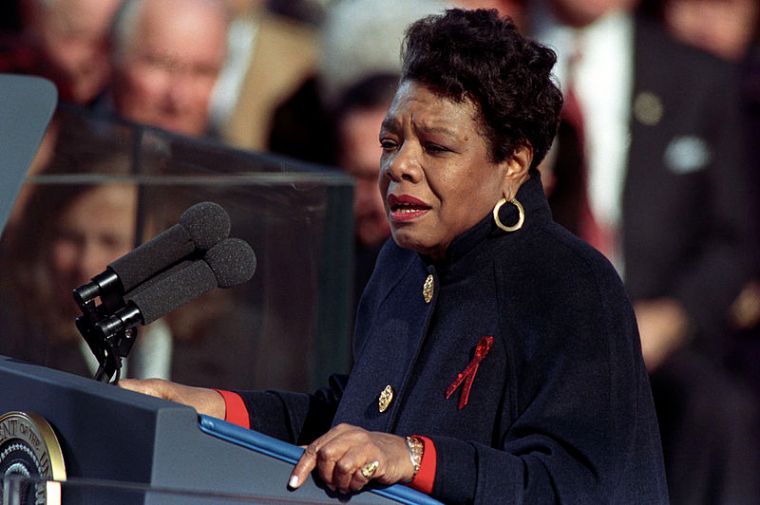
The photograph – Maya Angelou reading On the Pulse of Morning at the Clinton inauguration 1993 – is courtesy of The William J. Clinton Library and is in the public domain.
Thank you for sharing your love of words. Comments will appear after moderation.
Adrienne Rich (1929-2012)Audre Lorde, Meridel Le Sueur, Adrienne Rich
Madeline Ostrander wrote this article for YES! Magazine, “a national, nonprofit media organization that fuses powerful ideas with practical actions.” Madeline was YES! Magazine‘s senior editor at the time of this writing. She is now an independent journalist and contributing editor to Yes! Magazine.
“I know you are reading this poem listening for something, torn between bitterness and hope…”
I was 19 when I first read Adrienne Rich and these words from “An Atlas of the Difficult World,” which seemed to tear down the barriers between the poem and me, and let me in.
Like Rich, I grew up at a distance from true poverty: “reader reading under a summer tree in the landscape of the rural working poor,” she writes. But I knew how fractured and unstable the world around me was becoming. I was part of the first generation to grow up knowing about climate change, brought to world attention by James Hansen and to my school classroom by a forward-thinking science teacher. I was in high school when the Soviet Union collapsed; as a child, I had nightmares about nuclear war. Rich’s poetry gave me hope that stories could change things—could force us to confront and heal what is painful and give us hope, strength, and compassion.
Rich belonged to an activist strain of poetry; she believed words needed to be reclaimed by the people who have been left out of the history books.
When Rich died a profound loss at a time when we urgently need more storytelling that reaches across our fragmented, politically divided culture. “Atlas” is still one of the most searing and honest descriptions I’ve read about how broken and divisive the modern world is. It’s a 26-page poem that sweeps across the landscapes and histories of North America and elevates people and scenes that are ordinary, neglected, and counted out—farmworkers made sick from pesticides, a woman beaten by her partner, the wasting of our ecological landscapes, weedy fields of Jerusalem artichoke “that fed the hobos, could feed us all.”
Here is a map of our country …
This is the haunted river flowing from brow to groin
we dare not taste its water
This is the desert where missiles are planted like corms …
This is the cemetery of the poor …
This is the sea-town of myth and story when the fishing fleets
went bankrupt … processing frozen fish sticks hourly wages and no shares
Occupy didn’t exist then, of course, but Rich was crafting poetry for the 99 percent: “a poetry older / than hatred. Poetry / in the workhouse, laying of the rails.”
Rich’s long, image-dense lines could seem of out-of-step with a world obsessed with rapid-fire information, Twitter, and text messages. But Rich knew that the marginalization of poets is always a detriment to civil society. In the early 1980s, she traveled to Nicaragua, where she felt the culture “manifested a belief in art, not as commodity, not as luxury, not as suspect activity, but … one necessity for the rebuilding of a scarred, impoverished, and still-bleeding country.”
Rich belonged to an activist strain of poetry; she believed words needed to be reclaimed by the people who have been disempowered and left out of the history books. Her own life is a testament to the power of story in creating cultural change. Rich started college in the late 1940s, when she says even Elizabeth Barrett Browning’s writing was radical for a university campus and certainly no one spoke of feminist ideas in the classroom.
Early in her career, Rich had to scrape together a new kind of language. She used poetry to utter ideas that were almost unspeakable at the time: her poetry pulled back the veil around women’s sexuality and lesbian love and exposed the power and politics that enable war and violence: “I felt driven—for my own sanity—to bring together in my poems the political world ‘out there’—the world of children dynamited or napalmed, of the urban ghetto and militaristic violence—and the supposedly private, lyrical world of male/female relationships,” she said. She published Snapshots of a Daughter in Law, which she calls her first book to overtly tackle sexual politics, in 1963. Decades later, her poetry is still radical, but it’s also a mainstay in college literature classrooms across the country. Her poetry has been a beacon to feminists and social justice activists for several generations, and is included a digital poetry anthology pieced together by organizers of Occupy Wall Street.
Rich never wanted her poetry to be a medium primarily for academe. And she never believed words alone could solve the abuses and inequalities that she wrote about. But reclaiming, decolonizing, and taking charge of language was for Rich the first step in become personally whole and politically powerful. “Because when poetry lays its hand on our shoulder, we can be to an almost physical degree touched and moved. The imagination’s roads open again, giving the lie to that slammed and bolted door, that razor-wired fence, that brute dictum,” she said in a 2006 speech at the National Book Awards, where she received a Medal for Distinguished Contribution to American Letters.
We owe Rich a debt for unlocking the doors that barred the voices of women from art, academe, and the halls of influence for so long. And though she insisted on marking each poem with a date—so that it would stand in the historical context in which she wrote it—everything about her poetry still speaks with urgency and timeliness. Her work illuminates the dark, messy, often painful territory of sex, race, violence, and poverty in America but holds all of us responsible for taking power, ending suffering, and breaking apart social inequalities. In “Atlas,” she writes, “A patriot is one who wrestles for the / soul of her country / as she wrestles for the soul of her own being.” This is what Rich did her whole life, and her poetry enjoins the rest of us to do the same.
Jim Harrison, one of America’s most versatile and celebrated writers, died last Saturday. He was the author of over thirty books of poetry, fiction, and nonfiction, the most well-know was probably Legends of the Fall, a trilogy of novellas. His latest poetry collection, Dead Man’s Float, was published earlier this year. His death came on the heals ofAncient Minstrels, also a collection of novellas, which launched in March.
Jim Harrison’s essays on food and our relationship to it are among my favorites and as I searched my bookshelves over the past few days, The Raw and the Cooked, Adventures of a Roving Gourmandis one of the two books of his that seem to have survived my downsizing. That’s an issue of shrinking real estate not regard.
Food – according to Jim Harrison – is more than food. It is a metaphor for life and living. The trick is to enjoy as much as you can without killing yourself because then you couldn’t continue to eat. Some of the meals he describes sound truly epic.
A rough and tumble sort, his preference was for the out-of-doors and he spent his time between Montana and Arizona.
If you are viewing this post from email, it is likely you’ll have to link through to watch the video.
Tomorrow
I’m hoping to be astonished tomorrow
by I don’t know what:
not the usual undiscovered bird in the cold
snowy willows, garishly green and yellow,
and not my usual death, which I’ve done
before with Borodin’s music
used in Kismet, and angels singing
“Stranger in Paradise,” that sort of thing,
and not the thousand naked women
running a marathon in circles around me
while I swivel on a writerly chair
keeping an eye on my favorites.
What could it be, this astonishment,
but falling into a liquid mirror
to finally understand that the purpose
of earth is earth? It’s plain as night.
She’s willing to sleep with us a little while.
“your severed daughter
laughing our name into echo
all the world shall remember ”
Audre Lorde, The Black Unicorn: Poems
I discovered Audre Lorde when I happened upon From the House of Yemanjá (below). Wow! She’s been peaking in our window, I thought. How could she know? I was very young and didn’t start really delving into her work until recently. Time sadly lost.
How many women and men grew up with two-faced mothers who took care (albeit resentfully) of the pragmatic aspects of motherhood, but were unable to love and demanded perfection of their children in return for their own unhappiness. Many, no doubt; but no one writes about the experiences of being marginalized in the home – or in the greater world – like Audre Lorde, a seminal poet. She had a keen mind, courageous spirit, was stunning in her crafting and had a gift for expressing emotion.
“Poetry is the way we help give name to the nameless so it can be thought.”
Audre Lorde was born in New York City, the child of immigrants from Caribbean. She was a writer and poet, a radical feminist, a womanist and lesbian, an activist for right and the rights of the marginalized.
“Institutionalized rejection of difference is an absolute necessity in a profit economy which needs outsiders as surplus people.”
Lorde was New York State poet laureate in 1991 and until her death from liver cancer in 1992.
“The fact that we are here and that I speak these words is an attempt to break that silence and bridge some of those differences between us, for it is not difference which immobilizes us, but silence. And there are so many silences to be broken.”
From the House of Yemanjá
My mother had two faces and a frying pot
where she cooked up her daughters
into girls
before she fixed our dinner.
My mother had two faces
and a broken pot
where she hid out a perfect daughter
who was not me
I am the sun and moon and forever hungry
for her eyes.
I bear two women upon my back
one dark and rich and hidden
in the ivory hungers of the other
mother
pale as a witch
yet steady and familiar
brings me bread and terror
in my sleep
her breasts are huge exciting anchors
in the midnight storm.
All this has been
before
in my mother´s bed
time has no sense
I have no brothers
and my sisters are cruel.
Mother I need
mother I need
mother I need your blackness now
as the august earth needs rain.
I am
the sun and moon and forever hungry
the sharpened edge
where day and night shall meet
and not be
one.
– Audre Lorde (1978)
“What are the words you do not yet have? What do you need to say? What are the tyrannies you swallow day by day and attempt to make your own, until you will sicken and die of them, still in silence.”





 Jamie Dedes' THE POET BY DAY Webzine