SEQUESTRUM is accepting submissions for poetry for its Annual Editor’s Reprint Awards. Entry fee is $15. Deadline is April 30, 2017. Details HERE.
SEQUESTRUM is accepting submissions of Fiction and Nonfiction for its Editor’s Reprint Award. Entry fee is $25. Deadline is April 30, 2017. Details HERE.
Thank you for sharing your love of words. Comments will appear after moderation.
WEDNESDAY WRITING PROMPT, April 12, 2017 (1) Vacations: Well, this one is akin to the first composition assignment on returning to school after summer vacation: Tell us about your most fondly remembered vacations. Perhaps you enjoyed it because it involved family and childhood. Perhaps it was a dream vacation come true. Or, maybe it was an unexpected adventure. Or, perhaps your best vacation is the one you are planning now.
To Italy
you never expected this
we touch Florentine great black hog’s ringed cold snout
a ritual au revoir
taste best bitter coffee on the TGV
see snowed peaks of lower Apennine mountains
out of warm train windows
enter massive
Milan train Station
nine days coach trip
poke me in the side
when coach pace nods me off
stroll spiral down to medieval streets and a tilted horse race square
walk Rome’s cobbles amphitheatre
marvel at Vatican mosaics
we thought paintings
want to stroke cordoned vast
marble muscles
lilt up Venetian canals
wonder why when renovating buildings at home
builders don’t have picture tarpaulins
of the building beneath
you never expected this
for my fortieth
expected Wales or Scotland
then I request you order
a passport,
and live nine days
out of a suitcase
and thank your late father
our invisible companion
who made this possible
when one bottle of wine
seemed as if it was going to last forever;
the one I’m thinking of (purchased
one dinnertime in summer at 7/6d)
occupied a space in my life
a mile high and spanned the gap
all the way to Tibet; as you drank a glass
that dinnertime it seemed to refill itself
from the dregs of love
when one kiss would last
as long as the Rachmaninov cello sonata
whenever you put the record
on the turntable and let the needle fall –
obliterated in the so well-known cadences
which I could have been whistling
had my lips not been squashed against hers
when a bicycle ride would construct a day
down to the sea and back
across the long valley and over the downs –
magic ride often repeated –
I fill it from these dregs of memory
WEDNESDAY WRITING PROMPT, April 12, 2017 (2) Memories of those lost. Have there been people in your life that you don’t loose no matter what? Perhaps people like parents who are so much a part of you, you seem to sense their presence even after they have died. How good is that? Or, maybe you don’t think it is. Tell us about it in poem or prose.
One of My Tomorrows
for Celia
Our last goodbye was casual
as if I would see you again
on one of my tomorrows
I touched your arm
you flinched. In pain.
I felt persistent guilt
Born of carelessness
only nervous uncertainty
could freely demonstrate
Born of habitual presumption
that you were in charge
you weren’t. Not really.
You never were, save
your own sense of duty
to boss, nay care for everyone
Too much on small shoulders
that weren’t as strong as the
force of that inner being
the force that stopped being
that was someone once
whom I loved and miss
Some time after we’d helped you
to meet your God, one starlit night
I heard your voice as clear as the sky
O lamb of God, who takes away
the sins of the world, have mercy
and grant us peace. I swear
Lantern swinging down path —
I wonder if it is really there,
if that is you, or just some accident
of moonlight and wind.
How is it possible for the night
to be so black that no adjective
makes sense? Just black-black,
with shadows hovering and the wild phlox
lopped over reflecting greywhite back up.
No lantern, but there might as well be,
my heart lighting every moment,
bringing you back through memory
to stroll ahead telling me that story
I promised to never forget.
This is the first time Jennifer Cartland is featured on The Poet by Day. . She says of herself simply, “In between meetings, in between errands, seat cushions, and ‘oms’, I try to nab those little guys flying though my noggin’ and shake them up a bit, turn them into something humans can understand. Sometimes it works, sometimes not. Sometimes they are happy I did, sometimes they aren’t.”
Lavender & Whippoorwills
nasturtiums growing
in hollyhock fields
smelling of lavender
& blue whippoorwills
whose song bids me
follow the spirit
of you
entwined as we are
in consummate truth
i see you dancing
beneath the elm tree
with boughs your
dance partner
forever & free
as you slip transparent
from my view
the music plays softly
as it is never adieu
from the lemon bush
filtering meringue
soft dreams
to the orange orchard
citrus scenes
i knew you loved me
before i became a whisper
& held me near
before the dance…
taste of cinnamon cinders
nasturtiums growing
in hollyhock fields
smelling of lavender
& blue whippoorwills
Well, such wonderful responses to Wednesday Writing Prompts. I think it makes rather a lovely collection, which I hope you enjoy. I hope you’ll also visit these poets at their blogs and get to know them better. Look for another Wednesday Writing Prompt tomorrow.
LESSON NINE: Be kind to our languge. “Avoid pronouncing the phrases everyone else does. Think up your own ways of speaking, even if only to convey that thing you think everyone is saying. Make an effort to separate yourself from the Internet. Read books.” Prof. Snyder, On Tyranny, Twenty Lessons from the Twentieth Century
Thank you for sharing your love of words. Comments will appear after moderation.
It’s great to get a poem or story published. It’s about income and getting read and for some it’s validation as well. These are all important (even vital), but I was reminded recently that our poetry and other writing is about so much more.
“The title of David Cooper’s book on Kabbalah invites us to re-think the Creator as Creating: God is a Verb. While I don’t want to equate science to God in a religious sense, I want to borrow this re-conception. Science is creative, creating, if you will, knowledge of the world. Science is a verb.”
Jamie Dedes
A friend of mine came to visit and glowed when she told me she’d read Michael’s introduction. God is a Verb and Science is a verb popped out at her. Something she’d been struggling with suddenly fell into place. Other company arrived and I wasn’t able to get further explanation. I’m pleased but not surprised with her reaction to Michael’s piece. It demonstrates the power of words to bring joy, clarification and healing.
My own recent experience: a few people commenting or emailing me saying my post here – not with a bang but a whimper – helped release needed tears.
On another occasion a woman in Scotland wrote to say she’d read my poem – Wabi Sabi – to her wabi sabi group. They found it inspiring. Wow! While I do need my payments, it’s this sort of thing – this human connection – that is satisfying right down to the marrow of my bones.
Poetry is also important as an entry point into sacred space for both artist and audience. This is motivation for everyone to practice their art, whether professionally or as amateur, which is not a pejorative. I’m sure many of you – if not all of you – know what I mean. There’s a shift that happens. Sometimes it feels more like channeling than writing. The experience is illuminating, healing and peaceful. An unexpected insight often arrives just when you need it.
Our job as poets and writers goes even further: we bear witness, we give voice to the voiceless, and we observe and commemorate.
English Poet Myra Schneider at her 80th Birthday celebration and the launch of her 12th collection
Myra Schneider said in an interview HERE, that “I believe the role of the poet is to reflect on human experience and the world we live in and to articulate it for oneself and others. Many people who suffer a loss or go through a trauma feel a need for poetry to give voice to their grief and to support them through a difficult time. When an atrocity is committed poems are a potent way of expressing shock and anger, also of bearing witness. I think that the poet can write forcefully, using a different approach from a journalist, about subjects such as climate change, violence, abuse and mental illness and that this is meaningful to others. I very much believe too that poetry is a way of celebrating life. I think it deserves a central place in our world.”
So, as we celebrate poetry this month, be sure to give yourself time to read and write … for the sake of your spirit and for the rest of us too.
Please join us at The BeZine on April 15th for our special interNational poetry issue. Michael Dickel is the lead editor.
My apologies. When I logged in this a.m. I saw that I accidentally scheduled two prompts today. I’m leaving them both up since poets have started responding. 😦 At any rate, if you want to participate – and I hope you do – please feel free to do so for both if so inclined. Thank you!
.
like lucid dreaming, like light-infused rain drops and
the untarnished silver stars above country terrain,
my mother calls to me from the shadow of the moon
my father beams his smile at me from the milky way
gone and gone, still their essence scents my nights
Have there been people in your life that you don’t loose no matter what? Perhaps people like parents who are so much a part of you, you seem to sense their presence even after they have died. How good is that? Or, maybe you don’t think it is. Tell us about it in poem or prose. If you feel comfortable, put the link to the piece in the comments section below … or, if it’s short enough, you can just share the piece there. Work shared will be featured on The Poet by Day next Tuesday.
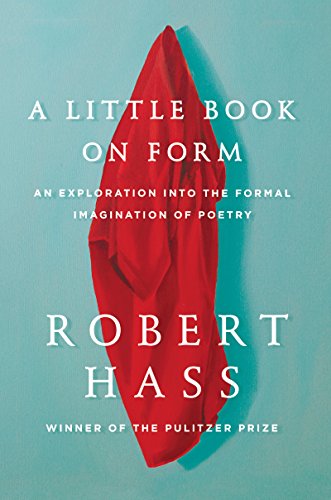
The recommended read for this week is A Little Book on Form: An Exploration into Formal Imagination of Poetryby Robert Hass (b. 1941), an American poet who was our Poet Laureate of the United States from 1995 to 1997. He won the 2007 National Book Awardand shared the 2008 Pulitzer Prize for the collection Time and Materials: Poems 1997-2005. In 2014 he was awarded the Wallace Stevens Award from the Academy of American Poets.
In A Little Book on Form: An Exploration into Formal Imagination of Poetry Hass brings to bear the same senisbility that marks his poetry with force, clarity and eloquence. From Rome in the time of Caesar to the Renaissance and our own times, Hass breaks down poetry, examining its components from a postmodern perspective. The book is ranging and intense. It’s over four-hundred pages – informed, witty, erudite – something we can go back to again and again. Never a boring moment. It’s all about love.
By shopping at Amazon through The Word Play Shopandusing the book links embedded in posts, you help to support the maintenance of this site. Thank you! (Some book links will just lead to info about the book or poet/author and not to Amazon.)
The WordPlay Shop offers books and other tools especially selected for poets and writers.



 Poetry Group, he published a collection, Petrichor Rising (eBook and paperback), the profits from which go to charity. You can read more about John and his projects at: Petrichor Rising and how the Twitterverse birthed friendships that in turn birthed a poetry collection.