Page 194 of 199

The Ring of Truth: Seamus Heaney

Seamus Heaney (1939-2013), Irish poet

“In fact, in lyric poetry, truthfulness becomes recognizable as a ring of truth within the medium itself.” Seamus Heaney

In the pantheon of Irish literary gods, there is a poet of our generation who stood in solidarity with people of conscience the world over. His name is Seamus Haney. We are the richer for his life and work and, as of Friday, the poorer for his death. His are works of truth and morality, soul and soil. He rested gracefully on the divide between poetry and activism and honored both, never strident or sensational. The poetry critic Helen Vendler wrote of him as a “private mind and heart caught in the changing events of a geographical place and a historical epoch…”

.

“Between my finger and my thumb
The squat pen rests.
I’ll dig with it.”  Digging

Seamus Haney, a farmer’s son, a teacher, a prophet, a writer of poetry and plays, a lecturer and translator, a husband and father, won the Nobel Prize for Literature in 1995. He was a decent human being who had – in spades – the Irish gift for lyricism and story-telling.  An accessible poet, he wrote for and about ordinary people. He was into whole-world living but didn’t forget his beginnings: Mossbawn, County Derry, Northern Ireland.  “Home” to him had the traditional meaning of origin, rootedness and belonging, not a structure to be bought or sold or moved at whim. He had a solid knowledge of the classics and played with them ingeniously, often irreverant but never pedantic. People everywhere recite his works. Politicians quote him.

.
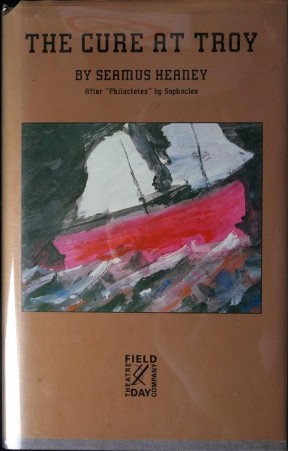
CureAtTroy
“History says, Don’t hope
On this side of the grave,
But then, once in a lifetime
The longed-for tidal wave
Of justice can rise up
And hope and history rhyme”
The Cure of Troy

.

Robert Lowell said Seamus Heaney was “the most important Irish poet since Yeats’” and most would agree with that.

.
books-1

“When a poem rhymes, when a form generates itself . . . when a metre provokes consciousness into new postures, it is already on the side of life. When a rhyme surprises and extends the fixed relations between words, that in itself protests against necessity. When language does more than enough, as it does in all achieved poetry, it opts for the condition of overlife, and rebels at limit . . . The vision of reality which poetry offers should be transformative, more than just a printout of the given circumstances of its time and place . . . “  The Redress of Poetry

.

Niamh Clune, writer and poet, publisher and musician

For Niamh Clune (Founder and CEO of Plumtree Books and Art), the loss of Seamus Heaney is a personal one. She posted this comment on Facebook on Friday and her comment – along with one of Seamus’ poems – close this post more eloquently than any words of mine would.

“Today, I lost someone I loved, someone who had a profound influence on me as a young impressionable girl growing up as an Irish exile in London . . . I knew him for his modesty, reason, temperance and wit. I am deeply saddened by his passing, as I know people whose lives he touched across the world will also be. I am sure he will rest in peace.” Niamh Clune

Blackberry-Picking

Late August, given heavy rain and sun
For a full week, the blackberries would ripen.
At first, just one, a glossy purple clot
Among others, red, green, hard as a knot.
You ate that first one and its flesh was sweet
Like thickened wine: summer’s blood was in it
Leaving stains upon the tongue and lust for
Picking. Then red ones inked up and that hunger
Sent us out with milk cans, pea tins, jam-pots
Where briars scratched and wet grass bleached our boots.
Round hayfields, cornfields and potato-drills
We trekked and picked until the cans were full
Until the tinkling bottom had been covered
With green ones, and on top big dark blobs burned
Like a plate of eyes. Our hands were peppered
With thorn pricks, our palms sticky as Bluebeard’s.
We hoarded the fresh berries in the byre.
But when the bath was filled we found a fur,
A rat-grey fungus, glutting on our cache.
The juice was stinking too. Once off the bush
The fruit fermented, the sweet flesh would turn sour.
I always felt like crying. It wasn’t fair
That all the lovely canfuls smelt of rot.
Each year I hoped they’d keep, knew they would not.

– Seamus Heaney

.

” I alway had this notion that you earned your living and that poetry was a grace.” 

© 2013, essay, Jamie Dedes, All rights reserved; Blackberry-Picking, estate of Sheamus Heaney, All rights reserved
Photo credits ~ Seamus Heaney by Sean O’Connor and released into the public domain; Niamh Clune portrait, copyright by Niamh and used here with permission; book cover art copyright of publisher or estate of Seamus Heaney
Video uploaded to YouTube by Arkadi200

… and thus we begin another week …

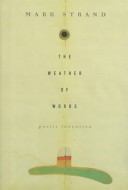
The Weather of Words

Mark Strand
Mark Strand

books“I is for immortality, which for some poets is a necessary compensation. Presumably miserable in this life, they will be remembered when the rest of us are long forgotten. None of them asks about the quality of that remembrance–what it will be like to crouch in the dim hallways of somebody’s mind until the moment of recollection occurs, or to be lifted off suddenly and forever into the pastures of obscurity.

“Most poets know better than to concern themselves with such things. They know the chances are better than good that their poems will die when they do and never be heard of again, that they’ll be replaced by poems sporting a new look in a language more current. They also know that even if individual poems die, though in some cases slowly, poetry will continue: that its subjects, it constant themes, are less liable to change than fashions in language, and that this is where an alternate, less lustrous immortality might be.

“We all know that a poem can influence other poems, remain alive in them, just as previous poems are alive in it. Could we not say, therefore, that individual poems succeed most by encouraging revisions of themselves and inducing their own erasure? Yes, but is this immortality, or simply a purposeful way of being dead?” The Weather of Words: Poetic Inventions by Mark Strand (b. 1934, Canada), American poet and essayist, Poet Laureate Consult in Poetry to the Library of Congress (1990-1991), Pulitzer Prize (1999) for Blizzard of One,  Gold Medal in Poetry (2009), American Academy of Arts and Letters.

A little something provocative this Sunday.

. . . and thus we begin another week . . .

Photo credit ~ SlowKing via Wikipedia and under the CC BY-NC

One Lifetime After Another

Angel and Dove, original watercolor c 2010 Gretchen Del Rio

one day, you’ll see, i’ll come back to hobnob
with ravens, to fly with the crows at the moment
of apple blossoms and the scent of magnolia ~
look for me winging among the white geese
in their practical formation, migrating to be here,
to keep house for you by the river …

i’ll be home in time for the bees in their slow heavy
search for nectar, when the grass unfurls, nib tipped ~
you’ll sense me as soft and fresh as a rose,
as gentle as a breeze of butterfly wings . . .

i’ll return to honor daisies in the depths of innocence,
i’ll be the raindrops rising dew-like on your brow ~
you’ll see me sliding happy down a comely jacaranda,
as feral as the wind circling the crape myrtle, you’ll
find me waiting, a small gray dove in the dovecot,
loving you, one lifetime after another.

© 2013, poem , Jamie Dedes, All rights reserved, Licensing for online publications is nonnegotiable and requires permission, attribution, link to this site, my copyright, no modification, noncommercial only and does not imply permission to include the work in the site’s printed collections or anthologies.
Illustration by Gretchen Del Rio © 2010, All rights reserved, used here with Gretchen’s permission

Reading Rilke’s Swan

I think it was Borges who used to remind us that poetry began as an oral tradition and that in these days of print it is still meant to be read out loud. This hit home for me recently when a friend read one of my own poems at a funeral service and when British poet, John Anstie, recorded his reading of another of my poems. Even though I had written these poems and labored over their births, they gained a new dimension for me in the hands of these good poets who also happen to be good at oral delivery. On that note, I take special joy in the poetry of David Whyte and I particularly appreciate his skilled readings of his own work and that of other poets. In the video below David reads and interprets Rilke’s The Swan and Walcott’s Love After Love. I listen to his readings of these two renown poems several times a week and never tire of hearing them. Jamie 

LoResPublicityPoet David Whyte grew up with a strong, imaginative influence from his Irish mother among the hills and valleys of his father’s Yorkshire. He now makes his home, with his family, in the Pacific Northwest of the United States.

The author of six books of poetry and three books of prose, David Whyte holds a degree in Marine Zoology and has traveled extensively, including living and working as a naturalist guide in the Galapagos Islands and leading anthropological and natural history expeditions in the Andes, the Amazon and the Himalaya. He brings this wealth of experience to his poetry, lectures and workshops.

His life as a poet has created a readership and listenership in three normally mutually exclusive areas: the literate world of readings that most poets inhabit, the psychological and theological worlds of philosophical enquiry and the world of vocation, work and organizational leadership.

An Associate Fellow at Templeton College and Said Business School at the University of Oxford, he is one of the few poets to take his perspectives on creativity into the field of organizational development, where he works with many European, American and international companies. In spring of 2008 he was awarded an honorary doctorate from Neumann College, Pennsylvania.

In organizational settings, using poetry and thoughtful commentary, he illustrates how we can foster qualities of courage and engagement; qualities needed if we are to respond to today’s call for increased creativity and adaptability in the workplace. He brings a unique and important contribution to our understanding of the nature of individual and organizational change particularly through his unique perspectives on Conversational Leadership.

portrait and bio courtesy of David Whyte


Video uploaded to YouTube by tjmjkm.