It’s nothing new for poets to write poems against war, to write poems to raise the general consciousness of injustice, to express their pain and to speak truth to power. What is relatively new is the use of technology and social media to make it easy for poets to come together in protest as we see now with 100,000 Poets for Change (100TPC). In 2011, Michael Rothenberg, cofounder of 100TPC, put out a call for poets on Facebook and just five years later we have a huge global movement and a thriving community of poets and other creatives to stand up for peace, social justice and sustainability.
On the eve of the Iraqi War, poet Sam Hamill received an invitation from Laura Bush to attend a White House literary salon to celebrate the works of Emily Dickinson, Langston Hughes and Walt Whitman. Hamill had just read about President Bush’s plan for the invasion and saturation bombing of Iraq that would kill innumerable civilians, a plan that did not rule out the possibility of using nuclear weapons. Hamill felt he couldn’t sit restrained among politicians and poetic aristocracy. He had to speak out. He contacted colleagues, asking them to join with him in using this event to make a stand for peace.
Poetry readings were scheduled outside the White House and across the country on February 12, the day the event was scheduled. A website was started to collect and display antiwar poetry. Such prominent poets as Rita Dove, Peter Levitt, Lawrence Ferlinghetti, W.S. Merwin and Adrienne Rich contributed work. Their poems and many others were collected in a print volume. Contributions for the webstie continued to flow in for several years. The poems were screened by a team before publication. I contributed two, which were my first anti-war poems. Ultimately I think some 5,000 poems were collected. The poems are now archived in a university library.
We all know that Poets Against the War didn’t stop the invasion. Poet, peace activist and Jesuit priest, Daniel Berrigan wrote, “One is called to live nonviolently, even if the change one works for seems impossible.” So too are we called to speak truth to power, ignorance and cruelty no matter how hopeless things seem and no matter that we may never see the fruits of our labors in our lifetime. Peace has to start somewhere and it might just as well start with us.
If you are viewing this post from email, you’ll have to click through to the site to see the video.
we, the nobodies, the little people
whipped by the whims of the power mongers,
nailing us to a cross of narcissism and greed,
tossing us on the trash heap of history
we, the wounded and noble nameless,
with all our bone, blood, heart and soul
do declare unequivocally— we find no redemption in chaos, no joy in parting seas of blood, no grace in killing one another
we now turn, not our cheeks, but our backs,
leaving the bullies to their naked delusion,
their rudimentary souls; relinquishing
the swords they hand us, we put our muscle
to the plow and reclaim our birthright
to all that is sane and good
Poetry is as necessary to life as water. With it we take our stand, raise the collective conscience, show a proper respect for intuition and instinct. Poetry uncobbles our hopes and dreams and anchors our power.
In the April issue of The Woven Tale PressAssociate Editor and Poet Michael Dickel• offers some background on 100,000 Poets for Change (100TPC) and activist poets and poetry. I have the honor to be among several of those poets featured including: 100TPC co-founder, Michael Rothenberg and St. Louis, Missouri Poet Laureate, Michael Castro. The edition includes not only outstanding poets and writers but some truly stellar artists. The Woven Tale Press is “the eclectic culling of the creative web.” View HERE
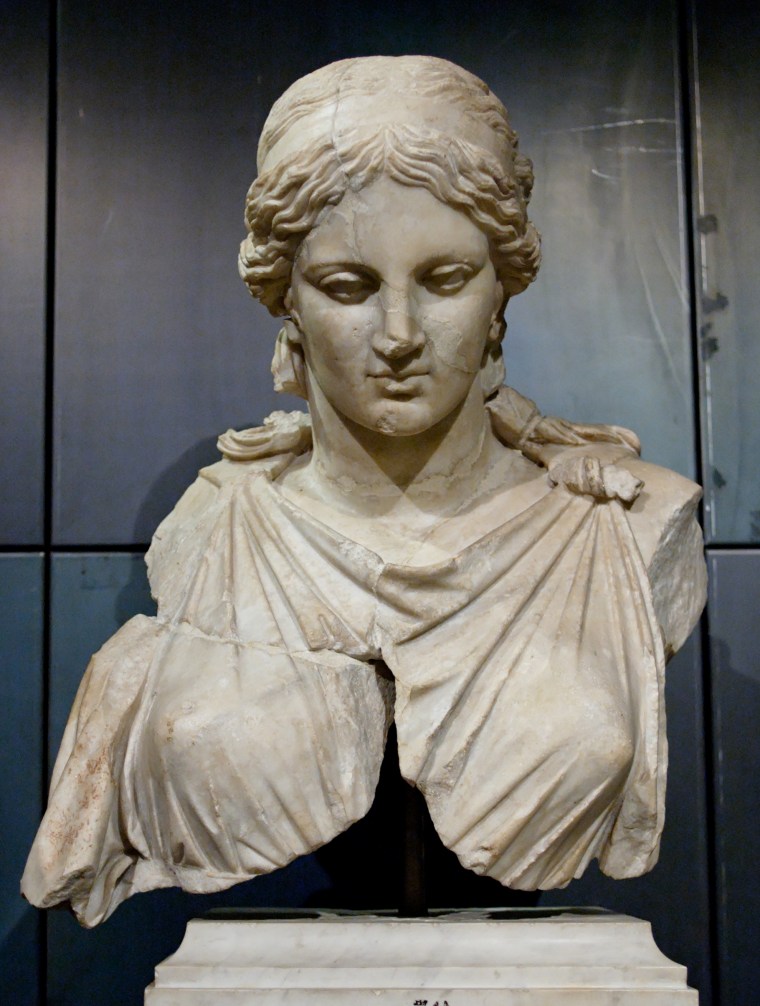
Roman marble Bust of Artemis after Kephisodotos (Musei Capitolini), Rome.
“Women, of course, write good and bad poetry – ‘ambitious’ implies more enterprising subject-matters and approaches, as well as a unique voice for each poet.” Kate Foley and Dilys Wood, Editorial Page, ARTEMISpoetry, November 2015
Here it is April – Poetry Month! – and the month in which I know that Dilys Wood, Anne Stewart and other poets in London at Second Light Network of Women Poets(SLN) are hard at work putting a wrap on the May 2016 issue of ARTEMISpoetry. This biannual literary magazine specializes in the work of women bent on honest self-expression, subjects of substance, and well-crafted poetry.
The issue included poems by Anne Stewart, the featured poet and the author of Janus Hour and Only Here till Friday.
Myra Schneider was the judge for the 2015 poetry contest. The winning poems are featured as well as the commended and we get a bit of the behind-the-scenes look at the hard work of judging.
“I went through over a thousand poems looking for poems that traveled, paid attention to form and made words work. Eventually I reduced a long list of 101 poems to 26 … I was very excited because the winning poems were telling me loud and clear which they were!”
No doubt it is an honor to be selected to judge – and clearly there are rewards – but what a job as well. Certainly a labor of love. The winners for 2015 were: Carolyn King, Margaret Wilmot, Judith Taylor and Kathy Miles.
I was also pleased to read Myra’s feature on one of my own favorites, American poet Louise Glück.
In line with the issue’s theme, politics and eco-politics were explored by Kay Syrad, a regular contributor. She discussed Priscila Uppal’s Sabotage (explores private and public acts of destruction, disruption, and vandalism in the 21st century) and Helen Moore’s Ecozoa(response to the destruction caused by industrial civilization).
Fiona Owen gifted us a thoughtful piece – both homage and exploration – on Anne Cluysenaar‘s eco-poetry.
“… Anne ponders ‘the tenuous job of the poet’ and sees the arts as having an intrinsic evolutionary role …”
In addition to poetry,ARTEMISpoetry always offers book reviews and announcements of publications, events and classes of interest … and lately continues some discussion and promotions of SLN’s last two anthologies Her Wings of Glass and Fanfare.
🙂 I recommend both. 🙂
Below is a sampling (three poems) from Fanfare with thanks to the poets and their publishers, to SLN and especially to Anne Stewart for doing the work of acquiring the permissions for me to share these poems with you here today.
January
Going into the sun
over mud flats skimmed with water
people are walking on ice or glass
their reflections perfect
and you know it’s a new year
walking into the sun
beach and sky cast in light
sheer
gone when you turn
and wave rippled mud
takes your footsteps, softly.
– Caroline Natzler
Caroline Natzler:January and Life’s Work, from Fold (Hearing Eye, 2014)
Untouchable
She shines like Lakshmi through the fields –
a gentle stride, arms at her sides.
By the houses, stooping her beauty
to the earth, she raises the brimming bucket,
its stench sealing her nostrils. Slurry clings
to hair and skin, but nothing changes
on her face, only a puckering of lips
in silent thanks to Kali
for twenty years of women’s work,
this dawn till dusk that’s nurtured seven sons;
thanks that she’s never known the blessing of –
nor visited this curse upon –
a daughter.
– Jill Sharp
Jill Sharp:Untouchable, from Ye gods (Indigo Dreams, 2015)
A Miracle at Iskitim
In Siberia, a symbol –
this is what the locals believe,
a magical birth of water:
a fresh water spring, a spurt
close to the ground, a low white
eternal flame.
We dip our cups
(plastic, from the hotel) and say,
“It tastes pure. The water is pure.”
Some people here heard the last trucks
grind out of sight, after they shut
the ‘lagpunkt’,
the slow-killing place,
left the scar for people like us
in a half circle, dark barrels
in our padded coats, gloves, hats, scarves …
With our white breaths, we breathe out lives
as we raise up transparent cups,
“The future came too late.”
– Dilys Wood
In her Gulag, A History (Penguin, 2004)Anne Applebawm refers to a new fresh-water spring near a former camp at Iskatim.
This slideshow requires JavaScript.
SLN, through community, classes, magazines and books, regularly serves up thought-provoking, often heart stirring and always engaging poetry by women as well as informative explorations and analyses of poems, collections, news and views. Whether you are an experienced professional or an amateur poet, there’s plenty to enjoy here, plenty to learn and think about. I venture to say though that if you are an older woman poet working to find your voice, you’ll discover special inspiration and encouragement through Second Light.
Guerrilla poets strike out for common sense, inclusion, social justice and all our best human ideals:Zero Forbidden Goals (ZFG) is a collective of artists from the Greater Sacramento area. It engages ideals and education through poetry, music and art delivered in a community setting, which is essentially what the “guerrilla” in “guerrilla art” refers to. I just found out about them today. All things considered: rather fabulous.
“In the past year ZFG has worked to bring an innovative brand of guerrilla art to Northern California with events such as Guerrilla Art Flash Mobs, National (Guerrilla) Poetry Month, Gorilla Storytime, Chainlink Poetry, and FLOW Sacramento.”
David Loret De Mola invites guerilla poets to participate in “Guerrilla” Poetry Month by sending in your videos.
“Whether you rap or you slam ZFG invites you and yours to take part in Guerrilla Poetry Month 2016! Just film your piece and send links to ZFGpromotions@gmail.com or hit us @ZFGpromotions.
Find out more at http://www.ZFGpromotions.com
We look forward to hearing from you!”
“Zero Forbidden Goals is a group of young creatives based in Northern California working to cultivate the next generation of art on the West Coast. Since it’s conception in 2014, the collaborative comprised of poets, emcees, musicians, writers, photographers, videographers, engineers, visual artists, and designers have been working to support the creative landscape and general accessibility of the arts on the West Coast by working alongside schools, local businesses, and non-profit organizations to provide and support arts programming.
“In addition to sanctioned art collaborations, Zero Forbidden Goals is known for unpredictable public pop-up art events, installations, and exhibitions. From interactive visual arts to flash mob dance parties, ZFG was founded on the belief that you can turn any slab of concrete into a stage and any empty lot into an art gallery.” from the website

 On the eve of the Iraqi War, poet Sam Hamill received an invitation from Laura Bush to attend a White House literary salon to celebrate the works of Emily Dickinson, Langston Hughes and Walt Whitman. Hamill had just read about President Bush’s plan for the invasion and saturation bombing of Iraq that would kill innumerable civilians, a plan that did not rule out the possibility of using nuclear weapons. Hamill felt he couldn’t sit restrained among politicians and poetic aristocracy. He had to speak out. He contacted colleagues, asking them to join with him in using this event to make a stand for peace.
 we, the nobodies, the little people
 In the April issue of The Woven Tale Press Associate Editor and Poet Michael Dickel• offers some background on

 Guerrilla poets strike out for common sense, inclusion, social justice and all our best human ideals:
 Jamie Dedes' THE POET BY DAY Webzine