Iceland: sounds like my kind of country!


 I am ever eager to know what other writer’s think, to “listen in” on debates and to find good recommendations. Happened upon this while rummaging through Staffer’s Book Review …
“How can so many (white, male) writers narratively justify restricting the agency of their female characters on the grounds of sexism = authenticity while simultaneously writing male characters with conveniently modern values?
“The habit of authors writing Sexism Without Sexists in genre novels is seemingly pathological. Women are stuffed in the fridge under cover of “authenticity” by secondary characters and villains because too many authors flinch from the “authenticity” of sexist male protagonists. Which means the yardstick for “authenticity” in such novels almost always ends up being “how much do the women suffer”, instead of – as might also be the case – “how sexist are the heroes”.
“And this bugs me; because if authors can stretch their imaginations far enough to envisage the presence of modern-minded men in the fake Middle Ages, then why can’t they stretch them that little bit further to put in modern-minded women, or modern-minded social values? It strikes me as being extremely convenient that the one universally permitted exception to this species of “authenticity” is one that makes the male heroes look noble while still mandating that the women be downtrodden and in need of rescuing. ” A response by Justin Landon in his now defunct Staffer’s Book Review (18 April 2012) to Michael J. Sullivan on Character Agency.
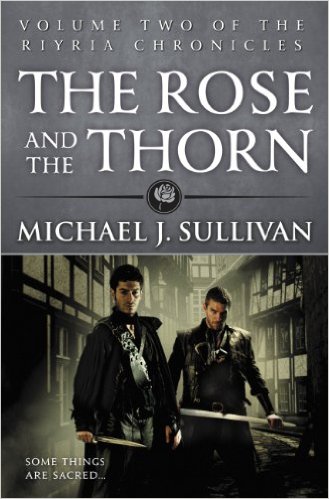 Michael J. Sullivan is a fantasy and science fiction writer. He is known for his popular series, The Riyria Revelations. His Amazon page is HERE, including bio and books.
Justin Landon writes for Tor.com, the science fiction and fantasy imprint of Macmillan Publishers.
Landon’s weblog is a good site and I’m sorry to see that Landon is no longer posting; but sometimes we all have to move on. The good news is that he left the site up for us to explore. He said in his closing post:
“This is the last week for Staffer’s Book Review. You are probably weeping uncontrollably. I’m not. It’s not because I don’t love my site. I do. But, we’ve come to the point where it has reached its logical conclusion. I have said much of what I wanted to say, and I have found new outlets for the rest. In addition, I have become increasingly burdened with other responsibilities. My career continues to grow. My work at Tor.com is ever-expanding (until they get sick of me!). My children need more of me than before. And the truth is I need more time to do those things right. There are also things out there I want to explore and do, and keeping up a blog just isn’t conducive to that.”
Illustration by Nihonjoe under CC BY-SA 3.0 license


Sometimes joy is as simple as finding a film that doesn’t involve violence and murder. In the midst of a world that is suffering pain and loss in every nook and cranny, I found a wonderful documentary film, BOOK CLUB: The Adventure of a Lifetime. It’s about a group of women living in the Washington, D.C. area in 1947. They formed a book club that was still active as of 2009, the year the film was released, making the club sixty-two years old. That’s longer than most marriages last, longer than some people live.
Watching this charming film is like opening a time-capsule. There are early references to WWI and the Great Depression. There is the club’s history through the pre-war years, WWII, the post-war ’50s, Kennedy’s assassination and the ’60s, and on it goes into the last decade.
Book Club travels from the weighty tomes the women read initially to “improve our minds” when their lives were focused largely on homemaking and child-rearing and comes to rest on lighter fare, literary and popular fiction and sometimes nonfiction.
The movie benefits from the strong underpinning of insight born of long life and astute observation.
“No story is the same to us after a lapse of time; or rather we who read it are no longer the same interpreters.” George Elliot
“I’ll go to the library and say, ‘Yeah! That was a good book,’ and I’ll pick it up and read it again, like Wallace Stegner’s ‘Angle of Repose.’ Things like that when you read a second time with a few more years inside you, you have an altogether different appreciation or understanding of what the author is saying.”
We walk with the club members through their lives as single women, to marriage and children, to grandchildren and loss and into the wisdom years. We move through good times and heartening memories and into and out of the kinds of heart-break that are universal.
“Life shrinks or expands in proportion to one’s courage.” Anaïs Nin
The life-long friendships forged by the book club create a through-line for the film. In life they provided a stability and depth of support that continued to strengthen the women. The only ones no longer attending meetings were those who have passed away.
“Nobody wants to let [the book club] die.”
“I don’t want to stop it because some of the members aren’t too well. We’d still like to meet when we can. We may not be able to follow a schedule but I hope we’ll be able to meet when we can.”
If you’re in the U.S. you can watch Book Club on Hulu. You don’t have to subscribe. I don’t. I was surprised to find something so worthy among Hulu’s often salacious and sensational documentary offerings. You can buy the DVD from Amazon or rent it for streaming. There’s a trailer on Amazon. I don’t do Cable but it might very well be available on-demand there.
“When we came together in that room for a book club meeting, it was ‘well, here we are again.'”
The world needs more book clubs. They are better than wars and conflict. Be the peace and the joy.
Love, Jamie
© 2015, review, Jamie Dedes, All rights reserved

“Ever since we had arrived in the United States, my classmates kept asking me about magic carpets.– They don’t exist-I always said. I was wrong. Magic carpets do exist. But they are called library cards.” Firoozeh Dumas, Laughing Without an Accent: Adventures of an Iranian American, at Home and Abroad
 “When I got [my] library card, that was when my life began.” Rita Mae Brown, Rita Will: Memories of a Literary Rabble-rouser
“The Parkchester Library was my haven. To thumb through the card catalog was to touch an infinite bounty, more books than I could ever possibly exhaust.” Sonia Sotomayor, My Beloved World
We went to the library on Friday and were charmed by this cheerful little exhibit. Apparently we weren’t the only adults who liked it. There were no kids around, just a few grown-ups with bright eyes and big smiles, ostensibly collecting Snoopy coloring pages for their kids.
I wondered if the others were remembering the magic of their first card and their early trips to the library. Perhaps they also smiled to think about taking their own children to the library. My son used to love visiting “the girls” … that is, the librarians hosting pre-school story-hour.
Thank goodness for free libraries, one of the foundations of democracy, of learning and refuge and wonder. And here we are again: September! now officially library card sign-up month for another generation of children. Some traditions are worth keeping. Some pleasures don’t fade with time.
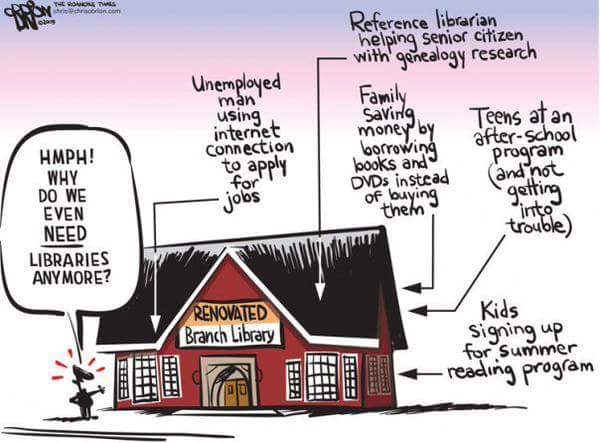
The photographs are mine and the cartoon is the work of Chris OBrion, writer, illustrator, visual journalist and editorial cartoonist.

 Jamie Dedes' THE POET BY DAY Webzine