Oleg Gennadyevich Sentsov: Ukrainian filmmaker and writer, native of Crimea, best known for his 2011 film Gamer. Following the Russian annexation of Crimea he was arrested in Crimea and convicted to 20 years in jail by Russian court on charges of plotting terrorism acts. The conviction was widely described as fabricated or exaggerated. On 14 May 2018, he went on an open-ended hunger strike protesting the incarceration of 65 Ukrainian political prisoners in Russia and demanding their release. (Photo courtesy of Antonymon under CC BY-SA 4.0)
I am currently in the process of working up Sunday Announcements, which will post by end-of-day. Meanwhile, I share this encouraging news.
In response to the release by two United States Senators—Roger Wicker (R-MI) and Benjamin Cardin (D-MD)—of their letter to the U.S. president calling on him to urge Vladimir Putin to release unjustly imprisoned Ukrainian filmmaker and activist Oleg Sentsov, PEN America Washington Director Thomas O. Melia issued the following statement:
“We are heartened by this bipartisan expression of support for the Ukrainian filmmaker Oleg Sentsov, 2017 recipient of the PEN/Barbey Freedom to Write award. As Sentsov’s hunger strike goes into its 37th day, his health continues to deteriorate in his remote prison north of the Arctic Circle, where he is facing a twenty-year sentence on fabricated charges due to his peaceful opposition to the Russian annexation of his native region of Crimea. We urge President Trump to do as the senators request and call on President Putin to release Sentsov from jail immediately.”
PEN America stands at the intersection of literature and human rights to protect open expression in the United States and worldwide. PEN champions the freedom to write, recognizing the power of the word to transform the world. Its mission is to unite writers and their allies to celebrate creative expression and defend the liberties that make it possible.
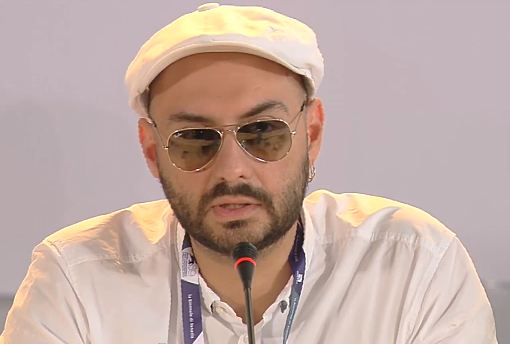
Russian Stage and Film Director, Theater Designer, and Artistic Director of the Gogol Center, Kirill Serebrennikov (b. 1969)
The detention yesterday of Russian Stage and Film Director, Kirill SemyonovichSerebrennikov, on dubious charges is part of a concerted campaign to silence dissenting voices in the arts in Russia.
Serebrennikov’s father was Jewish and a surgeon. His mother was from the Ukraine and taught Russian. Serebrennikov was graduated from Rostov State University in 1992. He was a physics major and had no formal theatre education prior to his 1994 debut as a stage director.
According to PEN America, Serebrennikov was detained on and will face trial on embezzlement. He is accused of embezzling 68 million rubles ($1.1 million) of state funding for a project called Platform, the purpose of which was to promote modern dance, theatre, and music to wider audiences. Investigators claimed that part of the project, a production of A Midsummer Night’s Dream, did not take place, despite having been staged at least fifteen times. Serebrennikov has turned to attendees on Facebook to prove that the play was staged, using the hashtag #ябылнаплатформе (I was at Platform.) If found guilty, he faces up to ten years’ imprisonment. In addition to PEN America, Civil society groups and prominent members of Russia’s and Europe’s artistic communities have called for Serebrennikov’s release.
The Gogol Center in Moscow is Russia’s leading avant-garde theater, a multi-use arts complex. It hosts movies, music concerts, a discussion club and performances by Russian and foreign directors on several stages. It is noted for its stagings of contemporary Russian Dramas and a lobby featuring neon-lit mirrors shaped like famous directors.
The Center’s has recently hosted dance companies including SoundDrama and Studio Seven as part of an experimental artist in residence program specifically committed to art that “does not limit itself with any genre boundaries and constantly strives to reflect Modern Art in the most relevant way.”
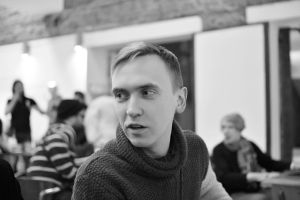
Russian Playwright, Damaturge and Journalist, Valeriy Pecheykin (b. 29184)
The Center’s writer and dramaturge, Valeriy Pecheykin, is a regular contributor to Russian LGBT magazine Kvir, author of the plays My Moscow (2008), Net (2009), Lucifer (2008), Russia,Forward! (2011), A Little Hero (2014), screenplay co-author for Pavel Lungin’s The Conductor (Russia, 2012).
Kirill Serebrennikov, the artistic director of The Gogol Center is professor (of acting and direction) at the Moscow Art Theatre School. His productions were presented in Wiener Festwochen, and Avignon Theatre Festival. His films were screened at Cannes Film Festival, Locarno Film Festival, Rome Film Festival, and the Warsaw International Film Festival where his film Yuri’s Day received the Grand Prix.
Russian Ballet Dancer Rudolf Nureyev (1938-1993)
Serebrennikov, artistic director of the Gogol Center, is a prominent critic of the Kremlin, having spoken out against anti-LGBT measures and the influence of the Russian Orthodox Church in cultural affairs. PEN America has followed his case since May 2017, when his apartment and the Gogol Center were searched, and a bookkeeper and two other theater directors were arrested. In July 2017 the production of a ballet directed by Serebrennikov for the Bolshoi Theater about celebrated dancer Rudolf Nureyev, who was gay, was canceled after intervention by Russian Culture Minister Vladimir Medinsky.
“The detention on dubious charges of a prominent theater director who has spoken out against the government is another move to stifle free expression and the arts in Russia, ” said Polina Kovaleva, PEN America free expression programs manager for Eurasia. “We urge the Russian government to drop all charges and release Serebrennikov immediately, and to end its campaign against artistic freedom.”
This is not the first time that PEN America sounded the alarm on the shrinking space for free expression, particularly artistic expression in Russia where the government has taken “increasingly brazen steps to control information and stifle creative expression.”
FREEDOM OF ARTISTIC EXPRESSION AND CREATION is defined by the United Nations Human Rights, Office of the High Commissioner as “the right of all persons to freely experience and contribute to artistic expressions and creations, through individual or joint practice, to have access to and enjoy the arts, and to disseminate their expressions and creations.”
It is important that we as poets and writers be aware of and supportive of the artists and arts in our own countries and elsewhere to – as PEN America says and does – “champion freedom to write” and to openly acknowledge the “power of the word to transform the world … [and] to celebrate creative expression and defend the liberties that make it possible.”
PEN America “stands at the intersection of literature and human rights to protect open expression in the United States and worldwide.”
The sources/content for this feature are largely courtesy of PEN America, the United Nations Human Rights, Office of the High Commissioner, and Wikipedia.




 Jamie Dedes' THE POET BY DAY Webzine