The last Poet by Day, Wednesday Writing Prompt, to write about farms and farming (Conjuring Farmhouses), December 12, is covered quite broadly here with responses from Gary W. Bowers, Paul Brookes, Irma Do, Jen E. Goldie, Shiela Jacob, Frank McMahan, Mike Stone, and Anjum Wasim Dar. These will provoke some thought and much pleasure, spiked as they are with memoir, questions, humor, and insight. Enjoy!
Wednesday Writing Prompt will return on January 16, 2019.
three cow salute
walking to my high school meant walking past three cows
just as 61st avenue came to its
senses and straightened up
south of bethany home road
and what was then
a bobwire fence held back these bored cows
who stood and chewed or didn’t
and slowly turned
their
heads
in
unison
as
you
passed
they were the stolid
they were the stupefied
the stunned
the milkbaggy trio
the watchers of boys and girls
they needed a date with a frisky bull
or maybe they needed nothing
but daily relief from udder strain
grass
and me tweaking their monotony
into near monotony
couldn’t tell you
don’t know why those bored
and boring cows still lease space
in a pasture in my head
just know
the smell of horseshit does nothing for me
but
the smell of cowshit
has more than once filled
my stupid stolid eyes
with nostalgic tears
droplets of blood from the tail
of last October’s sacrificed horse,
ashes of the stillborn calves,
the shells of beans.
We are sprinkled with water,
wash our hands
in spring-water,
drink milk mixed with must.
Towards evening after shepherds
fed their flocks,
laurel-branches
are used as brooms
to clean their stables,
water sprinkled through them,
then stables adorned
with laurel-boughs.
Shepherds burn sulphur,
rosemary, fir-wood, and incense,
usher the smoke through the stables
and the flocks to purify them.
cakes, millet, milk,
and other food
is offered.
Hay and straw bonfires lit
cymbals and flutes play
as sheep and shepherds
are run three times
through the fire.
At an open air feast
we sit or lay
on turf benches
and sup a lot.
who plough
who prepare the earth
who plough with a wide furrow to bring water from the river
who plant seeds
who trace the first ploughing, reploughing as first did not work
who harrow
who dg
who weed
who reap
who carry the grain
who store the grain
who share the grain
who share their good fortune with us, the dead
FYI: Paul Brookes, a stalwart participant in The Poet by Day Wednesday Writing Prompt, is running an ongoing series on poets, Wombwell Rainbow Interviews. Connect with Paul if you’d like to be considered for an interview. Visit him, enjoy the interviews, get introduced to some poets who may be new to you, and learn a few things.
The blue sky smelled of manure. Even the allure of coffee and raw milk, homemade bread with rhubarb jam and omelets plucked from their mother just that morning couldn’t overcome the scent that distinctly said, “You’re on a working farm.”
The distinct sound of a tractor pulled up to the farmhouse door. The farmer offered us a hay ride around the farm and explained the difference between hay and straw, silo versus barn. The farmer named each machine and it’s purpose, but not the animals.
That night, I briefly wondered if the chicken that gave her life for our pot pie dinner also sacrificed her progeny for our breakfast. And if the rooster that would wake us in the morning, knew what happened to his family.
Plastic and foam trays
Deception and protection
Farmers eat the truth
Yes, that’s me on a tractor – picture courtesy of one of my sorority sisters who posted some “throwback pictures” of a reunion we had a bed and breakfast in the Pennsylvania countryside a few years after we graduated college. I don’t think the tractor was actually moving for the picture, but it was a first for this city girl!
Coincidentally, Jamie Dedes’ Wednesday Writing prompt requested: This week share poem/s out of your own nostalgia, experience, impressions, gratitude, concerns, or convictions about farms, farming, or farm policy. Despite now living in “farm country”, I still don’t know about farming although I do appreciate the numerous farmers markets in our area.
One thing I do know: I am very appreciative of the men and women who work on farms because I know I don’t have the constitution or inclination to grow things or kill things to eat. Maybe because living in cities, I was never exposed to that reality and thus my aversion to being close to the true source of what I/we eat. Food came in a package and didn’t have faces. Maybe if more people were aware of the reality of farming, there would be less food waste and a better understanding of the need to conserve and protect the environment/nature and animals as finite resources. But what do I know…I’m just a city girl…
When Dad barked
You hopped to it,
Let’s go! In the car!
He loved the country.
One day, he said,
I’m moving to some
Small town,
Somewhere,
Someday.
Got my love of trees,
Wide expanses
And the smell of grass
From him
I guess.
Let’s go pick strawberries.
Get some fresh picked apples,
Some corn, if it’s ready,
Right from the field.
He always took the
Side roads
On our way to
Where he wanted
To be.
I marvel,
Now,
Where he was
Coming from,
Some secret desire,
Some past life,
Taking him home….
A tithed farm had flourished
since Queen Victoria’s reign.
Then the council needed acres
of land, built a housing estate
in the 1930’s for families like
us who couldn’t afford to buy.
Small, airy houses with an inside
toilet and coal shed, no running
hot water but spacious gardens
front and back.We made our home
here in the ’50’s and I walked past
apple trees to my first school.
Elderly neighbours recalled
the redbrick farmhouse, told
how they were sent there
as children and exchanged
a few pence for pats of golden
butter and hay-warmed eggs.
They felt the land’s closeness
despite shops and post office
and bus routes to the city centre.
Road names were echoes.
Farmcote Swancote
Old Farm Glebe Farm
And during the War,they dug
over their long back gardens.
Potatoes and turnips grew again.
Carrots were shaken free of soil,
peeled, grated and added to cake
mix instead of rationed sugar.
Hefting water out of the river to
feed the newly-planted.Long years since I
had to do the same on Uncle’s farm:enamel
white bucket hung from a windlass,sweet
water drawn from deep. I could lift but half
a pailful then. Brothers, neighbour’s girls,
rudimentary washes after endless
play; earth closet in the yard, potatoes,
their skins slowly curling in the cauldron
on the hearth.Somewhere a clock. Bored one day,
I stood beside the well and bawled for help.
Dad came running and rough chastisement
was love’s affirmation.
Brief check before I
swooshed down the hay bales in the barn, guiltless
until the straws in my hair betrayed me.
The years have added muscle, as I bend
and dip and lift from the grateful water,
remembering my boyhood’s guilty smile.
Sonja Benskin Mesher, RCA paintings (This is her Facebook page, so you can connect with her there as well as view photographs of her colorful paintings.)
The dark cloud squats heavily on the horizon
Undecided whether to drift slowly
Over our dusty fields with its fat bladder
Full of drought quenching rains
Or to drift up the coast a ways
To quench the thirst of our enemy’s fields.
O Lord, I know it makes no difference
In the grand scheme of things,
But I can’t help the fact
It would make all the difference in the world
To me.
The dead don’t envy the living
Any more than the living envy the dead.
Who’s to say what’s the best state
For matter to be in
In the long run?
I would think the best,
For one above ground,
Is to make the most of what you are
And, for those below,
To make the least.
Farm and village
soul and spirit
a nation’s harvest giver,
agri-armor of defense ,
lived in one,never,
but loved one where
Grand Dad lived
near the Jhelum River
A place, Sarai Alamgir
with tilled fields
lush green yields,
lands fulfilling needs
wells run by cattle
in circles, bound
pulling out water
round and round
and we so freely….
running in the fields
touching the trees
shouting and singing
with the breeze
But
When land is threatened by famine ,when food is scarce
by waywardness and sins,
when fuel is short
and dry are the streams
the farmer with his horse
and plough
is back in the fields-
the backbone of the people
he is following his dreams
or so it seems-
going back in time
working coping hoping
amidst blasts and screams’
Farmer Farmer get some coal
if you want your crop
and reach your goal
Farmer farmer get your horse
for salvation of the loss
Farmer Farmer get your plough
Let us work and fulfill our vow’
کسان اور گاوؑں
روح رواں زندگی
زرہ بکتر زراع و دفاع
رہنا فارم پہ کبھی نا ھوا
دادا کے گھر سے پیار ھوا
سراےؑ عالم گیر جھلم دریا
گاوؑں تھا پیارا سا
لھلھاتے کھیت و باغ
ھر سو سبزا سبزا ھوا
کوؑیں سے جوتے بیل
کھیت میں پانی ڈالے
ڈبے پے ڈبا ٓاتا جاؑے
اور ھم کھلے میدان میں
بھاگتے دوڑتے ھنستے
درختوں کہ چھوتے رہتے
مگر جب
زمین خطرے میں پڑھنے لگے
قحت و قلت ھو جاےؑ زیادہ
ایندھن کم اور ندیاں خشک
پھر کساں اپنا سامان لیکر
کھیت میں واپس جاتا ھے
گھوڑا جوت کہ ہل چلاتا ھے
اپنی قوم کی فکر ھے لاحک
اپنے خواب ادھورے پا کر
محنت کرنے لگتا ھے
بم دھماکے اور چیخوں میں
بھایو ٓاو آوؑ کوؑلہ نیکالو
اپنا اپنا کھیت اپنا ہل بچاوؑ
صلیب کو دیکھو مسجد جاوؑ
اپنا وعدہ پورا، خوب نبھاوؑ
شاید نجات مل جاےؑ شاید بخشے جاوؑ
“Let us all strive for peace on Earth for all. Let us make a better world. Write to make peace prevail.” Anjum Wasim Dar, Pakistani poet, writer, artist, educator, and parent.
Thank you for sharing your love of words. Comments will appear after moderation.
“For the city, his city, stood unchanging on the edge of time: the same burning dry city of his nocturnal terrors and the solitary pleasures of puberty, where flowers rusted and salt corroded, where nothing had happened for four centuries except a slow aging among withered laurels and putrefying swamps. In winter sudden devastating downpours flooded the latrines and turned the streets into sickening bogs. In summer an invisible dust as harsh as red-hot chalk was blown into even the best-protected corners of the imagination by mad winds that took the roofs off the houses and carried away children through the air.”Gabriel García Márquez, Love in the Time of Cholera
Cities certainly do stir the emotions as you’ll see from the passionate responses to the last prompt, Ciao Bella, Beloved, July 11, which was to write about the city in which you grew up or one that you grew to love.
Thanks and a warm welcome to newcomer Lexi Villa and thanks to stalwart regulars: Paul Brookes, Isabela DeLa Vega, Sheila Jacob, Frank McMahon, and Sonja Benskin Mesher.
Do join us tomorrow for the next Wednesday Writing Prompt. All are welcome no matter the status of career: novice, emerging or pro. Responses to tomorrow’s prompt will be published here on Tuesday as is tradition and this week’s responses will also be considered for inclusion in the September issue of The BeZine, which is themed social justice.
Devastation to My Happy Place
I remember running across the street to the little old lady’s tiendita.
After a long day of exploring canals and giving in to vendors (who definitely overcharged me because of my pale skin), I was hungry.
Can you hear the rain tapping against my window?
Can you hear that old lady’s silence from across the street?
Can you hear my stomach growling?
It was cloudy & dark, but I wanted to continue my adventure.
I only had that interaction, or rather transaction, with the old lady.
But as I lay here in my home, I think about that sandwich I bought from her.
Ham, cheese, & jalapeños. No condiments.
I’m laying here now, where the worst I’ve experienced is 125 degree weather.
What happened to that city the day the earthquake hit?
What happened to the businesses run along the canals?
But above all, what happened to that little old lady?
LEXI VILLA: “Hey! I’m Lexi, just turned eighteen and decided to participate. I only really dabble in poetry, I am not a professional. However, something I entered in a competition did get picked up for publishing. So I guess I must have a knack for it to catch the eyes of publishers right? I look forward to participating :)”
Even More Invisible Town
A paragraph/stanza difficult to read, then urge/ntly to know widens eyes, detail foregrounds, colour sharpens, shadows acute
No electric/gas light. Wood fires flicker at street ends, in single rooms shadow on walls, glorious stars and robbers abound
Every street must be a wasteland: broken bottles, discarded rubbish, rusty nails, decaying carpet. Belonging is discouraged.
Amount and weight not quality of jewellery you wear is sign of wealth/prestige. Piercings/tattoos admired/flaunted.
Violence is always acceptable. Non violence is cowardice, defeat admitted. Only big, strong survive. Bullying praised.
Freezing cold is welcomed. All animals slaughtered, every part used to build shelter, skins warmth, bone tools, percussion.
All surfaces are child friendly soft. All houses have slides, all workplaces ball pools. Play is work. Riotous creativity
dark corners are encouraged. It is an architectural trend to see how many can be made in one building. Cleaners despair.
where a buildings decay is encouraged as a haven for wildlife. People born/live/die in hides, record wildlife as heirlooms.
Nobody puts things back correctly. Compensation is unknown. Goods on wrong shelves. Kids to wrong houses. Fiction in non
I’ve come at this a bit slantwise. I see the city through my father’s eyes.
From the terraced
back-to-back
where he was born.
The poor end of town,
near Saltley gasworks
and sluggish canal
under the railway bridge.
Pigeon-roost on slate
roofs, sheen of starlings
in rain-puddles, hoot
and hiss of steam trains
spiralling smoke and grit,
roar of Saturday’s home
crowd at Villa Park.
Trams and buses trace
the city’s inner circle,
drop workers off
at Ansell’s Brewery,
Lucas’s,HP Sauce, streets
humming as he meanders
to school with his mates.
They’ll be fourteen, soon,
time for first suits
and steady jobs, they dream
football but know their
future’s in a car factory
needing ambitious lads
eager to learn a trade.
Paris, Venice, Udaipur: noise, rainbow
glitter, sensory orgasmatrons yet
nothing called serenity or the bliss
of a child carefree on a swing.
Here is my city, patient work of seeds
and seasons, pink campion, knapweed
and hawkbit’s yellow, filling the meadows’
edge around the solitary ash. High
ridge on a clear day, chalk or clay
underfoot, silent, watch the hawk’s lift
and stoop to the clustered oaks, sheen
on clear spring water bubbling. Cross
an open field where the breeze lifts away
the dreck and bric-a-brac of cares and toils,
open and be filled with birdsong,
float in moments endless ethereal.
Sonja Benskin Mesher, RCA paintings (This is her Facebook page, so you can connect with her there as well as view photographs of her colorful paintings.)
Poet and writer, I was once columnist and associate editor of a regional employment publication. Currently I run this site, The Poet by Day, an information hub for poets and writers. I am the managing editor of The BeZine published by The Bardo Group Beguines (originally The Bardo Group), a virtual arts collective I founded. I am a weekly contributor to Beguine Again, a site showcasing spiritual writers.
My work is featured in a variety of publications and on sites, including: Levure littéraure, Ramingo’s Porch, Vita Brevis Literature,Compass Rose, Connotation Press, The Bar None Group, Salamander Cove, Second Light, I Am Not a Silent Poet, Meta / Phor(e) /Play, and California Woman.
Thank you for sharing your love of words. Comments will appear after moderation.
“Poetry is a life-cherishing force. For poems are not words, after all, but fires for the cold, ropes let down to the lost, something as necessary as bread in the pockets of the hungry.” Mary Oliver, A Poetry Handbook
Thank you to Paul Brookes, Renee Espiru, Debbie Felio, Sheila Jacob, Carol Mikoda, Anne G. Myles, Marta Pombo Sallés, Sonja Benskin Mesher and to newcomers DeWitt Clinton (whose new collection will be out soon), Vageesh Dwivedi (a novice showing much promise), and Taman Tracy Moncur (an activist poet and Brooklyn girl like me, I suspect). The work of these poets certainly enriches the day for all of us.
Contributor websites/blogs are added so that you may visit and get to know one another. I hope you do. Some don’t have sites but you can probably catch up with them on Facebook.
Enjoy! … and do join us tomorrow for the next The Poet by Day, Wednesday Writing Prompt. All are welcome: novice, emerging and pro.
After Reading How Poets Often Die, I Do Hesitate to Read Ou Yang Hsiu’s “Reading the Poems of an Absent Friend”
Some old poet friends are not dead
Yet. One even lives exiled in far
Away Japan. Perhaps I’ll disappear
As I’m too old to be discovered
By any up and coming new
Lit clique. What part of friends
Stays in the sublime end of my
Old mind? Sometimes when I read
They’ve died I’d just as soon
Close the blinds and stay reclined.
Most all stayed up all night
Just to finish their new lines.
Now they’ve got their good books.
I do hate reading what they’ve
Spent their whole lives on
And I hate it that they’re gone.
Sometimes I have not written all
Year and when I do I know it’s
Nothing more than old oatmeal.
It’s incredible how long I’ve
Been drawn to this poetry life
And how often I can’t even
Find a word or two to make
Anew, and wonder, who turned
My brain into yummy worms?
Once I found an old Pole’s
Book of lines, left the day
For nothing else except to turn
More pages all the way to night.
I never am too keen to
Reread some old medieval
Gore but I could pick out
Any poem and think it’s
Something quite new. I wish
I knew what poets do.
Most men wouldn’t be caught
Dead writing with short lines
Would rather count the scores
Of grown men running plays.
I told my wife the other day
How long I’ve been devoted
To this quiet task of digging
Through what I already knew.
So if I could I’d just sit
Right here in our red room
And gaze outside to find
What brings such joy inside.
In fact I’d take my old dead
poet friends, and a few lines
made last night, catch the next
starry ride right out of here.
DeWitt tells us, “This poem is one of 114 I’ve adapted from Kenneth Rexroth’s One Hundred Poems from the Chinese and the entire collection is forthcoming from Michael Dickel’s is a rose press.
DeWitt Clinton
DeWITT CLINTON is Emeritus Professor of English at the University of Wisconsin–Whitewater, USA. Recent poems of his have appeared in the Santa Fe Literary Review, Verse-Virtual, Peacock Journal, Ekphrastic Review,Diaphanous Press, Meta/Phor(e)Play, and The Arabesques Review. He has a new collection forthcoming from Kelsay Books. He lives in Shorewood, Wisconsin.
Again
With bewitching beauty you walked again,
And the years of temperance, was all in vain.
The whisper’s melody was still the same,
And the longing ears ,were in heaven to acclaim.
Neither tequila nor the weed,
Your addictive eyes quenched the need.
Pattern of your long braided hair was well acquainted,
As if the steps were learned yesterday,that my fingers repeated.
It felt like the time stood still,
Unpacking each and every dimensions of my will.
And then came into play, My futile fate,
Rushing wildly through my window, as if it was in haste.
The breeze was soothing ,but brought the pain,
And my only lifeline was disconnected again,
Still didn’t open my eyes, struggling to connect again…
Vageesh writes, “Currently I’m doing B.tech from mechanical engineering. I like to write and express. I’m from Uttarpradesh, India.”
The Ultimate Transformation
Seniors captured by time
now prisoners in a body
no longer in sync with the mind…
A body transformed
through ages and stages
forming the persona that resides within…
That persona forever in search of new dominions
living out dreams and schemes
reaching heights of happiness
encompassed by depths of despair…
The body grows weary
eyesight becomes dim and bleary
days flee as hearing fades…
The bones no longer dancing
to the rhythm of the heart…
The bones captivated by a falling star
shoot through the galaxy
with a proclamation
announcing a new soul ready
for the ultimate transformation…
TAMAM TRACY MONCUR says, “I enjoy writing. I write for the sheer pleasure of writing. Writing helps me organize my world and express what matters to me at any given moment in time. I’ve been a Civil Rights activist, taught elementary school for twenty-five years, worked with my husband, Grachan Moncur III arranging musical compositions and performing. In 2008 I self-published a book entitled Diary of an Inner City Teacher, a project that was very close to my heart. I am now a retired teacher, a community activist, and a seasoned senior who still loves to write.”
The Gift
A small dark shape on kitchen tile
Stared at by our cat,
Move closer, it is a sparrow bairn,
Chest balloons out as my sigh releases.
Scooped up, as I take it out to the garden
It stands on the scoop.
Over the fence our neighbour stands hunched
in dark tears “My mam won’t be coming out of hospital”
Working with children is what I said I would do
Eight years of higher education said I was ready
Children from poverty, neglect, abuse
I’d create safety to help calm the unsteady
of their worlds where parents weren’t there –
out searching for something to calm their addictions
leaving the young ones abandoned and scared
easy to make that outcome prediction
I’ll work with the children and not the abusers –
the parents, their friends, whoever committed
these horrible acts – I am the accuser
and judge and jury – against them I’m pitted
’til I heard their stories of their own horror
and I realized abused children grow up
without anyone being their restorer
to sanity and filling their self worth cup
imitating was all they could know
trying to be different had no guide
resulting in return to the old ways, though
reassured them of something to hold on inside
so I’ll work with the children and just their families
but I can’t get involved in all the systems
that confuse and contribute their own brutalities
often retraumatizing rather than helping the victims
But who am I kidding when I say I will not
it’s all so related – system, child, family
there’s no way to separate it all out
that is what I’ve come to see
So whoever you are, whatever’s been done
I know there’s much to your history
No one has to go it alone
who can judge your journey – certainly not me.
Sonja Benskin Mesher, RCA paintings (This is her Facebook page, so you can connect with her there as well as view photographs of her colorful paintings.)
Everything you are made of begins
in a gigantic transition
as universe explodes into being
stardust becomes everything
transformation begets you,
your sister, your cat, the bees,
the tree, stones, water,
so: stop. Cease all striving.
Stop all struggle. Breathe: in, out,
like a butterfly coming and going,
to this flower, that flower.
Rest. Stay in this tender space. Before
you know it, without aid of will or anxiety,
you arrive in a new place
the right place, just the right
place. No harm will come to you
as your divine self
slides gently into that personalized
pocket on the overalls
of The Universe of Now.
Because what can we do but laugh?
Because what can we do but laugh?
Because what can we do?
Because what?
Because?
Be.
At eighteen, I stepped into the other world,
the one that sounds fantastical but is not.
Drainage pond at the bottom of a hill on campus,
behind it a small straggle of winter woods,
beyond that, a path towards the sports fields.
Grass still green in the mild mid-Atlantic,
twiggy dried milkweed standing and fallen.
Plain as plain, just hidden, just waste.
An ordinary afternoon, and I felt surfeited with reading;
walking down the hill, I cast away my mind.
At the water’s edge I looked at the surface;
the water looked back at me. The world had eyes:
perceived me as I perceived it, all the same.
The bare treetops in the distance moved in my arms.
I felt the cawing of the crows that rose inside my chest.
But no crows there, no chest here, only that cawing,
that burning and empty annunciation
of how we too are the shine in the tufts of the cracked pods,
falling and lifted in the wind through everything.
All of this I could see, while I rubbed my eyes,
as if to dislodge a film that was not there.
This happened. I was a freshman, with no one to tell.
Why do we seek imagined worlds? We know nothing
of what is real, how wondrous and complete.
Poet and writer, I was once columnist and associate editor of a regional employment publication. Currently I run this site, The Poet by Day, an information hub for poets and writers. I am the managing editor of The BeZine published by The Bardo Group Beguines (originally The Bardo Group), a virtual arts collective I founded. I am a weekly contributor to Beguine Again, a site showcasing spiritual writers.
My work is featured in a variety of publications and on sites, including: Levure littéraure, Ramingo’s Porch, Vita Brevis Literature,Compass Rose, Connotation Press, The Bar None Group, Salamander Cove, Second Light, I Am Not a Silent Poet, Meta / Phor(e) /Play, and California Woman.
My poetry was recently read byNorthern California actor Richard Lingua for Poetry Woodshed, Belfast Community Radio. I was featured in a lengthy interview on the Creative Nexus Radio Show where I was dubbed “Poetry Champion.”
Thank you for sharing your love of words. Comments will appear after moderation.
“I am fated to journey hand in hand with my strange heroes and to survey the surging immensity of life, to survey it through the laughter that all can see and through the tears unseen and unknown by anyone.” Nikolai Gogol
The heartening responses to the last Wednesday Writing Prompt, the hanged man, May 30, which asked what people – well-known or not – inspire us. Thanks to poets Lisa Ashley, Gary W. Bowers, Paul Brookes, Sheila Jacobs, Sonja Benskin Mesher and Marta Pombo Sallés responded with work that is both beautiful and heartfelt. Thanks to Sonja and Marta for also sharing their illustrations.
Welcome to the multi-talented Clarissa Simmens, making her debut here with Austisophobia.
I must also draw your attention to John Anstie’s homage to his stepmom, One of a Kind. Read it HERE.
Enjoy! … and don’t forget to visit these poets and get to know them and to join with us tomorrow for the next Wednesday Writing Prompt. All are encouraged to share their work on theme.
AUTISOPHOBIA
Most people fear me
Now that I’ve confessed
My autism
Despite the internet
And other fonts of info
They think we all melt down
And want to commit violence
On anyone blocking our path
Even if we only know them virtually
When the main thing
We on the spectrum share
Is our despair
That we are unlovable
To others
Merely because
We don’t know
The right words to say
Or the correct facial expression
When we are thinking of what was said
And what we’d like to convey
I dislike pity
So when things get sad
I go into Warrior Mode
A secret code
That bids me to lift my head
Love myself
And most days (and nights) I do
But there are times
When I watch as others
Shower kudos on their
Sisters and Brothers
The Neurotypical
Who fit in
While the Neurodiverse
Like me
Suffer the penalty
Of being different…
I have health and body challenges. This simply written narrative “homage” is trying to capture how it might be for my “Swim Buddy” and the thoughts that cross my mind about him as I swim and work out in the water. I hold nothing but admiration for him.
Swim Buddy
One random day he fell off a ladder.
Paralyzed on impact
never to walk again, they said.
What year ago did he appear
young man in a wheelchair
rolling into the water?
How many hours has he fought
his struggles unknown
to the likes of you and me?
What year did he appear one day,
legs booted and braced,
swaying from side to side?
He swims laps beside me most days now,
offers to loan his special chair—
my surgery is coming soon.
Some months with walker & cane for me,
sticks & braces for him forever,
we park side by side in the disabled spots.
We cross paths in the grocery aisle
sneaking looks at what we’ve chosen,
both leaning on our carts, canes tucked in.
He is greeted by many, a strange notoriety,
his story known on the island.
How many times a day does he say, I’m okay?
We speak hello by the locker room
noting the weather, he’s finished early today.
I don’t ask. We go our separate ways,
he to his truck, me to the water.
john wayne took
kirk douglas to task
for playing vincent van gogh
“play real men, not queers”
is only lightly edited for conciseness
but vincent was a real man
not a very pleasant man
but none can deny that fierce passion
that took him to the coal mines as a lay preacher
and gave him to live as the miners did
In the wretchedest of poverty
(he was soon fired, of course,
for misrepresentation of a proper preacher)
humiliation and scorn were his daily lot
the townsfolk called him “crazy red”
and he lived squalidly
but he was a dreamer alchemist
and he distilled an elixir
of hurtsoul and seethy seeing
from his churning core
and spread the elixir on canvases
he is gone but not
rectangles of his psyche remain
“Don’t let it get away!”
my sister shouts as my Dad’s hot air
wrapped in rubber flaps up
over the ocean
in a cross gust.
We both climb in to steady it.
“We’re going out too far!
“I can’t see mum and dad.”
She shouts clambering back out.
She grasps the rope to pull
it forward but gust is too strong.
She lets rope go. “I’m going
back.” she shouts and swims away.
I try to paddle but gust is against me.
I get out, grab the rope, try to haul,
the current is against me. I climb
back in. Watch the beach, and mum
and dad disappear, till there is only
the gusted, grey green waves.
It is cold. In my trunks I curl
into a question mark
in the rubber dinghy.
Suddenly, a shout. A huge hand
gathers me and dinghy up.
I rise into air. Lifted
into a smelly fishing boat.
“Thought tha wa lost their lad.”
the sea god says.
I set each odd shaped stone
in place to hold back debris
hold up the pit roof so others
may have space to work.
As I pack her bag
She says “Aren’t they beautiful.
The pied wagtails”
She watches their skitter
and bob outside the shop
window. “My dad was
a blacksmith in the pits.
Well, he was a farrier,
But when they got rid
of the ponies he became
a blacksmith. He allus
told me Pied Wagtails
nested in pit prop piles
stacked outside the pit.”
My pit prop holds up
the roof that others
may safely work.
The pits are all closed
their memories are all open,
a black and white skitter and bob.
Packer:
Pack – Roof support made of stone. Large stones at the front, built up like a dry stone wall. Packer (1) – One deployed to build the pack walls and fill behind with debris. Packer (2) – A big piece of stone to use in the pack wall. Packing – Act of building a pack wall and filling a void. Packhole – Void at coal face to stow dirt either or both sides of the gate from the ripping lip.
They discussed her wardrobe for Texas.
Simple, elegant outfits, Jack suggested
especially on the Dallas trip – to show
those fur-hugging diamond -dripping
dowagers what good taste really was.
She showed them: chose a pink Chanel
suit, navy blouse and matching pill box
hat laid out the night before, accessories
hidden while she smiled to crowds along
Elm Street, waved a white-gloved hand.
When he frowned,suddenly,slumped
forward in the heat’s glare she hunkered
down, cradled his broken head in her lap,
scrambled across the limousine’s trunk
with white kid gloves polka-dotted red.
She lay on the back seat, her body draped
over his, wouldn’t let go until she reached
the Trauma Room of Parkland Hospital;
sat outside,refused to remove her gloves,
relinquish any more of him to strangers.
She showed them, showed the world as
L.B.J.swore the Oath of Allegiance on Air
Force One and she stood at his side, wore
blood-stained stockings and snags of dried
grey matter on her shocking-pink suit.
Sonja Benskin Mesher, RCA paintings (This is her Facebook page, so you can connect with her there as well as view photographs of her colorful paintings.)
I do not have any poem specially dedicated to a famous person for their courage, wisdom or whatever other qualities to admire, but I have a homage to some anonymous people that unfortunately are no longer among us:
Time
cannot be changed
or escaped.
Time is a thief,
a friend to no one
and every day is
a gift.
You cannot change time
or travel back
to reverse those things which
should never have taken place.
People killed for no reason
or
is there ever a reason
to kill other human beings?
Those people did not get lost.
When you’re lost you’ll sooner or later
find the way back.
Or perhaps not.
But you’re not erased from Earth.
Those people were killed,
just a few compared to other countries
in our world.
None of them will ever return
to the world as we know it.
They’ve just been removed too soon,
swept away by the cruelty of others:
white supremacists, Muslim terrorists …
But which governments are orchestrating
such massacres in our world?
Who’s feeding the monsters
is equally a monster.
Let’s tackle the root of the problem.
Only this way we’ll be able to say:
I am not afraid!
Time and human cruelty
are friends to no one:
Charlottesville, Barcelona, Cambrils
and many more.
The outcome is always the same.
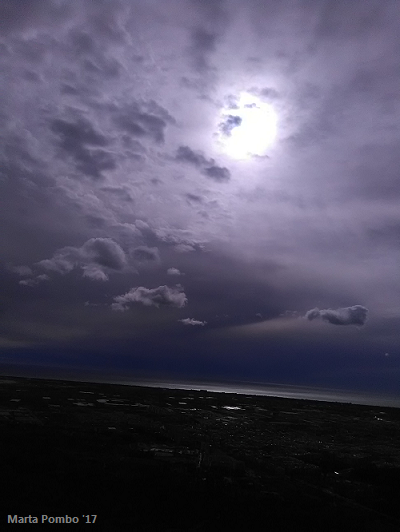
2nd poem: A tribute to a Catalan allegorical figure, the Pescallunes, a moon fisherboy, and to those anonymous people following his example:
Someone unplugged and unscrewed
the moon and the stars.
They were stolen away from us
and we were left with a dark blanket,
covering the surface of the Earth,
under which we must live our lives.
Amid the darkness, in the sky
of a salted night, some of us
sit by the same old sea,
or mountain, or field, or by that river,
where once a sickle moon reflected itself.
Soft wind combs the lonely fields
of broken dreams.
Some of us search for the lost moon and stars,
electricians looking for some spare parts
to screw and plug in again in our hearts,
in the sky of illusions.
Some of us have brushes in our hands
starting the repair job,
painting a new landscape.
Someone plugs in the sun
and when the night comes again
stars and moon begin to shine anew.
The mirror of the sickle moon
reappears on the river waters.
As the ancient legend tells
a fisherboy wants to fish the moon
and put it in his bucket.
Someone laughs at him
and at the impossibility.
But deep inside the boy knows
he is a pescallunes,
a moon fisherboy,
like any other inhabitant
of that small Catalan village.
The fisherboy knows deep inside
our world needs more moon catchers
like you and me,
people with plenty of illusions,
dreams and projects.
And the 3r poem is again an allegory or personification:
A long time ago
I got used to living with
My open wounds,
The last withered while
I was staring at the sunset
In the middle of the fog.
Yes, you told me so many times About your suffering, How your heart shrunk Fisted in bleeding red While your eyes tasted The salt of the ocean waves And cristal pearls were running Down your cheeks.
On that plane you felt The freezing coldness Where just one thing Would not freeze: The fountain of your tears.
Yes, indeed I remember
All the pain on that plane.
You sent me back to the
Land of rejection.
Yet I am a resilient rock
With my withered wounds
That I carry since ancient times
On this eroded earth.
But to exist is to resist
And so I dwell in human hearts
Who care for each other.
And may I receive your boasting waves
Crashing on my shores
Those hearts will restore me again
For I am silent love and not vain.




![shot_1410090348561[1]](https://sonjabenskinmesher.files.wordpress.com/2015/04/shot_14100903485611.jpg)










 Jamie Dedes' THE POET BY DAY Webzine