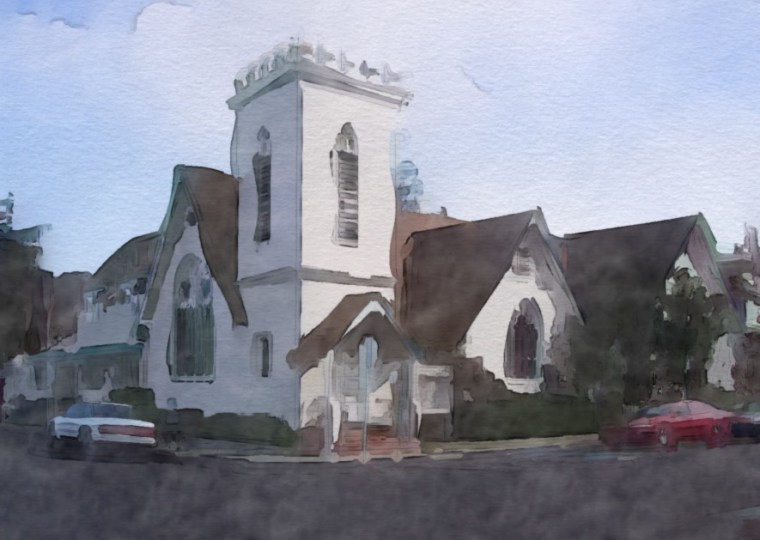
Rev. Ben Meyers, minister of the Unitarian Universalists of San Mateo (UUSM), announced today that UUSM members will stand in solidarity for peace, sustainability and social justice on Inauguration Day, January 20th. He invited the greater Peninsula community to join in a peaceful protest from noon – 1 p.m. along the El Camino Real (ECR) from San Francisco to San Jose. “If you too are concerned about the rhetoric and proposed policies of the incoming administration,” Rev. Meyers said, “you are encouraged to come out and show that as a community we will stand our ground and fight for tolerance, decency, economic justice and democracy in our country.”
Protesters are invited to come individually or in groups and to carry their organization’s banner or signs indicating their primary concerns. “Be direct,” counsels Rev. Meyers,
“but PLEASE, no hateful or violent language. Don’t block driveways, doorways, street crossings or traffic. We will gather at noon and disperse peacefully and promptly at 1 p.m.” Further details at ECR Protest. There’s a Group page set up so that you can meet-up with others near you. Ask to join or message Jamie’s personal FB G J Dedes.
Thank you for sharing your love of words. Comments will appear after moderation.
ZEN MASTER THICH NHAT HANH (his students call him Thãy) is a revered spiritual leader, a poet and a peace activist. Martin Luther King called him an apostle of peace and nonviolence and suggested Thãy for a Nobel Prize, which Thāy never received.
Thāy is sometimes called the other Dalai Lama. His key teaching is that, through mindfulness, we can learn to live peacefully in the present moment.
The featured poem (below), Please Call Me by My True Names, moves us to compassion. It reflects the Buddhist concept of interdependent coexistence for which Thāy coined the term “interbeing.” In it he seeks to remind us that we are one with each other and with nature. His poetry is gentle and his word-pictures and pacing tend to sooth and heal. His many published works include several poetry collections.
Thãy lives in Plum Village in France, where he is recuperating from a stroke.
Thích Nhất Hạnh (Nguyen Xuan Bao) b. October 11, 1926. Vietnamese Buddhist monk and peace activist.
Please Call Me by My True Names
Don’t say that I will depart tomorrow—
even today I am still arriving.
Look deeply: every second I am arriving
to be a bud on a Spring branch,
to be a tiny bird, with still-fragile wings,
learning to sing in my new nest,
to be a caterpillar in the heart of a flower,
to be a jewel hiding itself in a stone.
I still arrive, in order to laugh and to cry,
to fear and to hope.
The rhythm of my heart is the birth and death
of all that is alive.
I am a mayfly metamorphosing
on the surface of the river.
And I am the bird
that swoops down to swallow the mayfly.
I am a frog swimming happily
in the clear water of a pond.
And I am the grass-snake
that silently feeds itself on the frog.
I am the child in Uganda, all skin and bones,
my legs as thin bamboo sticks.
And I am the arms merchant,
selling deadly weapons to Uganda.
I am the twelve-year-old girl,
refugee on a small boat,
who throws herself into the ocean
after being raped by a sea pirate.
And I am the pirate,
my heart not yet capable
of seeing and loving.
I am a member of the politburo,
with plenty of power in my hands.
And I am the man who has to pay
his “debt of blood” to, my people,
dying slowly in a forced labor camp.
My joy is like Spring, so warm
it makes flowers bloom all over the Earth.
My pain is like a river of tears,
so vast it fills the four oceans.
Please call me by my true names,
so I can hear all my cries and laughter at once,
so I can see that my joy and pain are one.
Please call me by my true names,
so I can wake up
and the door of my heart
could be left open,
the door of compassion.
BEST PRACTICE: “FAITH & HOUSING WEEKEND” I am helping with this county-wide effort to address the housing crisis in our area. Between 2010 and 2014, San Mateo County produced 2,100 new housing units and 54,600 jobs. It’s not hard to imagine the resulting decrease in affordable housing and increase in homelessness and other stressful conditions. “The Faith and Housing Weekend” was born of a recent Clergy Housing Summit. At the Summits clergy and county officials unite to understand the crisis and to target solutions for ultimately achieving “Homes for All.”
I am proud of area clergy representing many faiths who have gathered with prayer and intention at the Clergy Housing Summits and are planning collaborative efforts (in numbers there’s strength) that can be implemented by them and their synagogues, mosques and churches to better serve our community. This weekend – “Faith and Housing Weekend” – many of our faith organizations will host educational sessions to provide information to their congregations on the housing crisis, resources, the local ballot initiatives for November 8th, and the ways individually and together members can help resolve the shortage and affordability challenges.There will also be sermons, homilies, music, and prayer. Bravo!
I’ve posted this info because there are many communities around the world where people are homeless for a variety of reasons. This is “a best practice” and one that I suspect could be implemented pretty much anywhere.
Thank you for sharing your love of words. Comments will appear after moderation.
“There are worse crimes than burning books. One of them is not reading them.” Joseph Brodsky
Well life happened – as it usually does until it doesn’t – and I missed Banned Book Week, September 25- October 1 – but it’s never too late to ponder banning and the unreason that often leads to it. One of the more humorous examples is:
How Not to Have to Dry the Dishes
If you have to dry the dishes
(Such an awful boring chore)
If you have to dry the dishes
(‘Stead of going to the store)
If you have to dry the dishes
And you drop one on the floor
Maybe they won’t let you
Dry the dishes anymore
– Shel Silverstein from A Light in the Attic (Harper Collins, 1981)
I wouldn’t blame you if you are surprised to think that a work by the recipient of a Golden Globe Award, an Academy Award and two Grammy Awards would be banned. Consider also that Shel Silverstein’s books have been translated into thirty languages and have sold over twenty-million copies. He may have written for children but adults are enamoured of his writing too. So why was A Light in the Attic banned? According to Cunningham Elementary School in Wisconsin, Shel’s book would encourage children to break dishes in order to avoid having to dry them. Apparently some people are missing a funny bone.
Ginsberg’s Howl was famously condemned as obscenity. Publisher Lawrence Ferlighetti and City Light’s Bookstore Manager Shig Murao were arrested, Ferlighetti for publishing obscene literature and Murao for selling it. There was a protracted and very public trial. Ultimately, it was determined that the book was protected under Freedom of Speech. The judge also pronounced the book “not obscene.” Here is a clip Howl, a movie about the trial. James Franco plays Allen Ginsberg.
If you are reading this post from an email subscription, you’ll likely have to click through to the site to view the video.
Not too long ago we celebrated the life and work of Gwendolyn Brooks. In this video she reads her poem We Real Cool and explains why some chose to ban it …
Walt Whitman’s Leaves of Grass was withdrawn from libraries for “explicit language. Six poems from Les Fleurs du mal by French poet Charles Baudelaire were considered an insult to public decency. Baudelaire and his publisher were fined and the poems suppressed. The Roman poet Ovid’s Ars Amatoria – essentially a relationship guide in a series of three books compossed in elegiac couplets – was considered “licentious.” Some speculate that Ovid was banished from Rome for it.
Some poets suffer worse than banishment, banning and fines. PEN America reports HERE (scroll down) on writers and poets around the world who are on trial, imprisoned or murdered for the perspectives revealed in their work. Such poets often remind us of social injustices that remain simmering but unaddressed in a back corner of our minds. They create awareness of current injustices and inspire us to act. They call on us to hold ourselves and the powerful to account, often pointing out the ways in which we are complicit. That these poets and their work are found so threatening is a testimony to the power of words. There’s some solace in that.
 Rev. Ben Meyers, minister of the Unitarian Universalists of San Mateo (UUSM), announced today that UUSM members will stand in solidarity for peace, sustainability and social justice on Inauguration Day, January 20th. He invited the greater Peninsula community to join in a peaceful protest from noon – 1 p.m. along the El Camino Real (ECR) from San Francisco to San Jose. “If you too are concerned about the rhetoric and proposed policies of the incoming administration,” Rev. Meyers said, “you are encouraged to come out and show that as a community we will stand our ground and fight for tolerance, decency, economic justice and democracy in our country.”




 Jamie Dedes' THE POET BY DAY Webzine