Page 13 of 17

An Editorial by UU Minister, Ben Meyers: SHOTS HEARD, HEARTS BROKEN, VIGILS HELD
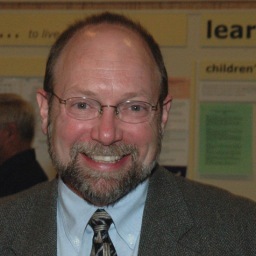
Rev. Ben Meyers of San Mateo, California

There’s something happening here,
What it is aint exactly clear.
There’s a man with a gun over there,
Tellin’ me I’ve got to beware …
I think it’s time we stop, Children, What’s that sound?
Everybody look what’s goin’ down …
Stephen Stills (Crosby, Stills & Nash)

UU San Mateo
Unitarian Universalists (UU) of San Mateo, CA

On June 12, 49 people were murdered at the Pulse Nightclub in Orlando, Florida and 53 were injured and hospitalized, four critically. People of good conscience gathered and mourned with victims and families at vigils held across the country and around the world. We grieved for lives lost. We grieved another mass shooting, the largest in U.S. history.

Congregational Church
Congregational Church, San Mateo, CA

Here in San Mateo, we joined in a interfaith vigil held at the Congregational Church. We joined in sadness, shock and solidarity, both for Orlando, and for those in our own community, our country, our world who are of a minority sexual orientation: gay men, lesbians, bisexual persons, transgender persons, persons uncertain of their gender identity or sexual orientation, victims of senseless hate in some quarters.

The community we must hold vigil for in our hearts is even larger. It includes all our Muslim brothers and sisters here and around the world who have and will suffer from the kind of religious bigotry that cannot separate the actions of one radically disturbed individual from the peace- loving behaviors of millions of religious people.
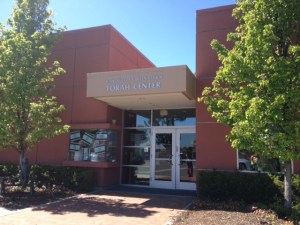
 

Torah Center, Peninsula Temple Sholom, Burlingame, CA

Recently, Unitarian Universalists of San Mateo (UUSM) joined over 200 people and broke the month long period of daily fasting for Muslims known as Ramadan. The event, which I had never participated in before, was made even more remarkable to me because of its location. It was not held in a Mosque or even a Muslim Cultural Center, rather, it was hosted, and well attended, by the Jewish congregation of Peninsula Temple Shalom, in Burlingame. Muslims and Jews, Christians, UUs and others came together to learn more about this most holy ritual of Islam, and to stand against the violence of Islamaphobia and hate, which currently, the majority of U.S. citizens embrace and promote.

We hold vigil for people, especially black and brown people, who continue to be the targets of racial profiling and the oppression and violence that comes with it. Acts of systemic hatred and violence which we can not even imagine but which they face every day just because of the color of their skin.

Here, in this religious community, we are striving to embody and live out a life-long vigilance to building the beloved community that the Rev. Dr. Martin Luther King, Jr. spoke of when he encouraged all people of good conscience, especially white people of privilege and power, to look at and dismantle the pervasiveness of white supremacy, lessons learned at a tender age and never truly unlearned without a committed effort and willingness to change and be changed—from the inside-out.
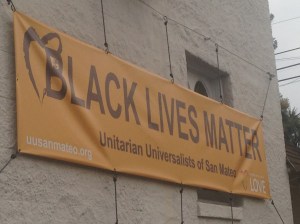
IMG_4365Our Black Lives Matter banner hangs outside our sanctuary, a reminder to be conscious of our complicity in the legacy of violence and hatred that is not yet overcome. We must hold in our hearts and move in our hands ALL of us here in our country who might at any time be the victims of violence of the highest order, violence inflicted by high-powered weapons that kill indiscriminately in every corner of this country: in our churches, mosques, temples and shrines…in our schools and workplaces, in our coffee houses and dance houses and our very homes.

Since the Orlando shooting on June 12th there have been 31 other mass shootings in the U.S. involving 4 or more victims, including the death of 5 in Las Vegas and 5 police officers in Dallas, Texas. More shootings. More vigils. So, what exactly do we mean by vigil?

A vigil is a SACRED kind of watchfulness, a call to be attentive and aware with devotion for the emotions that are sure to surge up within us— emotions of anger, even rage; emotions surrounding loss and shock; emotions steeped in frustration and fear. These emotions can convince us, if we are not careful, that rage justifies the kind of outrage that lashes out, repaying violence with violence, seeking a life for a life, an eye for an eye, the kind of rage that would turn the whole world into an unending whirl of violence and vengeance.

Inevitably,we must come to the question: “What WILL we do?” Because, now awakened, now alert, now vigilant…We know we are called to respond, to act, to engage in change that makes a difference.

Our first question is, “What do we need to make sure we do not do?” How do we honor the memory of those who were victimized by hate? How do we stand with those who are still victimized by hate? How do we keep from falling into the pattern of hate ourselves? Given the size and complexity of the problem, how do we remain vigilant and not acquiesce back into silence, numbness, complacency? How do we do more than pray?

We know that a culture that marginalizes and stigmatizes persons for any reason creates an environment that says violence towards those persons is acceptable because they are the “other,” that are not like us. But we who believe in a better way know that an eye for an eye only leaves us all blind.

We also know that a culture of violence such as ours also creates an environment of numbness and distance and silent complicity, which can be and has been part of what perpetuates the continuance of the dominant culture. We have now heard enough shots to know that silence is inadequate to the task of countering the culture violence. We must employ the power of love and peaceful engagement for we know that moments of silence and prayer are no longer enough. That they have never been enough…

Congresswoman Jackie Speier, our District 14 representative who, out of frustration to the impotence of her Congressional colleagues and out of vigilance and commitment to bringing real change to the culture of gun violence in our country, no longer participates in the moments of silence that have become the only response of our congress to these ceaseless mass shootings that are a plague upon our nation.

Jackie Speier
Jackie Speier

This is what our moments of silence have bought us. A silent nightclub, the only sound the frantic ringing of phones that would never be answered. Silent bodies, where there should be life and love and pride. And here, a silent Congress. Mere words cannot describe the depth of my grief and rage. Forty-nine lives lost, in the middle of Pride Month when they should have been safe and celebrated. Forty-nine families devastated by the loss of their loved ones. Forty-nine phones ringing, and ringing, and ringing. There were also frantic texts, like Eddie Justice’s final messages to his mother: “Mommy, I love you. He’s coming. I’m going to die.

“If you can hear these words without your heart breaking, if you can think of those little children gunned down in Newtown without grieving, if you can think of empty pews in Charleston without mourning, then truly you have lost your humanity.

“Hateful people like to compare LGBTQ equality to the sin-filled Biblical cities of Sodom and Gomorrah. But we in Congress are the real Sodom and Gomorrah. Are there 218 righteous members here to stand against this bloody tide? Increasingly, I doubt it.

“So I ask you today, how many lives must be destroyed before Congress acts?

Nine lives? Charleston showed us nine is not enough.

Thirteen lives? Columbine showed us that 13 is not enough.

Certainly 27 small children killed in their classrooms at Newtown? No.

The 32 lives lost at Virginia Tech? Again, not enough lives.

The more than 33,000 Americans killed each year by guns? Still not enough.

“And now 49 people have been murdered in Orlando.

“Yet even this historic tragedy hasn’t been deemed big enough, horrific enough, or insidious enough to break Congress’ silence.

“Congress is happy to debate for hours about bathrooms, but bring up the gun violence killing thousands? Absolutely not.

“Radical Islam, or home-grown American homophobia, or a toxic stew of both may have inspired the Orlando shooter. No doubt we will learn more about his disgusting motivations in the coming weeks.

“But there are simple actions we can take now, actions that would have reduced the deaths in Orlando as well as Aurora, Newtown, San Bernardino, and at Umpqua Community College…

“I urge you – I beg you – to make America better than this. We must be better than this. “ –Congresswoman Jackie Speier, California’s 14th District.

There exists among us a variety of responses to the NRA, more interested in the rights of those who sell guns than in the lives of innocent victims of gun violence.  The Human Rights Campaign, the largest LGBTQ-rights organization in the country suggests that we work to limit access to all assault weapons: That we move to expand background checks: that we limit access to firearms for suspected terrorists and for people with a history of domestic abuse. Common sense. Yes! In every other “civilized” country in the world, these are understood as common-sense regulations. But, here in our country, while the NRA owns the people’s Congress, these are seen as unreasonable restrictions. This has to stop. We must rise and turn the tide towards peace and justice when it comes to public safety. The best way to honor those who were senselessly slaughtered in Orlando and everywhere else is to act, NOW. We may BEGIN with prayers and with songs and with vigils…but let’s not stop there.

We can do better. We are better than this.

Amen.

May it be so.

– Rev. Ben Meyers

Essay posted under CC NoDerivatives (nd) license. You may copy, distribute, display only original copies of this work with attribution; © portrait, Ben Meyers; Jackie Spear’s portrait is her official one; UUSM photograph is in the public domain; Temple Sholom courtesy of PTseducation under CC SA-BY 3.0, other photographs, Jamie Dedes

JUAN FELIPE HERRERA: From limited-English speaker and Migrant Farm-Worker to United States Poet Laureate

U. S. Poet Laureate, Juan Felipe Herrera (b. 1948)

A year ago this month, the United States Library of Congress announced the appointment of former California Poet Laureate (2012-2014), Juan Felipe Herrera, to the position of national poet laureate, the highest honor awared to poets in these United States.

Herrera’s body of work is a reflection of the Mexican-American experience and is also representative of much that immigrants and migrants the world over have in common including the efforts and adjustments made along a path often leading to distinguished contributions to their communities and adoptive countries.

In announcing the appointment, James H. Billington – Librarian of Congress (1987-2015) – said of Herrera …

I see in Herrera’s poems the work of an American original—work that takes the sublimity and largesse of  Leaves of Grass and expands upon it,” Billington said. “His poems engage in a serious sense of play—in language and in image—that I feel gives them enduring power. I see how they champion voices, traditions and histories, as well as a cultural perspective, which is a vital part of our larger American identity.”

Herrera is the first Hispanic poet to serve in the position. Herrera said …

This is a mega-honor for me, for my family and my parents who came up north before and after the Mexican Revolution of 1910—the honor is bigger than me. I want to take everything I have in me, weave it, merge it with the beauty that is in the Library of Congress, all the resources, the guidance of the staff and departments, and launch it with the heart-shaped dreams of the people. It is a miracle of many of us coming together.”

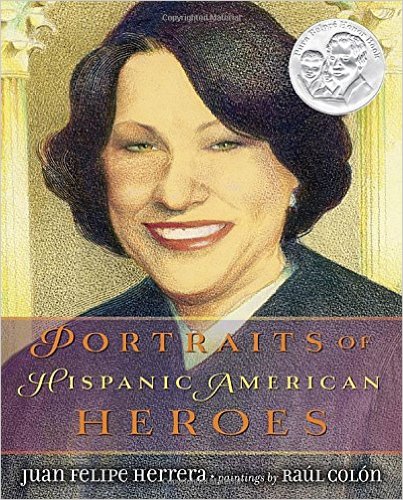
61WsQ5uGMTL._SX401_BO1,204,203,200_

Herrera has authored some twenty-eight books of poetry, novels for young adults and collections for children, including Portraits of Hispanic American Heroes (Dial Books,2014), a picture book showcasing inspirational Hispanic and Latino Americans.

Herrera was born in Fowler, California, in 1948. As the son of migrant farm workers, he moved around often, living in tents and trailers along the road in Southern California. He attended school in a variety of small towns from San Francisco to San Diego. In 1972 he was graduated from the University of California, Los Angeles (UCLA) with a bachelor’s degree in social anthropology. He then attended Stanford University, where he received a master’s degree in social anthropology. In 1990 he received a Masters of Fine Arts at the University of Iowa Writers’ Workshop.

books-noted-juan-felipe-herreras-half-world-light-new-and-selected-poems

Enter the Void

Sit on the embankment,
a dust fleece, there is a tidal wave ahead of me.

It will never reach me. I live underground, under the Dead Sea,
under the benevolent rocks and forearms and
mortar shells and slender naked red green
torsos, black,
so much black.
en route:

this could be a train, listen:
it derails into a could.

excerpt on the conflict in the West Bank from Half the World Is Light, New and Collected Poems (University of Arizona Press, 2008)

Herrera has published over a dozen poetry collections, including Half the World in Light: New and Selected Poems , which received the National Book Critics Circle Award and the International Latino Book Award. He is also a celebrated young adult and children’s book author. His honors include the Américas Award for both Cinnamon Girl: letters found inside a cereal box and Crashboomlove: A Novel in Verse, as well as the Independent Publisher Book Award for Featherless / Desplumado, the Ezra Jack Keats Award for Calling the Doves  and the Pura Belpré Author Honor Award for Portraits of Hispanic American Heroes and for Laughing Out Loud, I Fly.

For his poetry, Herrera has received two Latino Hall of Fame Poetry Awards, a PEN USA National Poetry Award, the PEN Oakland / Josephine Miles Award, a PEN / Beyond Margins Award, and fellowships from the Guggenheim Foundation, the National Endowment for the Arts, the Bread Loaf Writers’ Conference, and the Stanford University Chicano Fellows.

Herrera has served as the chair of the Chicano and Latin American Studies Department at California State University, Fresno. He has held the Tomas Rivera Endowed Chair in the Creative Writing Department at the University of California, Riverside, where he taught until retiring last year. He is currently a visiting professor in the Department of American Ethnic Studies at the University of Washington, Seattle. Appointed in 2011, he serves as a chancellor for the Academy of American Poets.

Juan Felipe Herrera’s Poet Laureate Project is La Casa De Colores or “the House of Colors” …

a house for all voices. In this house we will feed the hearth and heart of our communities with creativity and imagination. And we will stand together in times of struggle and joy. The website includes two features:

“La Familia (The Family) is an opportunity for you to contribute to an epic poem of all our voices and styles and experiences that will run the span of my Laureateship. By contributing to La Familia, you will be part of my family—and all our words will be seen and our voices be heard, throughout the nation and beyond.

“El Jardín (The Garden) is a special place where I will share my experiences with curators at the Library of Congress. Peek into the Library’s wealth of materials, such as: Pablo Neruda’s “España en el Corazón,” given to him by soldiers—the pages made out of their clothes turned to pulp; a letter the folksong pioneer Woody Guthrie wrote on the back of a dust jacket to Alan Lomax; a silkscreen by Yolanda M. López, on the courage of “Mujeres Trabajadoras”—women workers. I hope you will be as inspired by them as I am, and you can take the treasures of El Jardín with you—in heart and with pen.”

Herrera will begin serving his second term as U.S. Poet Laureate this September. His Amazon page is HERE.


CELEBRATING AMERICAN SHE-POETS (18): Joy Harjo, Crazy Brave

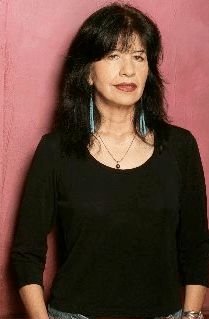
Joy Harjo (b 1951), Mvskoke (Creek) Poet, Musician, author and key player in the second wave of the Native Merican Renaissance (literary efflorescence)
Joy Harjo (b 1951), Mvskoke (Creek) Poet, Musician, author and key player in the second wave of the Native American literary efflorescence

51fFPVB5FTL._SX329_BO1,204,203,200_

 Crazy Brave (Norton & Company, 2012), Joy Harjo’s eminently engaging memoir, flows like a long prose poem. It is rich and well-built on a foundation of tribal mythologies, a strong sense of her ancestry, her difficult childhood and youth and salvation found in poetry and music. From her birth to a handsome much-loved fire-spirit father who inherited Indian oil money, allowing him to indulge a passion for cars, and her beautiful water-spirit singer-mother whose voice was stilled by a bully of a second-husband, Harjo tells the story of girl who survived a physically and emotionally abusive step-father, crushing poverty and the greater cultural obscenities to become one of our most influential poets and a formidable advocate for justice for Native Americans and liberation for women.

I was entrusted with carrying voices, songs, and stories to grow and release into the world, to be of assistance and inspiration. These were my responsibility.”

*****

I can’t imagine the human being who wouldn’t relate to Joy Harjo’s history, but those who have come from “broken” homes, poverty and a family of mixed ethnicity will most especially appreciate it and perhaps find some healing and strength in the pages of Crazy Brave. That Joy Harjo survived so much to become a decent loving person leaves the rest of us with no excuse; and any writer, poet or musician will take to heart the dreams and visions of that long journey to find hope and creative voice in poetry.

Joy Harjo, a member of the Mvskoke tribe was born in Tulsa, Oklahoma, an area where the Native American trail of tears ended, an area to which the indigenous peoples were removed – forced to relocate –  as people of European descent moved into their original home places. The removed were the Five Civilized Tribes – Cherokee, Chickasaw, Choctaw, Mvkoke and Seminole  – who were living as autonomous nations in what is now the American Deep South.

“I fought through the War Between the States and have seen many men shot, but the Cherokee Removal was the cruelest work I ever knew”. Georgian soldier who participated in the removal

*****

When the World as We Knew It Ended
It was coming.
We had been watching since the eve of the missionaries in their long
and solemn clothes, to see what would happen.
We saw it
from the kitchen window over the sink
as we made coffee, cooked rice and potatoes
enough for an army.
We saw it all, as we changed diapers and fed
the babies. We saw it,
through the branches of the knowledgeable tree,
through the snags of stars, through
the sun and storms, from our knees
as we bathed and washed the floors …
The conference of the birds warned us as they flew over
destroyers in the harbor, parked there since the first takeover.
It was by their songs and talk we knew when to rise,
when to look out the window

excerpt from When the World Ended in How We Became Human, New and Selected Poems (W.W. Norton & Co., 2004)

*****

screen-shot-2013-12-27-at-9-02-25-pm

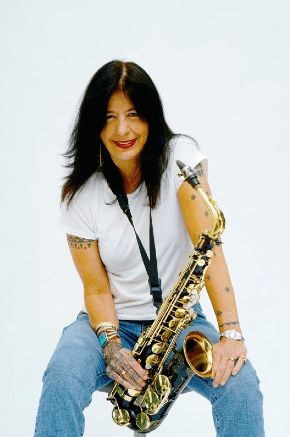
Joy Harjo’s poetry and music are influenced by her ethnic heritage and her feminist and social concerns as well as by her love of word and sound and her education in the arts. Largely autobiographical, her poetry is informed with descriptions of the Southwestern landscape and the mythologies, symbols and values of the Mvskoke people. Hers is the sort of writing that sits with you to become part of your own bone and marrow, which is the way of good poetry and good story. A poet of the people but also a critically-acclaimed poet, her many awards include the Wallace Stevens Award of the Academy of American Poets, The William Carlos Williams Award from the Poetry Society of America and the American Indian Distinguished Achiement in the Arts Award. She is the recipient of several grants and is a teacher, musician (saxophone) and singer.  She has published some fourteen books and ten music albums.

It was a dance,
her back against the wall
at Carmen’s party. He was alone
and he called to her – come here, come here
that was the firs time she saw him
and later she and Carmen drove him home
and all the way he talked to the moon,
to the stars, to someone riding

excerpt from There Was a Dance, Sweetheart in How We Became Human: New and Selected Poems (1975-2022) (W.W. Norton & Co., 2004) © Joy Harjo

If you are reading this post from email, you will likely have to link though to this blog to enjoy the video. Joy Harjo’s Eagle Song, poem and music:

© review, Jamie Dedes; poems, Joy Harjo, photographs courtesy of Ms Harjo

HAPPY ANNIVERSARY, SUPERMAN … and therein lies a writing prompt for you

SupermanRoss“On a purely personal level, it’s very strange, because as a kid, Superman informed my personality. Now I’ve been given the job of forming Superman’s personality and, in some ways, drawing on my own background.”  J. Michael Straczynski author of Superman: Earth One

The first comic about the character (an immigrant, by the way) that was destined to become an American cultural icon came out on this day in 1938.  Superman, the invention of Jerry Siegal and Joe Shuster, fought for “truth, justice and the American way.” He was ultimately affiliated with the Justice League and the Legion of Super-Heroes. He was the first of the great comic book superheros. He’s come a long way in both print and film media since 1938 and since this 1950s television version:

(I admit I could have used a more contemporary video but this is the version I grew up with and I still love it best.)
Note: If you are reading this post from an email, you will have to link through to the blog to see the video.

Yesterday, I wrote a poem, an homage, to real-life superheroes, the women and men who are dedicated  to fighting injustice and laying the groundwork for understanding and peace: the seeds of awakening. I wrote it because I’ve just finished reading some books by a brave and intelligent activist for common sense and social justice. The poem started out being an homage to her, but I began to think of and tick-off the names in my mind of the people who have invested their lives (and sometimes lost them) in the work of peace and justice and so had to broaden the poem’s reference.  Though the poem is written in the feminine, it is meant to be inclusive of all who fight for justice, female and male.

WRITING PROMPT: Write a poem, story or essay about a real-life superhero you admire. Show why you admire this person and perhaps what you try to emulate. Or, alternately, create your own fictitious superhero. Remember, every superhero has to have a vulnerability. Superman’s was krypton.

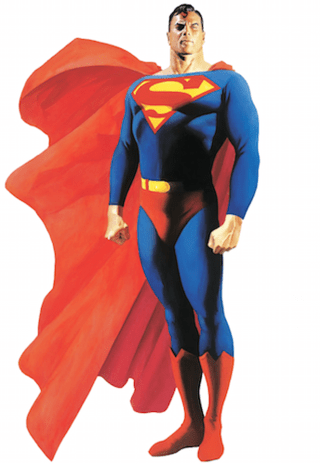
Illustration: Superman as depicted in The World’s Greatest Super-Heroes (August 2005). Art by Alex Ross. Used under U.S. fair use doctrine.