“In a time of deceit telling the truth is a revolutionary act.” —George Orwell
This is an extraordinary time; a time when post-truth culture is thriving in Russia, China, America, Australia, Britian, India, Japan and Turkey. This political climate is founded and furthered by appeals to emotion and on conclusions based on ignorance of and resistance to hard science and well-documented history. A perhaps unprecedented level of bombast replaces common sense, honesty and sincere promise creating a climate that rests on disinformation, intimidation and divide-and-conquer as its primary weapons of control. This all combines to undermine rule of law, free speech and free media. We have administrations evolving in the spirit of Orwell’s 1984 where diplomacy and statesmanship have devolved into manipulative spins calculated to influence the gullible and solidify the power of would-be autharitarians.
With the mixed blessing of social networking citizens seem unable – or perhaps unwilling – to distinguish lies from truth and fact from fallacy. President Obama is described as “obsessed” with this problem (hyperreality) and the mixed ecosystem of professional journalism and social network reportage in which “everything is true and nothing is true.”
“In an age where there’s so much active misinformation, and it’s packaged very well, and it looks the same when you see it on a Facebook page or you turn on your television, where some over-zealousness on the part of a US official is equated with constant and severe repression elsewhere, if everything seems to be the same and no distinctions are made, then we won’t know what to protect…If we can’t discriminate between serious arguments and propaganda, then we have problems.” —Barak Obama
We’ve decided this month to address the challenges that face our countries and the world. We’ve addressed these in essay and poetry, sometimes head-on and sometimes by a thread. Though perspectives and solutions may differ to some degree, there is clear agreement that the concerns are real as is the need to “resist.”
♦
A last note: Thanks to Michael Dickel for further technical refinements to make this zine more accessible and readily readable. Thanks also to the members of our core team, to our guest contributors and to our readers for continued support, encouragement and the pleasures of our shared values.
In the spirit of peace, love and community
and on behalf of The Bardo Group Bequines, —Jamie Dedes, Founding and Managing Editor
“Political language is designed to make lies sound truthful and murder respectable, and to give an appearance of solidity to pure wind. ” ― George Orwell
For this issue of The BeZine
Click HERE to read the entire magazine by scrolling (includes the intro above) and
To learn more about our guests contributors, please link HERE.
Thank you for sharing your love of words. Comments will appear after moderation.
Later today I’ll post the responses from readers to last Wednesday’s writing prompt, which is usual every Tuesday. Meanwhile . . .
In December 2015 world events led to a spontaneous eleventh hour special section – Waging the Peace – in The BeZine, which I edit. This seems a propitious moment to bring to the fore once again those ideas, ideals and experiences shared with us by Rabbi Gershon Steinberg-Caudill, Rev. Ben Meyers, Father Daniel Sormani, C.S. Sp., Sophia Ali-Khan, Israeli-American poet Michael Dickel, and the Venerable Bhikkhu Bodhi. Thanks to all of them and to Carla Prater, the assistant director of Buddhist Global Relief for their contributions to this collection and their assistance. I’ve included links to each of the features in table of contents for Waging the Peace. It is below the following introductory remarks.
Rabbi SteinBerg-Caudill (the Interfaith Rabbi) is a teacher who espouses a Jewish Spirituality and Universalist teaching for the future brotherhood of all people. When I contacted him about this effort he reminded me of what surely should be foremost in our minds and hearts:
“The Hebrew word for PEACE – שלום – does not imply a lack of strife. It implies instead WHOLENESS, COMPLETION. If one is in a state of peace, he can still be whole in a time of chaos.”
Rev. Meyers of the Unitarian Universalists of San Mateo also counsels inner peace with his You are the promise … the one … the hope. Rev. Meyers says:
“I understand and often share the ‘urge of urgency’ over the peacefulness of peace. But this I also know: We live at the intersection of action and reflection.”
Father Sormani, a Spiritan priest who has lived and worked in Algeria and Dubai and is now teaching theology at Ateneo de Manila University in the Philippines, asks What Have We Done that People Can Pick-up Weapons and Kill. Father Dan says:
“We have become our own worst enemy. Whenever we separate the world into ‘them’ and ‘us’, whenever we accept blind generalizations and cease to see a unique individual before us, whenever we forget we are all victims of carefully orchestrated deceit and deception for wealth and power, the force of darkness wins. Bullets will never win this struggle, only the heart and mind will.”
Lest you missed Sofia Ali-Khan‘s letter, Dear Non-Muslim Allies, which made the rounds on Facebook and was also picked up by some mainstream media, we’ve included it here.
We’ve also included a video recitation of Tunisian poet Anis Chouchéne‘s profoundly moving poem against racism and fanaticism. Chouchène speaks directly to radical Islam … but I think you’ll agree that he ultimately speaks to the fear in all of us.
“Peace we keep an eye on/while it packs its bags/to abandon our lands, little by little …”
Chouchène concludes as Father Dan does, that we must be able to see the individual.
Michael Dickel‘s poem Mosquitoes (excerpt from his chapbook,War Surrounds Us – 2015, Is a Rose Press), is featured. The poem starts out with Israelis and Palestinians crossing the artificial lines that divide to offer one another condolences on the deaths of their children. This is a favored poem of mine, especially so because when I initiated The Bardo Group (now The Bardo Group Beguines) in 2011, I had in mind virtual crossing of borders through the arts. (Our mission statement is HERE.) Michael’s poem demonstrates how we are manipulated by the propaganda machine.
We’ve included a short video presentation on the seven steps to peace developed by peace activist, Rabbi Marc Gopin. Director of the Center for World Religions, Diplomacy and Conflict Resolution (CRDC).
The Venerable Bhikkhu Bodhi is Buddhist monk in the Theravada tradition, an author and teacher. He is the founder of Buddhist Global Relief. With permission, we offer the 2015 talk he gave at the New Year’s Interfaith Prayer Service, Chuang Yen Monastery. Bhikkhu Bodhi says:
“Real peace is not simply the absence of violent conflict but a state of harmony: harmony between people; harmony between humanity and nature; and harmony within ourselves. Without harmony, the seeds of conflict and violence will always be ready to sprout.“
Bhikku Bodhi goes on to analyze the obstacles to achieving world peace, the prerequisites of peace, and the means to realizing these goals.
On behalf of The Bardo Group Beguines and in the spirit of love and community,
Jamie Dedes,
Founding and Managing Editor of The BeZine.
Originally published on The BeZine website, this issue was produced and introduced by Contributing Editor, Michael Dickel (Fragmentarily/Meta-Phore(e) Play). Much thanks to Michael for his work on this stellar poetry issue, which as he said turned out to be – in effect – an anthology. The last hours before putting out the Zine always end up to be an overnight effort. There is some work that can’t be done until just before publication and, of course, things do go wrong. Murphy’s Law. So really double kudos and much appreciation to Michael.
Thanks also to the poets and writers who contributed. We love having so many of you together and we are pleased as always to present established, emerging and talented amateur poets to delight you. Our hope is that you (readers and writers) now have some fine new (to you) poets to follow. You’ll find links to their books and websites in the bio pages at The BeZine.
Youth Chaplaincy Program Founder, Rev.Terri Stewart. (Photo: Christmas at the King County Youth Detention Center, Seattle, Washington) Terri is the minister at Riverton Park United Methodist Church, Seattle and founder of Beguine Again
Also thanks to our stalwart supporters, including Terri Stewart ( Beguine Again), Lana Phillips, Ruth Jewell, James R. Cowles (look for a fab piece by him in next month’s issue) and Chrysty Darby Hendrick.
Much thanks to all our readers who are a valued part of The Bardo Group Beguines (the publishers of the Zine), a virtual arts collaborative. Much appreciation to the many of you who have referred poets and writers and enriched the work of this Zine in doing so. And thanks most of all to readers and writers for your love of the arts and your peacefilled hopes for humankind and our Mother Earth. J.D. – And now here’s Michael with the introduction and the table of contents …
Poetry Month means that we have arrived at
…the cruelest month, breeding Lilacs out of the dead land, mixing Memory and desire, stirring Dull roots with spring rain. (T. S. Eliot, The Wasteland)
One of the most famous poems “about” poetry, Marianne Moore‘s poem, “Poetry.” It famously begins with
I, too, dislike it: there are things that are important beyond all this fiddle.
However, she goes on in the very next lines to say
Reading it, however, with a perfect contempt for it, one discovers that there is in it after all, a place for the genuine.
There is much that is genuine in this April issue of The BeZine, which celebrates Poetry Month globally with our celebration of interNational Poetry Month. We are proud to present a wide variety of poets and poetry from all over the world. We have 45 posts of poetry (many with more than one poem), an essay, and one short story. This issue of The BeZine is an anthology!
Over the years, questions of poetry’s health, suggestions of its “death,” and concerns over who, if anybody, might be reading it, continue to swirl around in various articles, essays, and round tables. While many of the debates one might encounter in this bubbling broth come from a perspective of poetry’s decline, it seems to me that the reasons that such questions arise come from two primary sources.
One is an anxiety about how society values what we do, as poets or readers of poetry. It seems that the writers from this vein often worry that, in fact, society does not value poetry—as recorded in statistics about readership or as suggested by some other perceived decline in attention to it. The other vein, in my view, is a more healthy concern with what poetry is and what we are doing when we “do” poetry (read, write, critique).
This past year, a lot of words spilled onto the screen and page regarding Bob Dylan receiving the Nobel Prize—is a song writer a poet? Of course, poetry comes from song, so a song writer is a poet. Is poetry still song, then, or has it gone “beyond”? These articles and essays seem to flow from both of the sources I’ve suggested: anxiety and reflection. If our modest zine is any indication, poetry thrives throughout the world.
While the anxieties and reflections continue—and they are not new, witness the 1919 date of Marianne Moore’s poem—poets continue to write, and readers continue to read. You are reading this, so you are evidence of readers who have an interest in poetry. Whether there are more or fewer readers in any year or decade might fluctuate, or the methods of measuring them might change. However, as there are poets, there are those who read poetry. And listen to it—as in spoken word and slam.
Billy Collins opens his essay, The Vehicle of Language, suggesting that a problem with the reception of poetry is how poetry is taught:
For any teacher of poetry with the slightest interest in reducing the often high-pitched level of student anxiety, one step would be to substitute for the nagging and ultimately pointless question, “What does this poem mean?” the more manageable question “Where does this poem go?” Tracking the ways a poem moves from beginning to end puts the emphasis on the poem’s tendency to travel imaginatively and thus to carry the reader in the vehicle of its language.
In principle, I agree that the emphasis should be on where poetry goes, how it plays with language—not on decoding “meaning.” The same approach could be applied to the concerns expressed about poetry. The concerns need not be about where poetry is as measured against expectations of its current quality, akin to the “meaning” anxiety of its teaching.
Although some express an anxiety about the “quality” of online poetry or spoken word or even “today’s” written word, we would do well to reflect instead on where poetry is going, for us as readers and writers—where we as writers of it want to go with our poetry, and where we as readers of it want poetry to go to be most satisfying.
Poetry invites us to take an imaginative journey: from the flatness of practical language into the rhythms and sound systems of poetic speech. (Billy Collins, The Vehicle of Language)
It is our hope that you will read the poetry here with an appreciation for poetry’s “place for the genuine,” and find satisfaction in the depth and breadth presented here. Whether or not you will have “a perfect contempt for it” as you read, we leave up to you…
—Michael Dickel Contributing Editor
TABLE OF CONTENTS
Celebrating interNational Poetry Month
To Read this issue of The BeZine
Click HERE to read the entire magazine by scrolling, or
You can read each piece individually by clicking the links below.
To learn more about our guests contributors, please link HERE.
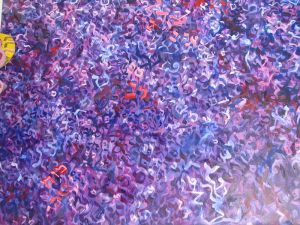
Kabbalistic painting of the supernal illumination of Hebrew letters in Creation. Courtesy of David Rakia under CC BY 3.0 License
March 15, 2017 Originally published on The BeZine site. Most of the links here will take you there.
The title of David Cooper’s book on Kabbalah invites us to re-think the Creator as Creating: God is a Verb. While I don’t want to equate science to God in a religious sense, I want to borrow this re-conception. Science is creative, creating, if you will, knowledge of the world. Science is a verb.
Too often we get tied down to a concept of science as about facts. However, as Thomas Kuhn describes it in The Structures of Scientific Revolutions, science is a process (hence, verb). The process involves a method (the scientific method), observation, repeated results, and, if repeated results are consistent, an assertion that a hypothesis is likely to be true. However, Kuhn explains that it is also a sociological process where the method and affirmed hypotheses lead to paradigmatic beliefs—models that predict reasonably well future observations.
The paradigms are not easily changed—the paradigm of Newtonian Mechanics, which work very well in most real-world situations, did not easily yield to Relativity and Quantum Mechanics even as Newtonian physics accumulated observations it couldn’t explain while quantum physics explained more and more. As a model for most human activities on Earth, though, Newton’s model still works. It’s when boring down to atomic particles or moving out into massive astronomical systems, or specific cases like black holes and light itself, that we need Quantum Mechanics.
The different (and often competing) models—also known as theories—are products of science, the verb. The scientific process refines, overturns, explores new models. Science, at its best, produces closer and closer approximations of the actual universe it models. This is different from a belief in an unwavering truth or an ideology—in part, because it relies on observation and corrections if observations do not show what the model predicts. And second, because science does not make truth statements but, rather, probability statements. Sometimes, the probability approaches 100%, sometimes only 95%.
The flexibility that comes from self-correction unfortunately also provides ammunition for “science deniers,” such as those who deny climate change. As science is a process and models do change, as models are based on predictive ability and that ability is not 100% even in the best cases, those whose ideology or greed get in the way of accepting the predictions (even the very strongly likely ones) often claim the whole model is “unreliable,” or point to earlier results that required corrections to the model in order to discredit the whole theory. Yet, those who object do not offer an alternative model that does stand up to the process of scrutiny, repeated results, and reliable prediction of future events. They often offer no alternative at all.
At its outer theoretical spheres, the science verb sometimes takes us to conversations that sound like mysticism—as do some of aspects of that mysterious energy, light. Humans have a long cultural (and religious) history with light. Arthur Zajonc’s book Catching the Light: The Entwined History of Light and Mind provides a wide ranging cultural and inter-cultural exploration of human understanding of light through history. In the end, Zajonc re-connects current quantum physics concepts with those from ancient myths as accurate metaphors (or analogies). Zajonc, a professor of physics at Amherst (now retired), has studied culture, mind and spirit in relation to physics from his perspective as a physic working in quantum optics (for example: The New Physics and Cosmology: Dialogues with the Dalai Lama, one of his better known books).
In a very real sense, the verb science interacts with arts and culture. It is an active process of human society, a developed methodology for producing close observations and repeatable results to help us build models that predict future results under different conditions. It is not a series of facts, but rather a system of understanding and predicting creation. In this way, it actively creates the world, literally as we know it. And it has influence culture. Certain newly (re)discovered understandings from mathematics helped European artists develop perspective in painting. A recent example, Chaos Theory, with its fractals and butterfly effect, has influenced art, music, and literature, and not just with science fiction movies.
In this issue, we celebrate, explore, and raise questions involving science, culture, politics, and religion. John Anstie and I both contribute poems that have sub-atomic particles at their centers, but are not (only or even mostly) about them. Naomi Baltuck explores Galileo through the Musee Galileo, in another one of her marvelous photo-essays. An sampling of snippets from science take us through “Science in culture, politics and religion” in Corina Ravenscraft’s exploration of connections. In “A Life,” Michael Watson gives a highly personal account of his own encounters and loves with different ways of understanding — or knowing — embodied in the theme’s elements of science, culture, religion, and politics. Current politics seem to attack the different approaches each has to offer. Phillip T. Stevens begins with Chaos Theory and moves into myths, the myths of myths, as it happens. Hearts, Minds, and Souls, by John Anstie, considers the theme from a socio-political framework, considering societies need to control as one of many elements in shaping science, culture, and religion through politics.
The issue has much more to offer— fiction by Joseph Hesch and lots of poetry by Jamie Dedes, Renée Espiru, Priscilla Galasso, Terri Muuss, and Phillip T. Stevens. The more light section has three more poems that are not directly related to this month’s theme, but we wanted to share with our readers at this time.
Michael Dickel
Associate Editor
“It is frequently the tragedy of the great artist, as it is of the great scientist, that he frightens the ordinary man.” Loren Eiseley (1907 – 1977), American anthropologist, educator, philosopher, and natural science writer
This issue of The BeZine is dedicated to scientists the world over, especially those who are conscientiously fighting to preserve this earth, its people, and scientific integrity. Throughout history scientists have met with the same skepticism they face in some quarters today. They were sometimes misunderstood and crudely punished. Alan Turing comes to mind first, cruelly treated after being of enormous service to his country.
I think of Rhazes (865-925), a forward-looking medical scientist who wrote a compendium of all that was known about medicine in his time. He was beaten over the head with his book, went blind and was unable to continue his work. Galileo’s (1564-1642) insight and honesty was labeled heresy. Albert Einstein’s (1879-1955) books were burned. Henry Oldenburg (1619-1677) was suspected of spying when he sought to acquire and publish worthy works by people outside his own country.
The tensions between ignorance and cognoscence continue today. So much so that in my country scientists are planning an Earth Day march on Washington to protest the current regime’s dismantling of climate protections. Members of many scientific and research groups are scrambling to archive government data they believe could be in jeopardy under this new regime.
Many thanks this month to Michael Dickel for having my back on this issue and for his distinguished contributions. Thanks also to all our supporters – especially Terri Stewart, Charlie Martin, Chrysty Darby Hendrick, Ruth Jewel, Lana Phillips, Sharon Frye, Silva Merjanian, M. Zane McCllelan and Inger Morgan and to this month’s contributors (not in any particular order) Priscilla Galasso, Corina Ravenscraft, Joe Hesch, Michael Watson, Naomi Baltuck, John Anstie, James R. Cowles, Terri Muuss and Pat Leighton. All are valued as we pursue this small effort in the name of peace and understanding.
New to our pages this month is Phillip T. Stevens. Phillip tells me he spent most of the eighties and nineties as a community and arts activist. To pay his bills he taught writing and visual design to community college students and at-risk youth for the Texas Youth Commission. He published four novels, two volumes of poetry and academic papers (including a series of articles on the role of metaphoric thinking in the development of scientific theory and religious belief for the International Journal of Religion and Spirituality in Society). Phillip lives with his wife Carol in Oak Hill, Texas, where they rescue abandoned cats for Austin Siamese Rescue.
And here we are. Thanks to the efforts of many, we leave the March issue in your hands. Enjoy and …
Be inspired. Be creative. Be peace. Be …
On behalf of the Bardo Group Beguines
and in the spirit of love and community, Jamie Dedes, Managing Editor
TABLE OF CONTENTS
Science in Culture, Politics and Religion
To Read this issue of The BeZine
Click HERE to read the entire magazine by scrolling. (I placed it in backwards though, so you start at the end and move forward. Sorry about that. Just getting this down. J.D.), or
You can read each piece individually by clicking the links the below.
 “In a time of deceit telling the truth is a revolutionary act.”
 “In an age where there’s so much active misinformation, and it’s packaged very well, and it looks the same when you see it on a Facebook page or you turn on your television, where some over-zealousness on the part of a US official is equated with constant and severe repression elsewhere, if everything seems to be the same and no distinctions are made, then we won’t know what to protect…If we can’t discriminate between serious arguments and propaganda, then we have problems.”





 Jamie Dedes' THE POET BY DAY Webzine
