Page 5 of 7

CELEBRATING AMERICAN SHE-POETS (20): Terri Muuss, Over Exposed

American She-Poet, Terri Muss

41GZoJ9eI3L._SX322_BO1,204,203,200_

SCARLET LETTER

In fifth grade
my father’s secrets
start to breed under my red
confirmation dress—
dig deep in the tunnel of my inner
ear, cling to sentry hairs
on the nape of my neck—

his secrets: black bodies,
glassy eyes, squeeze
beneath my fingernails—
quiet as eggs;
they spin a red thread
that cuts me inside
out.

Over Exposed, the memoir of Terri Muuss, is at once painful and triumphant. It is an examined life that exposes the family of her childhood, the obscenities imposed on her by her father, her numbing with alcohol and drugs and her journey in therapy. All of this and yet she arrives victorious and accomplished with a healthy marriage, healthy sons and a multifaceted career, elements of which reach a hand out to those in trauma.

This is the story of how a child survived and became a woman who found herself and a writer who found her voice. The experiences of a lifetime form a collection of poems and prose vignettes that bespeak the possibilities of redemption and hold out hope and affirmation to those others whose childhoods have left them wounded. I recommend this book to everyone but, most especially, to those who have a history like Terri’s.

Lately, I feel a bull’s eye on me: on the street, the A train, in the fruit market. Men infect me with words, with smiles. Eyes snatch at breasts, tongues pin me to subway walls, mouths like a cold speculum pry open my inner ear. Their words pound, pound me, a worn head of drum. Voices divide and conquer, dividing me from myself—

Emotionally it was not the easiest book to read. I often found myself in tears.It is rewarding though, not only because its subject remains unbeaten but because the writing, pacing and organization have you moving through the pages anxious to gobble up each poem, each story, every nuance. Terri’s switches from child-voice to adult are smooth, her imagery clear and moving, her poetry well-crafted.

13550802017232

There are two videos in this post. If you are reading this from an email, you will have to click to this site to view the videos.

INTERVIEW

JAMIE: Am I right that your first love was acting? If so, how did you transition – or what inspired – the addition of poetry to your artistic repertoire?

TERRI: Yes, acting, theatre and directing have always been my first loves. I came to acting quite young and naturally. It will always be a huge part of who I am and how I see art in a larger sense. Much of my poetry is born out of a theatricality I possess from being onstage these many years.

That being said, poetry was always sort of waiting in the wings for me. When I was in 10th grade, my best friend Leslie was a beautiful person and poet who I admired greatly. I spent long days at her house after school as I had no inclination to go home to my own dysfunctional house. There, she read and wrote poetry in front of me and it certainly inspired me to use it as an avenue for expression. Later, during senior year, I had a teacher hand me a packet of poems by e.e. cummings, T.S. Eliot, Emily Dickinson and Langston Hughes that she thought I would enjoy. That packet sent me on a journey of reading as many poets as I could. Still, poetry was off to the side while theater took center stage.

It really wasn’t until I was faced with the trauma of my past and of putting myself together that writing became both a therapeutic tool and an artistic passion. To better understand the trauma of being sexually abused as a child, I wrote and wrote and wrote. Mostly poetry but also monologues. At the end, what I’d constructed was a one-woman show skeleton that became Anatomy of a Doll. I performed the show throughout New York City and then the country at conferences and in theaters. Even then, I didn’t identify myself as a writer. I thought of myself as a performer who just happened to use my writing as a script. When Veronica Golos (my friend, mentor and a gorgeous poet who’s won numerous awards) began taking an interest in my work and started editing it in a poetry workshop she led out of her house on the Upper West Side, I started to see myself in the context of being a poet and poetry as a vocation. I think the form of poetry works well to showcase the dissociation that comes with abuse much more than prose does. Veronica is still my editor, having worked on both Anatomy of a Doll and my book, Over Exposed.

But the biggest transition from actor to writer happened during my marriage to poet Matt Pasca. He’s always seen me as a writer and, before I even claimed that identity for myself, always pushed me to go deeper, to write more, to get better, to submit my work. Through our marriage I have grown as a writer and came to see myself as a poet.

JAMIE: It is one thing to write about painful events in life and another to share them publicly. I think you are something of a hero for doing so. Where does this core of courage come from? What is the reaction from friends and relatives?

TERRI: This is a very interesting question that I get often–the question of the courage it takes to reveal my past. Many people have said they’ve seen me as courageous because I share the truth of my childhood sexual abuse, subsequent rapes, addiction and my recovery quite publicly. I have to acknowledge that this is the way it is perceived by other people. For me, however, it’s born out of necessity and so it’s never felt or seemed like courage. I have lived my life according to the 12-step saying, “You’re only as sick as your secrets.” I know that what I keep inside me, what I feel shame about, what I try to hide, will destroy me from the inside. Giving a voice to my pain and shame and grief and mistakes gives me back my power, my joy and my life.

I’ve also grown to see that if I’m hiding the fact that I was sexually abused, I am sending myself and others the message that it was somehow my fault or that there’s something for me to be ashamed of. I’ve come to understand that what happened to me was not anything that I should be ashamed of. I was the victim so why should I be ashamed. I’ve also come to understand that the sexual abuse and the rape and the violence are a part of me but they are not the entirety of me.

Lastly, if I can help someone (with my story) to recover, let go of their shame, and move into survivorhood, then it is all more than worth it. As social worker and researcher Brene Brown states, “If you put shame in a petri dish, it needs three ingredients to grow exponentially: secrecy, silence, and judgment. If you put the same amount of shame in the petri dish and douse it with empathy, it can’t survive.” I choose let go of secrecy and to douse my shame with empathy, and empathy for the world must begin with me.

Friends and relatives have been overwhelmingly supportive, although for some of them, it took a period of adjustment and listening that gave birth to deeper understanding. I surround myself with people who are willing to be empathetic, courageous, vulnerable, and honest with both me and themselves. I consider myself very lucky to have a wide circle of supportive people in my life.

JAMIE: With two parents who are poets, do your children like poetry? Have they started writing themselves? Have they read your poetry?

TERRI: Great question! Yes! We have two boys, Rainer, 10, and Atticus, 7, and they have both had poems published. Rainer is by far the more prolific writer who really loves writing and poetry. Atticus is a drummer who dabbles in writing. They both had poems published in Skipping Stones, a journal for children ages 7-14. Rainer has also been published in Stone Soup, The Louisville Review (when he was 4), and the anthology, Holiday Word Gifts (JB Stillwater, 2011). Some of the things that Rainer writes take my breath away. It’s proof positive that as artists we are always trying to get back to that place where we were as children– where we can take risks and be playful and not worry about being judged.

JAMIE: You seem to have a gift for building a poetry community. What advice do you have for readers who might be trying to do the same?

TERRI: I’m a licensed social worker and the macro version of social work is community organizing. The first rule of community organizing is to listen to the community. Too often, people come into a community with their own expectations and demands. They try to foist onto a community what they want to see the community have. If you’re really trying to build community, through the arts or otherwise, ask questions and be willing to hear the answers. The community might not want the same things you want for them but if community is your ultimate goal, you need to let its members be your guide. Too often in the poetry community, as in other communities, people set up an event that mirrors the kind of poetry THEY want but disregard what the community is really is looking for. Finding the right venue, format and publicity are integral to success.

I would also add that it’s so important to have collaborators in any community venture. Without them, burnout is a real factor. You need to be able to share the workload, bounce ideas off of each other, and laugh together to elevate stress and keep it going!

JAMIE: You put together a lovely trailer for “Over Exposed.” How long did it take to put it together and what kind of tools did you use. Have you found it helpful in getting the word out.

TERRI: Dana Maddox did my trailer. She’s a brilliant filmmaker studying in LA right now. I came in contact with her through the mother of someone I directed in a show. We did the voiceover elements in the studio first and then she came to shoot the video at my house. It took about 10 hours of shooting and about two weeks of intense editing for her to put together the trailer. It’s not something that I could have done alone. Many people have that skill set but that’s not my wheelhouse. I can direct videos but editing is a different thing. She did an amazing job and I’m very proud of it. It certainly helps get the word out about my book. I think social media and online platforms always help books.

JAMIE:  So you have to my knowledge three books out: one on poetry as therapy, the recently published anthology, and “Over Exposed.” What’s next on the agenda?

TERRI: I have two books out currently. Over Exposed is my memoir, told in both poetry and prose. Grabbing the Apple is an anthology of New York women poets that I coedited with M.J. Tenerelli. The other group you mentioned here is the Poets of Well-being (Susan Dingle, Maggie Bloomfield, Nina Yavel and I). We are all social worker-writers who are in long term recovery (we have over 100 years of sobriety between us). I was the last member to join the group and so their chapbook does not include my work. It’s absolutely worth checking out. You can find the group on Facebook. As a group, we travel to conferences and venues to showcase how writing can be a therapeutic tool for helping others overcome addiction and abuse. We facilitated a workshop at AWP in Minnesota, at the Expressive Therapies Conference in NYC and were even invited to the 2016 NASW conference in DC. Susan runs a beautiful poetry event called “Poetry Street” out in Riverhead that is a fine example of great community organizing and art as a healing method.

*****

A tidbit on the light side and apropos upcoming elections in the U.S.: Atticus and Rainer Muuss on Ellen and at The White House with the First Lady.

©2016, portrait, poems, bookcover art and interview responses, Terri Muuss, All rights reserved

CELEBRATING AMERICAN SHE-POETS (17): NIKKI GIOVANNI, Quilting the Black-eyed Pea

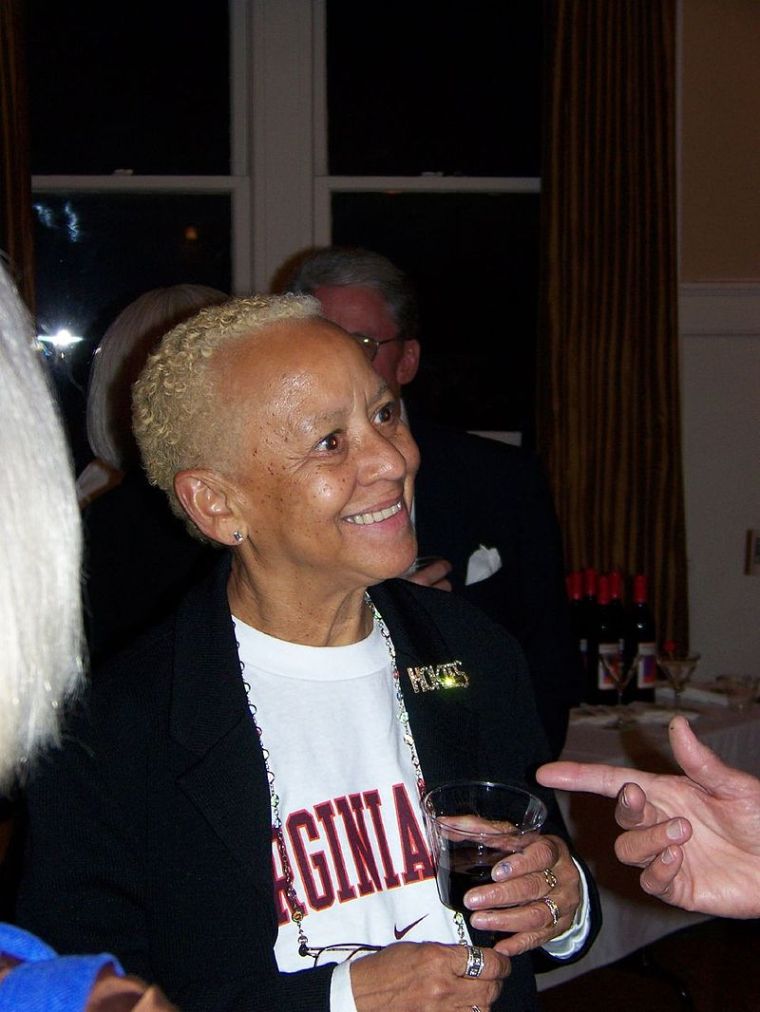
Nikki Giovanni (1943), American poet, writer, activist and educator

Everyone deserves Sanctuary a place to go where you are
safe
Art offers Sanctuary to everyone willing
to open their hearts as well as their lives”
excerpt for Art Sanctuary in Quilting the Black-Eyed Pea, poems and not quite poems

Nikki Giovanni is lauded as iconic, luminous, adventuresome and courageous.  She is all of these, but I think what I like most about her is that she is straight-forward, practical and compassionate. These characteristics are the underpinning that make her a rather extraordinary poet, a powerful combination of visceral and intellectual.

There is always something to do. There are hungry people to feed, naked people to clothe, sick people to comfort and make well. And while I don’t expect you to save the world I do think it’s not asking too much for you to love those with whom you sleep, share the happiness of those whom you call friend, engage those among you who are visionary and remove from your life those who offer you depression, despair and disrespect.”

Nikki Giovanni first came to note in the late ’60s and early ’70s as part of the Civil Rights, Black Arts and Black Power movements. The strength of her voice punctuated our poetic and political world and she has written, taught and advocated for uncommon good sense ever since. As with all of us, she has many roles in life including daughter, mother, friend and lung cancer survivor. It is clear in her work that she values family and community and supports and encourages these values in others.

Ms. Giovanni was born in Knoxville, Tennessee. She earned her undergraduate degree in history with honors at Fisk University and did her graduate work at the University of Pennsylvania and Columbia University. Her knowledge of history richly informs her perspectives in poetry, essay and talk. She taught at several universities including Virginia Tech and was at Virginia Tech for the shooting by Seung-Hui Cho in 2007 when he murdered thirty-seven people.  Cho was a student in her poetry class. She sensed something was amiss with him and asked the authorities to remove him from her class.  After the shooting, she spoke at the convocation.

We know we did nothing to deserve it. But neither does a child in Africa dying of AIDS. Neither do the invisible children walking the night awake to avoid being captured by a rogue army. Neither does the baby elephant watching his community being devastated for ivory. Neither does the Mexican child looking for fresh water….We are Virginia Tech….We will prevail.”

This video is the first of two in this post. If you are reading from an email subscription, you will have to link through to the site to view the videos.

Ms Giovanni’s early writing was a response to the assassinations of Martin Luther King, Jr., John and Robert Kennedy, and Medgar Evans.  Her first book (1968) Black Feeling, Black Talk/Black Judgement is considered by some to be the one of the most important books on the black-rights movement.  Younger people reading it will want to research the history of the era to put the book in context.

Ms. Giovanni has written some twenty-one books of poetry as well as autobiography and children’s books. She’s edited anthologies and collaborated on books with James Baldwin and Margaret Walker. She’s won countless awards for both her work and her activism. The following video is a reading of Quilting the Black-Eyed Pea (We’re Going to Mars).

I want to be clear about this. If you wrote from experience, you’d get maybe one book, maybe three poems. Writers write from empathy.”

portrait ~ Brett Weinstein under CC BY-SA 2.0

CELEBRATING AMERICAN SHE-POETS (16): Victoria C. Slotto, Jacaranda Rain …

Victoria C. Slotto, the poet as captured in (c) photo by David Slotto

Plain as a needle a poem may be, or opulent as the shell of the channeled whelk, or the ace of the lily, it matters not; it is a ceremony of words, a story, a prayer, an invitation, a flow o words that reaches out and, hopefully, without being real in the way that the least incident is real, is able to stir in the reader a real response.” San Dabs, Seven from Winter Hours by Mary Oliver

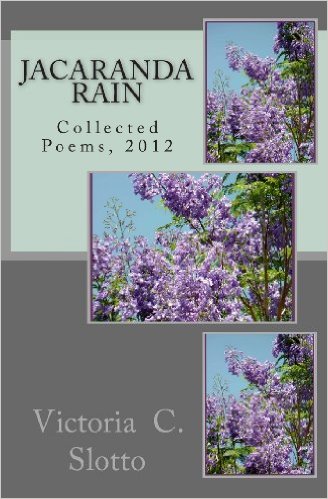
51+5zJY7zaL._SX326_BO1,204,203,200_

Thus begins Victoria C. Slotto’s 2012 poetry collection, Jacaranda Rain, which she dedicated to Oliver “my mentor unaware.”  Like Mary Oliver, nature is frequent inspiration for Victoria. The collection includes some fifty-five poems on nature, spirituality, death and dying, which are arranged rather charmingly in alpha order.

What haunts me,” said the dead man
to his wife whose ashes mingled with
his own, “are books I’ve never read –”
from About the Dead Man and Books

“What haunts me more,” the dead man said
for no one else to hear, “are books I never
wrote — ideas fanned to life by life …”
from More About the Dead Man and Books

Victoria certainly will have no such regrets. Since 2009 she’s been publishing her poetry on her blog  (Victoria C. Slotto, Author; Fiction, Poetry, Essays). Her original intention in starting the blog was to promote her first novel, Winter Is Pastwhich was ultimately published by Lucky Bat Books in 2011.

Victoria is however a lover of poetry and was drawn to write and published more and more poetry – Lovely! – becoming involved in poetry groups. (We met via Jingle’s poetry group for those of you who have been around as long as we have and remember that dear lady.)

Victoria eventually became involved with dVerse ~ Poets Pub, “a place for poets and writers to gather to celebrate poetry. We are many voices, but one song. Our goal is to celebrate; poets, verse & the difference it can make in the world. To discover poetry’s many facets and revel in its beauty, even when ugly at times.”  dVerse is a collaborative effort offering inspiration, encouragement and education. I highly recommend it, especially if you are just getting started online and want to make connections. Jacaranda Rain includes several poems that were part of an anthology published by dVerse (also recommended). Victoria was for a time a core-team member of The BeZine where she offered monthly prompts for poets and writers.

Victoria’s collection includes explanatory notes for some of the poems and these are engaging and not intrusive.

I dreamt
I flew among the stars
skirted between planets,
cracked open doors
to distant worlds
from Quantum Leaps in Jacaranda Rain

In all since 2009, Victoria has maintained a blog, been an inspiration to poets and a friend to many, written two novels (the second is The Sin of His Father) and a nonfiction book, Beating the Odds: Support for Persons with Early Stage Dementia. Victoria is a former registered nurse who worked primarily with the elderly. She writes from that experience and the more intimate experience of caring for her own mother. As her mother faced early stages of dementia, they worked together to devise practical steps to help her mom remain independent for as long as possible. Victoria offers memory prompts, health care considerations, ideas to help one find meaning in life, suggestions for preparing for the future and more in this very worthy book.

This slideshow requires JavaScript.

Though I must leave you
I’ll come to you again
a shower of purple petals
on dew covered sod –
from the poem Jacaranda Rain in the collection

Victoria now has a second blog, Be Still and Know That I Am God.

© poem excerpts, book covers/art, and portrait, Victoria C. Slotto


MAXINE HONG KINGSTON, “Joy and beauty and delight!” … I Love a Broad Margin to My Life

Maxine Hong Kingston (b. 1940), Chinese-American atuhor, educator and activist
Maxine Hong Kingston (b. 1940), Chinese-American author, story-teller, poet, educator and activist

“Keep this day. Save this moment;
Save each scrap of moment; write it down.
Save this moment. And this one. And this.”  

Randolph College announced last month that Maxine Hong Kingston would be the sixth recipient of the college’s Pearl S. Buck Award. The ceremony will be held on April 20.

Pearl Buck and Ms. Kingston share the distinction of shining a light on Chinese culture. For Pearl Buck it was the Chinese people in their homeland and for Maxine Hong Kingston it is Chinese-Americans. Both are known for their activism and for their memoirs and fictions, Pearl Buck more for the later than the former I think.

What these women also have in common is poetry. Pearl Buck’s slender collection, Words of Love (John Day, Co., 1974), was published posthumously. Ms. Kingston’s I Love a Broad Margin to My Life (Alfred A. Knopf, 2011) was the fruit of coming to terms with turning sixty-five.

As part of the two-week-long celebrations of my own birthday (61st) in 2011, the CitySon Philosopher took me to dinner one night at Cafe Barrone in Menlo Park, California. Afterward we went next door to Kepler’s Books – a favorite among family and friends, the local independent –  to hear Maxine Hong Kingston talk about what was then her new book. She is a “neighbor,” living only a few miles away in Stanford.

“Story gives form and pleasure to the chaos that’s life. By the end of the story, we have found understanding, meaning, revelation, resolution, reconciliations.” 

The book is a memoir in free verse, a long poem in effect like the old-country tradition of writing a poem on a scroll. Flowing.

“Am I pretty at 65?
What does old look like?”

Ms. Kingston immediately addressed the  issues of aging, both in her presentation and in the book itself. She talked about being superstitious and thinking that as long as she has things to write “I keep living…” She told of the origins of the title: Thoreau. It’s a line from Walden that, she says, also hangs framed over her desk.

She explained the Chinese custom of “writing poems back” and told of her dad who would write poems to her in the margins of her books. She was at that time translating these for publication, though that was never her dad’s intention. Or so I would infer. She encouraged us to write our own poems in the margins of her book.

Ms. Kingston stood in front of us, like a fragile little bird, reading excerpts from the book, delightful to hear in her voice. She is ten years older than me but we’ve lived through the same events and movements: civil rights, women’s rights, Vietnam, Iraq … and so on. She too is the child of immigrants. She sounds like a Buddhist, has the Buddhist sensibility: respect for life, for silence, for present moment.

When Ms. Kingston finished her presentation and Q & A, my son excused himself and kindly went to buy two copies for us. We stood in line with other guests, waiting for Ms. Kingston to sign our books. Every moment spent attending to writers of good conscience, talking about books and writing, is precious…even more this one, because I was with my son and the writer happened to be one with whom I share values, gender, and the context of time. She also is a mother with one child, a son.

Finally it was our turn: Ms. Kingston sat tiny and cheerful with pen in hand. She greeted us just as cordially as she had each reader throughout the long night. She wrote my name in bold sprawling black letters followed by “Joy and beauty and delight” and then signed her full name with “Hong” in hanzi (Chinese characters).

I wrote in my journal that night that “as long as we have cherished children, valued friends, conscientious authors and quality books, we have everything. Life is indeed joy and beauty and delight.”

As far as the book goes: The charm of I Love a Broad Margin to My Life is its gentle meandering. It made me think of the way books meandered before the modern preference for brevity and before computers and word processing and the ease technology brings to rewrites, cuts, and tight line-by-line editing … and perhaps needless to say, before life was so tightly packed with activity, rush and noise.

In her promising opening, Ms. Kingston is bemused in her self-awareness as she examines questions of aging, appearance, and vanity. As the book moves on, she blends nonfiction with fiction, a few references and viewpoints from characters that people her novels.

This long poetic memoir is a backward look at a time some might enjoy revisiting and others might want to learn about through the memory of one who was there. One of its strengths is the contemplation of life by a dedicated activist whose creative work helps the reader understand. I enjoyed the book, got value out of it; but I did feel rather like Ms. Kingston was putting on the unaccustomed robes of a poet and didn’t feel quite at home with this form.  Unlike other poetry books on my shelves, I suspect I’ll never pull it out for another read.

© 2016, essay and photograph of Ms. Kingston at Kepler’s Books on February 22, 2011, Jamie Dedes;  All rights reserved