Poets, Poetry, News, Reviews, Readings, Resources & Opportunities for Poets and Writers
Author: Jamie Dedes
Jamie Dedes is a Lebanese-American poet and free-lance writer. She is the founder and curator of The Poet by Day, info hub for poets and writers, and the founder of The Bardo Group, publishers of The BeZine, of which she was the founding editor and currently a co-manager editor with Michael Dickel. Ms. Dedes is the Poet Laureate of Womawords Press 2020 and U.S associate to that press as well. Her debut collection, "The Damask Garden," is due out fall 2020 from Blue Dolphin Press.
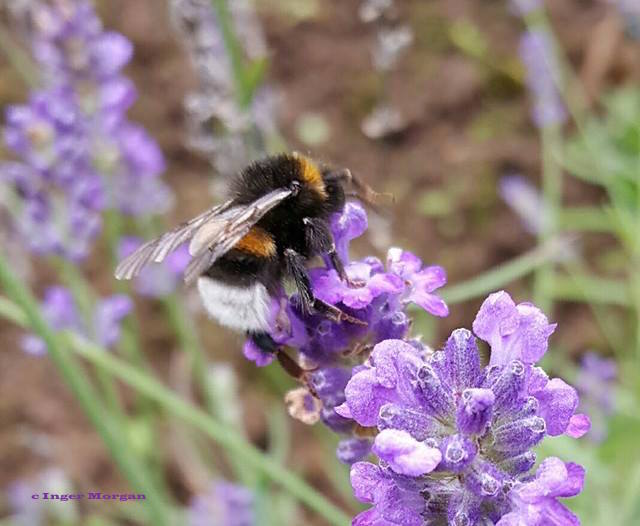
i planted seeds of lavender,
tiny things in the palm of my hand,
then the black soil and water,
patience . . . . and waiting
for the first signs of life,
the need for care and love
’til the splendor of blue,
the comforting fragrance,
a gift for the bumblebees and me
INGER MORGAN lives in Trollhättan,Sweden. She’s a retired nurse who says she’s always written “small pieces” but never shared anything until – much to my delight – she shared a poem with us on Facebook. Inger’s first published poem was about grief and guilt and it was featured in the November issue of The BeZine. It looks like Inger has birthed a new interest, if not a new career, at 74 years-of-age.
When Inger and I talked about the December issue – due out tomorrow – with the theme: The Healing Power of the Arts, Inger said frankly her healing comes from nature. Okay! Fair enough. I know that’s true because she takes wonderful photographs on her property and of the adjacent woods with its wild trees, tumbling brooks, gray stone and green mosses. Just from the photographs, I feel I almost know her place, the care of which is the inspiration for the splendor of blue.
So the question is: Where do YOU find healing? Nature. Poetry. Art. The ocean or the sky. Tell us about it in poem or prose. If you’d like to share what you’ve written, please leave it – or the link to it – in the comments sections below.
Many of us are concerned about the rhetoric, policies and appointees of the incoming administration and my church – Unitarian Universalists of San Mateo (UUSM) – is organizing a peaceful protest. We’re inviting people to line the El Camino Real (ECR) from San Francisco to San Jose with messages of love (respect), not hate, on Inauguration Day, January 20, Friday, from noon to 1 p.m. This form of PEACEFUL protest comes from the People Power tradition of the Philippines.
If you share our concerns, we invite you to look at the EVENT FLYER and to consider joining with us … but also to consider promoting it through your faith organization or other organizations and among your friends and family. In addition to sponsorship by UUSM, this event is also endorsed/sponsored by Suit Up! Action Network Mid-Peninsula/SF Bay Area, an offshot of Pantsuit Nation, and will likely be endorsed/sponsored by our local interfaith partnership.
Please mark your calendars and look for more information soon.
“We’ve made love private, contained it in family, when its audacity is in its potential to cross tribal lines.” Krista Trippet Leading in Difficult Times, Conversations Among the Clergy of San Mateo County, CA http://wp.me/pne74-dvy
Thank you for sharing your love of words. Comments will appear after moderation.
For good or ill, I seem always to have something to say. In retrospect I may find I didn’t say it well, it wasn’t worth saying, or I didn’t really know what I was talking about. Is it a gift or a curse? I don’t know. I just know that even in despair, I never have writer’s block. Having said that, I don’t blame or judge those who do. Especially right now. The world’s gone mad.
In reaction some of my friends are writing up a storm – almost literally. Others are so overwhelmed with emotion – fear, anger, hopelessness – that they can’t work. It wouldn’t matter if their jobs weren’t creative. They just can’t work. No romance about it. No calling it “writer’s block.” We should call it – in this case – what it really is: heartbreak.
Normally, I would say block comes from trying to write and edit at the same time. That doesn’t work. Or, I’d ask “Are you self-conscious? Are you afraid of being judged, of revealing yourself, of just not being good enough?” Write about those feelings then. Write just for yourself. Dabbler or journaler, amateur or professional, one of the best ways to get to the root of a problem is to put it down on paper, to explore the feelings, fears and trepidation.
Or, I’d wonder: Is it a matter of perfectionism? That can be a steel wall.
“You know, the whole thing about perfectionism. The perfectionism is very dangerous. Because of course if your fidelity to perfectionism is too high, you never do anything. Because doing anything results in…it’s actually kind of tragic because you sacrifice how gorgeous and perfect it is in your head for what it really is. And there were a couple of years where I really struggled with that.” David Foster Wallace
These days though, I’m feeling sad too … and insecure … and this may be one of those times when I should still my pen and hold my tongue, but I find I have to ask myself what can we do when we feel that our hearts are breaking? See a therapist? That might not be a bad idea, especially if the feeling goes on and on and we can’t pull ourselves out from under. Or, we could just sit with the sadness.
Periods of heartbreak and disappointment often turn out to be a sort of liminal time. . . a transitional stage . . . Most of us have experienced this in our creative lives: when events are overwhelming and our inner lives seem the most sterile but turn out to be silently rich in process and promise and demand of us patience as our becoming works itself out. During such periods, when our inner lives are dark, maybe we need to simply live in the darkness, not try to avoid it or suppress it.
For creative people – for everyone perhaps – these times can be valuable; in the sense of our becoming, a gestational period, a personal advent waiting for the birth of a truer self. Difficult as these times are, as creatives, as citizens, perhaps they are simply times to pause until the pieces come together and our intuitive sight clears. Don’t be surprised if you wake up one day to find your creative spirit is a phoenix rising from the ashes of despair, no longer haunted and ready to take on the insanity. History, personal and shared, shows us that – however trite it sounds – out of the darkness comes light. We may have a long haul ahead of us. It might not be tomorrow or the day after, but the light will come. Hold fast. We can’t afford to believe otherwise.
Editorial Note: In discussion with other members of the congregation to which I belong, I learned that folks would like our minister’s sermons posted to the new church website, which I am helping to build and which may take a couple of months. (Learning curve!) I’m posting Ben’s sermons here for my fellow congregants. For other readers who might be interested or curious, I’ve put Ben’s bio and a short explanation of Unitarian Universalism below the sermon. J.D.
Unitarian Universalism: A Theodicy of Love*, by the Rev. Ben Meyers, Unitarian Universalists of San Mateo, Sermon 12/11/16
A THEODICY OF LOVE
by
Rev. Benjamin Walker Meyers
“A college student once told me how he asked questions about God in his childhood church and the leaders did not know how to answer. He decided that God must not be real.
Rev. Ben Meyers of San Mateo, California
A woman told me that all she knew about God was the passages that her mother would quote from Leviticus and Romans—passages meant to shame her for being a lesbian.
My neighbors’ parents survived years in a concentration camp during the Holocaust. He could never fully answer: How could there be a God who would allow this to happen to my family and millions of others?
I feel confident that these or similar wounds are real for many of us in this room and I would never encourage someone to ignore such wounds.” (SM*)”
“Western theologians have a concept for how we human beings make sense of the evil which we experience and which exists in the world. The word is THEODICY. Theodicy asks and tries to answer eternal questions as: “Why does evil exist and what is its origin? How can a good Ultimate/God/Source allow for needless and undeserved suffering and pain? How shall WE face the real complexities of life, which include destructive emotions and impulses, wrong and harmful choices, and the inevitable reality of sickness and death? The rabbi Harold Kushner famously addressed this in the question that is also the title of his book: ‘Why Bad Things Happen To Good People.’
“Consider this famous and challenging koan from the Zen Buddhist tradition:
Once, when the great teacher Dongshan was washing his bowls with his pupils by the river, two large crows contended over a squirming frog for their meal. Another monk nearby asked, rhetorically, “Why does it come to this?” Dongshan said, “It is only for YOUR benefit, Honored One.”
“‘Dongshan’s answer is shocking. Pain and suffering is “for your benefit, Honored One.’ The ancient Chinese is vague enough that his response is often translated to mean: ‘It is because of you, Honored One!’
“Wait…that doesn’t seem fair! How could it be because of ME when it’s been going on for eons and ages before I even got here?
“Of course, that “Honored One” doesn’t refer just to the individuated monk, although it includes him, and you, and me, and all of us.
“It refers to the Honored ONENESS of all who partake in the gift of life. It refers to the completeness of being…you know…the Great Big Idea/Thing/Verb/Word that has been going on for eons. It pertains to the notion of God and this idea of evil, what we think about it…and how we respond.” (CB*)
Before I go further, let me just make it clear, that, whether we have a direct understanding of God or not, we all have the right to a religious life, to developing our spiritual growth. That is why I am a Unitarian Universalist minister, because I know that religious life is bigger than any one scripture, any one culture and certainly bigger than any one word.
“So, consider this: Almost all of us, even if we DON’T believe in G*D, have a mental image of what that word means. It might be a mysterious figure in heaven keeping track of good and bad behavior (but, I’m wagering, probably not…)
It might be an image from scripture, or art: the caring shepherd, or the voice in a whirlwind. It might be a feeling, based upon a direct experience: the lifting of burdens, the gentle touch of love, or the pricking of conscience.
Our word/picture/idea might be quite abstract: Great Spirit, Higher Power, Holy Source of All Being, Nature, Science, Love.
We may believe our image of God exists, and so we are theists, or doesn’t exist, and so we are atheists, OR…is not possible to know, and so we are agnostics…but, we ALL have a picture/idea/words for God in our minds.
For some, the description of God is beyond words. For instance, Orthodox Jews, do not use the word G-o-d. When speaking aloud, they use a description like, Adonai, ‘the holy one,’ and when writing, they write G _ d. Or, YHWH (yod-hay-vod-hay), which is sometimes referred to as Yah-Weh, although, written without vowels, it remains a word that signifies more than a mere word can signify—and that we can never completely understand the nature of…it is, in essence, a sign of humility before the great “I AM.”
Then, why use the word “God” at all, (you might be asking) if it is such a slippery thing as to need warnings and explanations?
Well…I believe it is because without words, we can’t even think, much less communicate. An example of this phenomenon is found in an isolated culture of hunter-gathers in New Zealand that uses the same word for the colors BLUE and GREEN. Because of this, they have great difficulty when presented with the task of sorting blue and green objects by color.
They are born with eyes like ours, capable of seeing blue and green as different colors. But without words for the different colors, they don’t really “see” them. It is the same for us. As difficult as this word G-_-D is, if we don’t use it (or an understandable substitute), we’ll not be able to think about a part of our lives that most people intuit as existing.
If the word God is spoiled beyond redemption for us, we can substitute other words, such as Goddess, Higher Power, Spirit of Life, Great Spirit, the Divine, Holy One, Whom-It-May-Concern, or ‘whatever’, even. Some people use the word Goddess in conversation, as in: “We’ll have to leave that up to the Goddess.” This is not simply a matter of cherishing the feminine connotations of the word, which are often lacking in our “god” words; it is also a way of alerting listeners to the possibility that theological creativity is allowed in our conversations.
It is so very important to remember that our images of God, while useful and necessary, are at best only partial truths and will lead us astray and divided if taken too literally or set too concretely in our minds.
And again, the same is true if the word/concept/image is too vague.
We must each find the definitions, images, and poetry that make sense to us if we are to participate in the critical issues of our times. So we must remain open to the many ways G*D is thought about by many religious people in the world…and they are many:
Including pagan ideas of divinity, in which “God” is the sum total of everything, material and immaterial, in our universe, so EVERYTHING is holy, even things we might think are not good, such as the lightning that strikes our favorite tree…
Or, the notion of a Higher Power used in 12-step programs such as Alcoholics Anonymous, in an attempt to bring spirituality into a meaningful place in people’s recoveries, without entangling people in theological arguments…
Or, the God present in Liberation Theology, which desires that each person have the maximum possible opportunity for a fully human life, beyond the oppression of poverty and tyranny. This is a God who sides with the poor and oppressed wherever they are found and nudges people toward acting for justice and making peace and equity real in the lives of all.
Or, the Humanist belief that the highest and the best we can know in this world is HUMANITY, with our grand ideals, marvelous minds, and great creative potential. Humanists say that divinity is within the human being and nowhere else. Most humanists don’t really like to use the word GOD, but they still have a theology, which is a theory or a belief about the highest and best, of which we are a part. (CR*)
And, then there is a movement in the liberal religious circles of Process Theology, which considers how God is a force that is ever-present, that evolves, grows, mourns and even suffers losses. It teaches that God can honor all that we know to be true…about modern science, about protecting the earth, and the right to equality for all people—no matter their orientation, culture, beliefs or practices. It is like the Unfinished God: not a force that controls the world like a puppet on a string, but rather a God who is and has the power to call us toward Love, in partnership with God—even as part of God. It is the notion that God only has our hands to do good in the world.
That is it. Without our partnership, without our agreement, God is powerless. If we do not respond to the call and walk in the ways of Love, God is waiting and calling and waiting and calling.
These are just some of the images and understandings of divinity which can be found within Unitarian Universalism. In our poetry and songs and in what we consider as scripture: Each representing a wide theology beyond mere acceptance. It helps with our desire to learn how we can all get along, both within and beyond these walls.
How can we talk to each other when the meanings behind our words seem so different? We do that by being always mindfully challenged and aware that our images and understandings are at best approximations of an infinite truth that simply cannot be captured by finite beings.
When we remember that fact, and strive to live and ENGAGE in it, beyond comfortable complacency, apathy, or worse, a disrespect of other’s beliefs, OUR faith and our regard for persons with visions and words that differ from ours is NOT a grudging tolerance, but an open-hearted curiosity about yet another way of understanding the God, the universe, and everything.
I believe this is what the Reverend Dr. Martin Luther King, Jr. spoke of when he said: “Itisnotwhere we standinmomentsofcomfortandconvenience, butwhere we standattimesofchallengeandcontroversy that marks the ultimate measure of a person and a people.”
These words represent and inspire me to take risks for the sake of promoting and extending this partnership with ‘all Gods who are love.’
In closing you may be wondering, ‘What do I mean by God?’OK, That’s fair. For me, God is Love—all acts of Love are the stuff of God and all acts of bigotry and violence have nothing to do with God. I believe in striving to live in service to all Gods who are love—and this is a powerful God for it is the power of many lives, working together to bring more love and life and justice into the world. It empowers to me to believe in a power at work in the universe. It is the power of our capacity to return to JOY, once our sorrow and grief have been honored, in times of loss;It is the power of our audacity to live with hope, again and again, even within the legacy of despair and hopelessness that has been with us always in the shape of injustice and bondage of all kinds.
My God is the power of our courage to stand in resistance to hate. For my friends, in the days in which we live, Resistance is what love looks like in the presence of hate.This power, I believe, works through human hands, but it was not made by human hands—we are a part of the universe—we are not its most important part, but an important part all the same. This power is creative, sustaining, and transforming and we can trust this power with our lives. It will sustain us whenever we take a stand on the side of love;
whenever we take a stand for peace and justice; whenever we take a risk for its sake. Trust in that power. We are, together, held by this power. And it will not let us go, as long as we hold on to one another, O Honored Ones. Amen. —
*Acknowledgements to the Rev. Susan .Maginn, the Rev. Chris Bell and the Rev. Christine Robinson for inspiration and some content, where noted
REV. BEN MEYERS was born into a family with a Catholic father and a Baptist mother. He grew up in the Disciples of Christ Church, but hung out with friends from other progressive religions. During his childhood and youth, he was engaged in exploring various world religions and active in social movements during the 1980’s. He later discovered he was a UU while attending the UU Fellowship in Chico. Rev. Ben was ordained in 1995. He has a: BMusic from California State Univ., Sacramento, 1990 and a MDiv, Starr King School for the Ministry, 1994, He is the devoted and much appreciated minister of UUSM, where he provides inspiration, spiritual guidance and also leadership in grassroots social justice initiatives and interfaith collaborations. Rev. Ben is a gifted singer and musician.
UNITARIAN UNIVERSALISM (UU) is a noncreedal liberal religion characterized by a “free and responsible search for truth and meaning.” UUs are unified by their shared search for spiritual growth. The roots of UU are in liberal Christianity, specifically Unitarianism and Universalism, traditions that express a deep regard for intellectual freedom and inclusive love (respect) for the diverse ways in which people seek to understand life and spirit. UU Members seek inspiration and derive insight from all major world religions. The beliefs of individual Unitarian Universalists range widely, including atheism, agnosticism, pantheism, deism, Judaism, Islam, Christianity (including Eastern and Roman Catholicism), neopaganism, Hinduism, Buddhism, Daoism, Humanism, and many more.
 i planted seeds of lavender,







 Jamie Dedes' THE POET BY DAY Webzine