Page 378 of 433

A Potpourri for Poets and Writers

13444741_ae809af345_o

Recommended Reading

Ta-Nehisi Coast won the National Book Award for nonfiction for Between the World and Me, an exploration of his experience of being a black man in America.  Well done.  Must read.

51ViHdI1ZtL._SX327_BO1,204,203,200_

“The classroom was a jail of other people’s interests. The library was open, unending, free.”

“You must resist the common urge toward the comforting narrative of divine law, toward fairy tales that imply some irrepressible justice. The enslaved were not bricks in your road, and their lives were not chapters in your redemptive history. They were people turned to fuel for the American machine. Enslavement was not destined to end, and it is wrong to claim our present circumstance—no matter how improved—as the redemption for the lives of people who never asked for the posthumous, untouchable glory of dying for their children. Our triumphs can never compensate for this.”

Poetry Reading

FullSizeRender-2On December 5, at 5:30 p.m. Michael Rothenberg is reading along with San Luis Obispo Poet Laureate, Dian Sousa at Laurel Bookstore, 1423 Broadway, Oakland, CA 94612.  Details HERE.

Michael is an American poet, songwriter, editor and environmentalist. In 1989 Michael started a fine print literary press, Big Bridge, with artist Nancy Davis. Big Bridge has published work by Jim Harrison, Joanne Kryger, Allen Ginsberg, Philip Whalen among other.  Michael also edits Big Bridge, a poetry webzine and Jack magazine.He is the co-founder (with Terri Carrion) of 100,000 Poets for Change (100TPC).  Bay Area residents will be familiar with Shelldance Orchid Gardens (Pacifica), an orchid and bromeliad nursery, co-owned by Michael.

Transatlantic Poetry

TRANSATLANTIC Poetry is global poetry movement bringing some of the most exciting poets from the US, UK, Europe and beyond together for live online readings and conversations. With the help of notable partners, we are transforming the way people experience poetry in the twenty-first century.”

Transatlantic Poetry was founded by an American poet living in England, Robert Peake, the “Transatlantic Poet.”  Peake’s most recent collection of poetry is The Knowledge (Nine Arches Press, 2015).  He writes about poetry and culture. His essays may be found on Huffington Post HERE. Robert Peake also hosts Poetry Writing Prompts.

A Poem a Day

The Academy of American Poets publishes a poem a day online.  You might want to take your morning break with them.

Poem-a-Day is the original and only daily digital poetry series featuring over 200 new, previously unpublished poems by today’s talented poets each year. On weekdays, poems are accompanied by exclusive commentary by the poets. The series highlights classic poems on weekends. Launched in 2006, Poem-a-Day is now distributed via email, web, and social media to 350,000+ readers free of charge….”

The BeZine

398px-Heroesjourney.svg

Our fourteenth issue will publish on December 15.  Submissions should be sent to bardogroup@gmail.com for consideration. Guidelines are HERE. Deadline is December 10.

The theme for the December 2015 issue is The Hero’s Journey.

100TPC Group Discussion Page

The BeZine is hosting an ongoing discussion page on Facebook where we share information related to peace, sustainability and social justice.  Our focus for 2016 is environment/environmental justice.  If you would like to join the Group and you are on Facebook, leave me a message in comments.

From Second Light Network of Women Poets (SLN)

ARTEMISpoetry submission deadline for Issue 16: FEBRUARY 29th.

If you live in the area (Worcestershire, England) or expect to be there, you might be interested in

  • AUGUST 2016: Mon 1st to Fri 5th, Holland House Residential, Worcestershire; and/or
  • JULY/AUGUST 2017: Mon 31st July to Fri 4th August, Holland House Residential, Worcestershire

Copyright (United States)

Creative Commons

Thanks to Corina Ravenscraft (Dragon’s Dreams) for these:

Copyright Laws + Licensing Digital Content Resources

U.S. Copyright Fair Use Index

Resources for Photographs &

llustrations

IMG_2254

First off, I’ve found two sources of public domain* photos, which might serve you well as either inspiration or as illustrations to go with your poem or story.  The first is Public Domain Review.

“Founded in 2011, The Public Domain Review is an online journal and not-for-profit project dedicated to the exploration and sharing of curious and compelling works from the history of literature, art and ideas. In particular, the focus is on showcasing digital copies of public domain works – all drawn from a wide range of various online archives – with a mission to facilitate the appreciation, use and growth of a digital cultural commons which is open for everyone. With a focus on the surprising, the strange, and the beautiful, the site provides an ever-growing cabinet of curiosities for the digital age, a kind of hyperlinked Wunderkammer – an archive of materials which truly celebrates the breadth and variety of our shared cultural commons and the minds that have made it.”

The other is Emilian Robert Vicol Public Domain Photos.

It’s always nice to credit the source even when it’s public domain.

These both come from Flickr, where there are lots of other photos available.  Some are “all rights reserved” but some are available under a Creative Commons license and you should comply with the rules and link the photo back to its source.

Two sites I’ve used for years are: PublicDomainPictures.net and morgueFile. Directions for use are on the sites. You don’t have to sign in to use these and they offer quick and easy downloads.

Wikipedia is another resource.  It’s not enough to just put Wikipedia as the source. You’ll note if you click on the photographs in Wikipedia, the name of the “author” is on the left under the photograph and on the right you’ll see the licensing.  It’s usually either public domain or it’s one of the Creative Commons licenses.

public domain: belonging to the public and not subject to copyright

©Photograph by Chilli Head under CC A-2.0 Generic license and public domain illustration courtesy of Slashme via Wikipedia. Michael Rothenberg’s photograph and the rose illustration are mine.

What have we done that people can pick up weapons and kill?

Dan and I as kids and probably the last time he was shorter than I. He stands 6'5' and I stand 5'2".
Dan and me as kids and probably the last time he was shorter than I am. He stands 6’5″ and I am 5’2″.

With all its faults – and there are many – Facebook can be a blessing. I haven’t seen my cousin Dan in almost forty years. I lost track of him, but was much delighted to find him again on Facebook last March. 

Dan and I were raised in the United States, but our family was from Lebanon. Our mothers were sisters. Our religious roots are Melchite (our grandfather’s side) and Maronite (our grandmother’s side).

My mother, Zabaida, used to tell me that in Lebanon first cousins were like brothers and sisters. Among other things this was one way she tried to understand what people meant when they talked or wrote about Jesus having brothers. I understood it as my relationship to my cousins, especially cousins Daniel and Christopher, who were brothers (Christopher died prematurely) and my most beloved relatives.  Though we haven’t seen one another in forever and we’ve walked different paths in life,  I suspect our basic values remain the same: peace, love (respect) for others and for life, and appreciation of life’s gifts. Dan has worked in many places around the world, including Algeria and Dubai. Currently he teaches Theology in the Philippines. This essay is Dan’s.

*****

What Have We Done That People Can Pick Up Weapons and Kill?

by

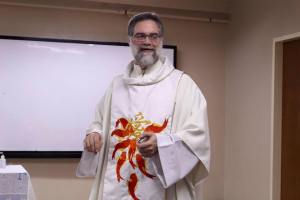
Fr. Daniel S. Sormani, C.S. Sp.

DANIEL S. SORMANI C.S. Sp.

It was one of those things you think but don’t want to say. In the horror of the carnage in Paris and the world’s reaction, it struck me how very little had been said about the terrorist attack in Beirut the day before…or the attack on a funeral in Baghdad…or so much of the other violence that shakes the world. And I felt like I couldn’t say it for fear of looking like I was somehow diminishing the horror or pain of Paris, afraid it could been seen as a lack of respect and understanding. But I wondered. And now so many people are indeed raising such questions, and others are also reacting to such questions, calling them an appalling lack of sympathy…and things have at times spiraled down to a repulsive debate of numbers and geography, rather than of lives and humanity.

When I was young, it was the last hurrah of Lebanon’s golden era when people still referred to it as the “Switzerland of the East” and the wealthy went there to bask on the beach in the morning and ski on its snow-capped mountains in the afternoon. It was the land of poets and artists, and welcomed refugees and visitors equally.

I remember all the Lebanese women with my mother at fundraisers for the Palestinian refugees. We were all kinds of Christians, Muslims, Druze and even a lone family of Lebanese-Jews who ran a shop in our neighborhood. We were just “us”, the Lebanese diaspora, the children of the Phoenicians. And if you were Syrian or Egyptian, that didn’t matter, then we simply enlarged our self-definition to being Middle Easterners. And if you were anything else, then we were “the melting pot” and loved to learn from you.

But so much interference in the internal workings of the country, so much pushing and shoving, dangling of carrots by different powers and religious groups, and finally civil war exploded in Lebanon. What we had known suddenly disappeared. There were a myriad of political parties I couldn’t keep up with, weekly fundraisers for dozens of necessary causes, a flood of refugees, some legal, some not. It should have brought us together, made us one in the struggle for peace and justice. But it didn’t.

I remember vividly the look of joy on the face of complete strangers if they heard my family speak a bit of Arabic. There would be warm introductions and everyone wanted to know everyone. Suddenly it was different. I would say something in Arabic, and the other person would immediately ask “Muslim?” I remember once in my old neighborhood I went into an Arabic music store and was taken by the album playing. Great music, but the dialect threw me a bit. I cheerfully greeted the young man behind the counter with a wish for a morning filled with goodness. He gave me an annoyed look and pointed to the veiled young woman. When he walked away the woman leaned over and whispered in Arabic, “Don’t mind my brother. It’s clear from the way you greeted him that you’re not Muslim.”

I remember in Algeria when I used the traditional Muslim greeting of peace in the market place and the stall-keeper rudely told me I had no right to say such a thing because he knew I wasn’t Muslim. To my delight, an elderly gentleman in traditional dress got angry and shouted at him, “And what should he do, wish you war and trouble instead?” He went on to greet me with great poetry and many warm blessings. Touched, I kissed him the way one kisses his favorite uncle and a few of the women, all wrapped in the white haiks of western Algeria, applauded and blessed God. This, I thought, is what family is, this is how we will conquer the darkness.

We have become our own worst enemy. Whenever we separate the world into “them” and “us”, whenever we accept blind generalizations and cease to see a unique individual before us, whenever we forget we are all victims of carefully orchestrated deceit and deception for wealth and power, the force of darkness wins. Bullets will never win this struggle, only the heart and mind will.I know political scientists and analysts can tear my thoughts to shreds. I do not claim an intellectual understanding…I am only sharing a broken heart that grieves.

A young Melchite priest once told me a story from his village in Lebanon during the war. There was intense shelling and sniper fire for almost three days. After it stopped, people went out to gather up the dead. An old man went to the church and asked the priest to offer two masses. The priest took his pen and book and asked the man to continue. The first mass, he said, was for his son whom they found shot to death in the orchard by their house. And the second mass was for the person who shot him. Startled, the young priest looked at the old man with amazement. The old man explained the obvious saying “What have we done that people can pick up weapons and kill strangers? What have we done that some poor fellow can kill my son without feeling it? We must pray for him, and ask God’s forgiveness.” When I remember that story, after all these years, I still cry.

© 2015, essay and family photographs, Daniel S. Sormani C.S. Sp., All rights reserved

This slideshow requires JavaScript.

No kidding: The Adventure of a Lifetime, “Book Club” (the movie)

60627688

Sometimes joy is as simple as finding a film that doesn’t involve violence and murder. In the midst of a world that is suffering pain and loss in every nook and cranny, I found a wonderful documentary film, BOOK CLUB: The Adventure of a Lifetime.  It’s about a group of women living in the Washington, D.C. area in 1947. They formed a book club that was still active as of 2009, the year the film was released, making the club sixty-two years old. That’s longer than most marriages last, longer than some people live.

Watching this charming film is like opening a time-capsule. There are early references to WWI and the Great Depression. There is the club’s history through the pre-war years, WWII, the post-war ’50s, Kennedy’s assassination and the ’60s, and on it goes into the last decade.

Book Club travels from the weighty tomes the women read initially to “improve our minds” when their lives were focused largely on homemaking and child-rearing and comes to rest on lighter fare,  literary and popular fiction and sometimes nonfiction.

The movie benefits from the strong underpinning of insight born of long life and astute observation.

“No story is the same to us after a lapse of time; or rather we who read it are no longer the same interpreters.”  George Elliot

“I’ll go to the library and say, ‘Yeah! That was a good book,’ and I’ll pick it up and read it again, like Wallace Stegner’s ‘Angle of Repose.’ Things like that when you read a second time with a few more years inside you, you have an altogether different appreciation or understanding of what the author is saying.” 

We walk with the club members through their lives as single women, to marriage and children, to grandchildren and loss and into the wisdom years. We move through good times and heartening memories and into and out of the kinds of heart-break that are universal.

“Life shrinks or expands in proportion to one’s courage.” Anaïs Nin

The life-long friendships forged by the book club create a through-line for the film. In life they provided a stability and depth of support that continued to strengthen the women. The only ones no longer attending meetings were those who have passed away.

“Nobody wants to let [the book club] die.” 

“I don’t want to stop it because some of the members aren’t too well. We’d still like to meet when we can.  We may not be able to follow a schedule but I hope we’ll be able to meet when we can.”

If you’re in the U.S. you can watch Book Club on Hulu.  You don’t have to subscribe.  I don’t. I was surprised to find something so worthy among Hulu’s often salacious and sensational documentary offerings.  You can buy the DVD from Amazon or rent it for streaming.  There’s a trailer on Amazon. I don’t do Cable but it might very well be available on-demand there.

“When we came together in that room for a book club meeting, it was ‘well, here we are again.'”

The world needs more book clubs. They are better than wars and conflict. Be the peace and the joy.

Love, Jamie

© 2015, review, Jamie Dedes, All rights reserved