to stay or leave . . .
the tension hurts our hearts as she,
frenzied and naked, prowls the dense night,
shifting from palpable dark to a fragile light,
driving to and fro along State Route 84, she
smothers terror with a diet of lattes and sweets
she’s on the run, carrying talismans in a bag,
small figurines of angels, Quan Yin, Buddha . . . to stay or leave … as if the choice was hers –
her posture is bravado; ‘bite me,’ she says – ‘i’m not afraid to die,’ pain-wracked and dizzy,
her bones under siege; grasping, she’s consumed –
imagines safe harbor in Home Shopping Network ……………THINGS, anyTHING!
clutching at life in the inexorable face of death
The recommended read for this week isElizabeth Bishop: A Miracle for Breakfastby Pulitzer Prize winning Megan Marshall who studied with Bishop at Harvard. This biography is richly spun, energetic, engaging and even inspirational despite the breathtaking depth of Bishop’s losses, her sense of marginalization and her head-long push into alcoholism. Indeed, some of the inspiration comes because with all her loses, Bishop managed to hold poetry tight. Her poems were for her a charm “against the loneliness they often expressed.” The book covers Bishop’s relationships with other poets and her romantic interests, the last was for me the singular wearisome downside, much overrided though by the book’s pleasures and values. It is laced with Marshall’s own stories and together the lives of these two bare witness to the power of words to give shape, sense and meaning to life. We come away with a strong sense of Elizabeth Bishop, one of America’s most extraordinary poets. A page-turner. A must read or everyone who loves and writes poetry.
By shopping at Amazon through The Word Play Shopandusing the book links embedded in posts, you help to support the maintenance of this site. Thank you! (Some book links will just lead to info about the book or poet/author and not to Amazon.)
The WordPlay Shop offers books and other tools especially selected for poets and writers.
who knew …
Time was fading like a whistle on the wind,
that you wouldn’t have wealth or forever.
Who knew you had to capture short-lived youth,
relish it like the salt in a rich savory stew, dance
to the music of that age, dress in its pastels.
and who knew …
That all those years you worked at survival,
life would slip by, that holding-on was like
trying to grasp an ocean in your hands.
Suddenly, the moment had passed when you
could layer the joys of life’s spring in the basket
of your heart; now like old photo albums
you pull them out on occasion, unpacking
aspirations built on the fault lines of time.
how could you have known, my friend
That while you were busy with survival
the blue planet spun; in its ceaseless whorl,
the years passed and life changed, but now
you discover that you’ve changed too
and change comes baring its own gifts.
“Out of suffering have emerged the strongest souls; the most massive characters are seared with scars.” Khalil Gibran
The recommended read for this week is Elizabeth Bishop: A Miracle for Breakfastby Pulitzer Prize winning Megan Marshall who studied with Bishop at Harvard. This biography is richly spun, energetic, engaging and even inspirational despite the breathtaking depth of Bishop’s losses, her sense of marginalization and her head-long push into alcoholism. Indeed, some of the inspiration comes because with all her loses, Bishop managed to hold poetry tight. Her poems were for her a charm “against the loneliness they often expressed.” The book covers Bishop’s relationships with other poets and her romantic interests, the last was for me the singular wearisome downside, much overrided though by the book’s pleasures and values. It is laced with Marshall’s own stories and together the lives of these two bare witness to the power of words to give shape, sense and meaning to life. We come away with a strong sense of Elizabeth Bishop, one of America’s most extraordinary poets. A page-turner. A must read or everyone who loves and writes poetry.
By shopping at Amazon through The Word Play Shopandusing the book links embedded in posts, you help to support the maintenance of this site. Thank you! (Some book links will just lead to info about the book or poet/author and not to Amazon.)
The WordPlay Shop offers books and other tools especially selected for poets and writers.
In the broad sleepy range of memory
I found us on that first day, awakening
in the garden where history understands
us at our beginning and colored his
name weakness and mine infamy.
It made him the scabbard for the
sword of division and formed my flesh
into a chalice for new life and hope.
It wasn’t knowledge but knowing we
sought and still find on the tree of life
as we pass through the eons, melting
the moments into nameless gardens and
the freedoms that come without words.
– Jamie Dedes
WEDNESDAY WRITING PROMPT
What do you think? Is it knowledge or knowing that we seek in Life or some combination of the two? Share your thoughts in poetry or prose. If you feel comfortable, post your poem or the link to it in the comments below so that we might all enjoy it.
The recommended read for this week is Ted Kooser’s The Poetry Home Repair Manual: Practical Advice for Beginning Poets. There’s so much I like about this manual. For one thing, Ted assumes that if you are a heavy-duty reader, you already know quite a bit. After all, one of the best ways to learn to write is to read. He operates on the moral principle that if you have a gift then you have the obligation to offer something by way of giving back. He says, “I hope I won’t exhaust your patience” and he doesn’t. He assumes that our goal is to reach others and to move them, so there is a great deal of emphasis on the relationship between the poet and her reader. He discusses our job as poet – not money, not fame – but “to serve the poems we write.” This perspective makes reading and working with Ted Kooser’s The Poetry Home Repair Manuala refreshing guide to the poetic terrain for both budding and experienced writers interested in creating work that is fulfilling and truly artistic.
By shopping at Amazon through The Word Play Shopandusing the book links embedded in posts, you help to support the maintenance of this site. Thank you! (Some book links will just lead to info about the book or poet/author and not to Amazon.)
The WordPlay Shop offers books and other tools especially selected for poets and writers.
Gary Bowers (One With Clay) is one of our triple-threat poets: poetry, art and humor. Words like “quick-witted” and “pithy” come to mind. He is adapt at combing his talents and this is a post he created, which I will cherish. It’s always nice to be acknowledged and Gary is particularly kind to me. Thank you, Gary! This is sweet and clever. There’s a lot more of Gary’s poetry, art and unique style to be enjoyed on Gary’s blog,where he often acknowledges other creatives. Recommended. J.D.
Jamie Dedes is alive, though she was given but two years to live in a prognosis delivered before the end of the last century. She credits her son and “an extraordinary medical team” for her continued existence. Though I don’t know her well–I don’t even know how many syllables are in her last name, much less how to pronounce it–I would venture to add that Moxie also has something to it.
For she has Moxie in abundance. She cares enough about poetry and its practitioners to have created and maintained an outstanding resource-blog called THE POET BY DAY, which connects poets via showcased poet exemplars, essays, links to items of interest to poets, her own poems, and on Wednesdays, those springboarding challenges known as prompts, which are invitations to write about a specific thing, or on a certain theme, or some other limiting, focusing factor.
And it was a week ago Wednesday that I responded to one such prompt. This one:
Write a poem, a fiction or a creative nonfiction piece telling us how you envision a feminine God or about the feminine side of God. What might S/he be like? Does/would such a view change the way you feel about yourself and the world? Would it change the world? How? You don’t need to believe in God or in a feminine aspect of God. This is an exercise in imagination not faith. Have fun with the exercise and if you feel comfortable, share the piece or the link to the piece below so that we might all enjoy.
For some reason this prompt struck a chord and got me going. I don’t know if there is a Supreme Being. I have certain feelings but I don’t trust them, being a rationalizer and wishful-thinker. A much more intelligent man than I am, Stephen Hawking, envisions a cosmology that, in the words of Carl Sagan in his introduction to Hawking’s A Brief History of Time, gives “nothing for a Creator to do.” In other words, Hawking’s universe has no need for a Creator.
But if there IS a Supreme Being, it makes sense to me, since the Supreme Being brought us all to be, that since that Being birthed us all, that She be a mother. And so I took a weird word from a conspiracy theory about our 44th President, Barack Obama, for a title, and was off to the races imagining God as Mom:
*****
birther
o god
thou residest betwixt r and t
god s be thy name
birther of us all
mixmistress of galaxies
crecher of clusters
ovulatrix of ylem
thy mother’s care is in the dew
thy admonishment is in the don’t
and when we want to play in the woods of reckless fun
thou respondest “we’ll see”
which almost always means “fat chance”
thy human smartalecks speak of heat death
it is merely a pause
in thy menopause
and soon thou’lt bake us cosmic cookies again
thanks for Ever
y
Thing,
maman
*****
Sure was fun to write, and oddly, bouncily, spiritually uplifting. Things just seemed to naturally occur: the Heat Death of the Universe resonates with the “hot flash” of menopause–hey how bout that, menoPAUSE–perhaps prelusive of the Big Crunch and the next Bang–and double up on “baking us cosmic cookies” with us being some of the cosmic cookies She bakes–and Everything with the y, possibly the Spanish “and,” joining Ever and Thing–and the French word for Mama, maman, slightly hinting at both “amen” and “ma MAN.” Wrote it first, realized it later. Could it be that She helped? Fun to think so.
I posted “birther” in the Comments section of Jamie’s post, and she replied that she loved it and wanted to include it in her following-Tuesday post. I happily agreed, and supplied a photo and my poet’s curriculum vitae at her request. She published my and three other poets’ responses to her prompt last Tuesday, and I was proud and happy enough to be in such august company that I put a link to her post on my Facebook Timeline.
As fate would have it, the next day was Jamie’s Birthday, and it was there I learned about her “Sixty-seven Years on the Razor’s Edge.” You can too, and I think you should. HERE is a link.
One thing I’d left out of my poet’s biography was the fact that my specialty is Acrostic poetry, i.e. poems where the first and/or last and/or midstream letters of the poem form words. In my gratitude to Jamie, and wanting to show off a little of this weird skill, I composed and illustrated a birthday acrostic for her, thus:
Here are the words of what may be the first birthday-occasion, acrostic, limerickal, end-words-all-rhyme-or-nearly-so poem in human history:
Jamaica may thrill, undenied,
And Nawlins is burstful with pride;
MARVEL at, though, who’s hied
In the clouds with her stride,
Energetically shifting the tides.
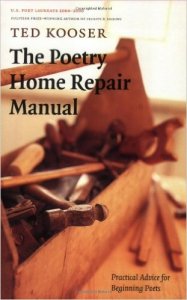
The recommended read for this week is Ted Kooser’s The Poetry Home Repair Manual: Practical Advice for Beginning Poets. There’s so much I like about this manual. For one thing, Ted assumes that if you are a heavy-duty reader, you already know quite a bit. After all, one of the best ways to learn to write is to read. He operates on the moral principle that if you have a gift then you have the obligation to offer something by way of giving back. He says, “I hope I won’t exhaust your patience” and he doesn’t. He assumes that our ultimate goal is to reach others and to move them, so there is a great deal of emphasis on the relationship between the poet and her reader. He discusses our job as poet – not money, not fame – but “to serve the poems we write.” This perspective makes reading and working with Ted Kooser’s The Poetry Home Repair Manualan refreshing guide to the poetic terrain for both budding and experienced writers interested in creating work that is fulfilling and truly artistic.
By shopping at Amazon through The Word Play Shopandusing the book links embedded in posts, you help to support the maintenance of this site. Thank you! (Some book links will just lead to info about the book or poet/author and not to Amazon.)
The WordPlay Shop offers books and other tools especially selected for poets and writers.

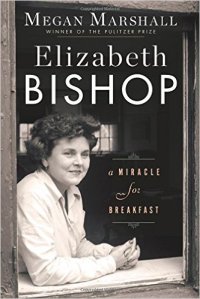 The recommended read for this week is Elizabeth Bishop: A Miracle for Breakfast by Pulitzer Prize winning Megan Marshall who studied with Bishop at Harvard. This biography is richly spun, energetic, engaging and even inspirational despite the breathtaking depth of Bishop’s losses, her sense of marginalization and her head-long push into alcoholism. Indeed, some of the inspiration comes because with all her loses, Bishop managed to hold poetry tight. Her poems were for her a charm “against the loneliness they often expressed.” The book covers Bishop’s relationships with other poets and her romantic interests, the last was for me the singular wearisome downside, much overrided though by the book’s pleasures and values. It is laced with Marshall’s own stories and together the lives of these two bare witness to the power of words to give shape, sense and meaning to life. We come away with a strong sense of Elizabeth Bishop, one of America’s most extraordinary poets. A page-turner. A must read or everyone who loves and writes poetry.






 Jamie Dedes' THE POET BY DAY Webzine