“Sit down and put down everything that comes into your head and then you’re a writer. But an author is one who can judge his own stuff’s worth and, without pity, destroy most of it.” Collette, Casual Chance, 1964
I remember it well: my first encounter with Sidonie-Gabrielle Colette. Picture it. Brooklyn. A Lebanese restaurant someplace on Atlantic Avenue, ambiance of the Middle East, redolent with fragrances of cinnamon and cardamom and the mouth-watering smell of lamb roasting.
It was 1958. We had just seen the movie, Gigi, starring Leslie Caron, which is based on Colette’s novella of the same name. You might remember that in the early scenes Ms. Caron wore a wide-brimmed straw hat with a ribbon tied in a bow. The ribbon trailed gracefully down her back. I had such a hat and suffered the illusion that I looked just like Gigi in the film. This illusion was strongly supported by the fact that Gigi is my childhood nickname. In fact, from that day on and until her death, my mother would tell everyone – as she did at the restaurant on this occasion – that I was Gigi before Gigi. I knew it wasn’t true. I’d read in the newspaper that there was a book written in 1944, which would predate me by six years. I was hungry to get my hands on it.
As the adults talked, I mentally replayed scenes from the movie and imagined a woman sitting at her desk writing the story that became the movie. I might have felt smart and pretty and even glamorous and certainly rather grown-up, but I would soon be relieved of my illusions. My mother allowed one of the restaurant patrons – an artist – to do a picture of me. Much to my dismay all he saw and drew was a scrawny olive-skinned kid with a rather gauche hat that sat too far back on her head. Nothing at all approaching the light, elegant, grown-up beauty of Ms. Caron. Then our supposed* distant cousin, Julia, the restaurant owner, worked her special magic. She told fortunes by reading the sludge left in the cup after drinking Lebanese coffee. Julia would provide this service . . . “reading” coffee grounds . . . for her favorite (i.e., frequent) patrons.
*Note: Honestly, everyone we met from Lebanon was pronounced a cousin, so I’m skeptical. Cousin in spirit and language, maybe. Blood cousin? Not so sure.
At Julia’s my special treat was one cup of Lebanese coffee with my baklava. On this day, Mom let Julia do a reading for me. It had none of Julia’s usual romantic niceties: “You are like the sun and the moon. He is the sun that warms your heart. You are the moon that reflects his strength.” Or, “I see a key. Many doors will open for you. And, see there? There are two bells entwined with a string. There will be much love shared.” There was to be no romance like the fictional Gigi’s for me. No. No. For me there was: “See that, Gigi. Two books. You must keep up your studies. Therein is your happiness.” Maybe Julia did have something of a seer’s eye. I turned out to be better at reading books than reading men and I’m content with that.
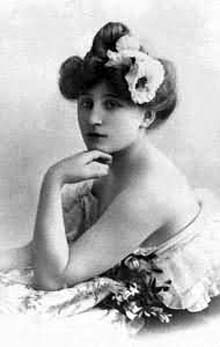
As for Sidone-Gabrielle Colette (a.k.a. Colette), the Nobel nominated (1948, Literature) French novelist, actress, and mime, this was my introduction and the beginning of my appreciation for her life and work.
Colette was a prodigious writer of many popular literary works. The Claudine stories were the first. For La Belle Époque, Colette’s writings were racy but – perhaps unfortunately – by today’s often jaded tastes, not so much. While Colette’s life was too much on the wild side for me, I appreciate her courage and honesty and I do love her writing, so full of an appreciation for life and so rich in perfume, color, and humor, occasionally wry.
Publicity still of Colette for Rêve d’Égypte at the Moulin Rouge.
Quotable Colette
For the romantics among us:
“I am going away with him to an unknown country where I shall have no past and no name, and where I shall be born again with a new face and an untried heart.”
The story of Gigi is about a young Parisian who – in her family’s tradition – is being groomed for a career as courtesan. A handsome, wealthy, and well-placed young man is targeted by her grandmother (Mamita) and aunt for Gigi’s first relationship. For the movie version, the story is sanitized to get by the American censors. It was 1958 after all.
“You will do foolish things, but do them with enthusiasm.”
Colette’s life and work are honored in film, song and story by (among others) The Year I Read Colette (YouTube video) by singer-songwriter Roseanne Cash, The White Rose by Truman Capote (describes his first meeting with Colette), and the movies Coletteand Becoming Colette. Les Vrilles de la vigne is number fifty-nine on Le Monde’s 100 Best Books of the [20th] Century. When Colette died, she was denied a religious burial by the Catholic Church because of her divorces but the French people justly honored her literary significance with a state funeral.
If you are reading this post from an email subscription, you’ll likely have to link through to the site to view these trailers from two movies about Colette.
Poet and writer, I was once columnist and associate editor of a regional employment publication. I currently run this site, The Poet by Day, an information hub for poets and writers. I am the managing editor of The BeZine published by The Bardo Group Beguines (originally The Bardo Group), a virtual arts collective I founded. I am a weekly contributor to Beguine Again, a site showcasing spiritual writers. My work is featured in a variety of publications and on sites, including: Levure littéraure, Ramingo’s Porch, Vita Brevis Literature,Compass Rose, Connotation Press, The Bar None Group, Salamander Cove, Second Light, I Am Not a Silent Poet, Meta / Phor(e) /Play, and California Woman. My poetry was recently read byNorthern California actor Richard Lingua for Poetry Woodshed, Belfast Community Radio. I was featured in a lengthy interview on the Creative Nexus Radio Show where I was dubbed “Poetry Champion.”
“What if our religion was each other. If our practice was our life. If prayer, our words. What if the temple was the Earth. If forests were our church. If holy water–the rivers, lakes, and ocean. What if meditation was our relationships. If the teacher was life. If wisdom was self-knowledge. If love was the center of our being.” Ganga White, teacher and exponent of Yoga and founder of White Lotus, a Yoga center and retreat house in Santa Barbara, CA
“Every pair of eyes facing you has probably experienced something you could not endure.” Lucille Clifton
Thank you for sharing your love of words. Comments will appear after moderation.
“For, after all, every one who wishes to gain true knowledge must climb the Hill Difficulty alone, and since there is no royal road to the summit, I must zigzag it in my own way. I slip back many times, I fall, I stand still, I run against the edge of hidden obstacles, I lose my temper and find it again and keep it better, I trudge on, I gain a little, I feel encouraged, I get more eager and climb higher and begin to see the widening horizon. Every struggle is a victory. One more effort and I reach the luminous cloud, the blue depths of the sky, the uplands of my desire.” Helen Keller, The Story of My Life [recommended – Kindle version is a whopping sixty-cents]
In the dark,
Found light
Brighter than many ever see.
She,
Within herself,
Found loveliness,
Through the soul’s own mastery.
And now the world receives
From her dower:
The message of the strength
Of inner power.
– Langston Hughes
HELEN KELLER (1880-1968) is a hugely compelling figure for so many of us, an inspiration. She was the first deaf and blind person to earn a B.A. – at Harvard University, no less. She was a writer and activist.
LANGSTON HUGHES (1902-1967) – also an inspiration – was a social activist and leader of the Harlem Renaissance, a poet, novelist, playwright, and columnist. Hughes was an early innovator of a new style in his time, jazz poetry – i.e. jazz-like rhythms, improvisational feel – and much of his poetry was on social justice themes. (Jazz poetry tends to be consider outsider art. It is the root of poetry slams and hip-hop.)
Poet and writer, I was once columnist and associate editor of a regional employment publication. I currently run this site, The Poet by Day, an information hub for poets and writers. I am the managing editor of The BeZine published by The Bardo Group Beguines (originally The Bardo Group), a virtual arts collective I founded. I am a weekly contributor to Beguine Again, a site showcasing spiritual writers. My work is featured in a variety of publications and on sites, including: Levure littéraure, Ramingo’s Porch, Vita Brevis Literature,Compass Rose, Connotation Press, The Bar None Group, Salamander Cove, Second Light, I Am Not a Silent Poet, Meta / Phor(e) /Play, and California Woman. My poetry was recently read byNorthern California actor Richard Lingua for Poetry Woodshed, Belfast Community Radio. I was featured in a lengthy interview on the Creative Nexus Radio Show where I was dubbed “Poetry Champion.”
“What if our religion was each other. If our practice was our life. If prayer, our words. What if the temple was the Earth. If forests were our church. If holy water–the rivers, lakes, and ocean. What if meditation was our relationships. If the teacher was life. If wisdom was self-knowledge. If love was the center of our being.” Ganga White, teacher and exponent of Yoga and founder of White Lotus, a Yoga center and retreat house in Santa Barbara, CA
“Every pair of eyes facing you has probably experienced something you could not endure.” Lucille Clifton
Thank you for sharing your love of words. Comments will appear after moderation.
“The country’s money simply declined by 38 percent”, explains Milner, author of The Lives and Times of Bonnie and Clyde. “Gaunt, dazed men roamed the city streets seeking jobs … Breadlines and soup kitchens became jammed. [In rural areas] foreclosures forced more than 38 percent of farmers from their lands [while simultaneously] a catastrophic drought struck the Great Plains … By the time Bonnie and Clyde became well-known, many had felt that the capitalistic system had been abused by big business and government officials … Now here were Bonnie and Clyde striking back.” Milner, E.R. The Lives and Times of Bonnie and Clyde.Southern Illinois University Press, 2003.
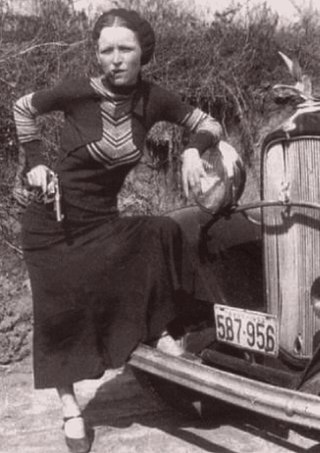
The Guardian recently ran a feature, ‘We donte want to hurt anney one’: Bonnie [Parker] and Clyde’s [Barrow] poetry revealed” … Wow! Who knew? I certainly didn’t. The quote in the headline is allegedly Clyde’s work. He tried his hand, but it looks like Bonnie was the poet. For those who may not know these were Depression Era criminals in a day when the most notorious were labeled “Public Enemy” and these two certainly were, though they are often glamorized in media.
Apparently there’s a notebook in which the poems believed to be written by the couple are collected. It is up for auction by Barrow’s nephew. (Find more details and photos of the notebook at Heritage Auctions. They’re also auctioning off photographs.)
A little further research – very little (but I was curious) – reveals that there are several poems popularly ascribed to Bonnie. Here’s one:
The Story of Bonnie and Clyde
You’ve read the story of Jesse James
Of how he lived and died;
If you’re still in need
Of something to read,
Here’s the story of Bonnie and Clyde.
Now Bonnie and Clyde are the Barrow gang,
I’m sure you all have read
How they rob and steal
And those who squeal
Are usually found dying or dead.
There’s lots of untruths to these write-ups;
They’re not so ruthless as that;
Their nature is raw;
They hate all the law
The stool pigeons, spotters, and rats.
They call them cold-blooded killers;
They say they are heartless and mean;
But I say this with pride,
That I once knew Clyde
When he was honest and upright and clean.
But the laws fooled around,
Kept taking him down
And locking him up in a cell,
Till he said to me,
‘I’ll never be free,
So I’ll meet a few of them in hell.’
The road was so dimly lighted;
There were no highway signs to guide;
But they made up their minds
If all roads were blind,
They wouldn’t give up till they died.
The road gets dimmer and dimmer;
Sometimes you can hardly see;
But it’s fight, man to man,
And do all you can,
For they know they can never be free.
From heart-break some people have suffered;
From weariness some people have died;
But take it all in all,
Our troubles are small
Till we get like Bonnie and Clyde.
If a policeman is killed in Dallas,
And they have no clue or guide;
If they can’t find a fiend,
They just wipe their slate clean
And hand it on Bonnie and Clyde.
There’s two crimes committed in America
Not accredited to the Barrow mob;
They had no hand
In the kidnap demand,
Nor the Kansas City depot job.
A newsboy once said to his buddy;
‘I wish old Clyde would get jumped;
In these awful hard times
We’d make a few dimes
If five or six cops would get bumped.’
The police haven’t got the report yet,
But Clyde called me up today;
He said, ‘Don’t start any fights
We aren’t working nights
We’re joining the NRA.’
From Irving to West Dallas viaduct
Is known as the Great Divide,
Where the women are kin,
And the men are men,
And they won’t ‘stool’ on Bonnie and Clyde.
If they try to act like citizens
And rent them a nice little flat,
About the third night
They’re invited to fight
By a sub-gun’s rat-tat-tat.
They don’t think they’re too tough or desperate,
They know that the law always wins;
They’ve been shot at before,
But they do not ignore
That death is the wages of sin.
Some day they’ll go down together;
And they’ll bury them side by side;
To few it’ll be grief
To the law a relief
But it’s death for Bonnie and Clyde.
– Bonnie Parker
.
“At approximately 9:15 a.m. on May 23, the posse, concealed in the bushes and almost ready to concede defeat, heard Barrow’s stolen Ford V8 approaching at a high speed. . . . The lawmen opened fire, killing Barrow and Parker while shooting a combined total of about 130 rounds. . . Barrow was killed instantly [but an officer reports hearing] Parker scream as she realized Barrow was dead before the shooting at her fully began. The officers emptied all their arms at the car. Any one of the many wounds suffered by Bonnie and Clyde would have been fatal.” Wikipedia
.
All photographs in the post are in the public domain.
Poet and writer, I was once columnist and associate editor of a regional employment publication. I currently run this site, The Poet by Day, an information hub for poets and writers. I am the managing editor of The BeZine published by The Bardo Group Beguines (originally The Bardo Group), a virtual arts collective I founded. I am a weekly contributor to Beguine Again, a site showcasing spiritual writers. My work is featured in a variety of publications and on sites, including: Levure littéraure, Ramingo’s Porch, Vita Brevis Literature,Compass Rose, Connotation Press, The Bar None Group, Salamander Cove, Second Light, I Am Not a Silent Poet, Meta / Phor(e) /Play, and California Woman. My poetry was recently read byNorthern California actor Richard Lingua for Poetry Woodshed, Belfast Community Radio. I was featured in a lengthy interview on the Creative Nexus Radio Show where I was dubbed “Poetry Champion.”
“What if our religion was each other. If our practice was our life. If prayer, our words. What if the temple was the Earth. If forests were our church. If holy water–the rivers, lakes, and ocean. What if meditation was our relationships. If the teacher was life. If wisdom was self-knowledge. If love was the center of our being.” Ganga White, teacher and exponent of Yoga and founder of White Lotus, a Yoga center and retreat house in Santa Barbara, CA
“Every pair of eyes facing you has probably experienced something you could not endure.” Lucille Clifton
Thank you for sharing your love of words. Comments will appear after moderation.
“…you have to stitch and cherish and nourish and never have the chance to flourish!” Amirah Al Wassif
Amira’s exquisite poetry and prose have the lilt of Arabic and although I know many American editors would be tempted to edit into more standard straightforward English, I am loath to do so. This is perhaps because from childhood my ear is used to listening to English lyrically spoken by family and friends for whom Arabic was a first language. It is my pleasure to bring this young intuitive talent and her unique perspective to you here today. Enjoy! / J.D.
To Be A Brilliant Woman in the third world!
to be a brilliant woman in the third world you have not to be! so, if you want the basic tips kindly listen to me put your mind in a box be ready to say every moment “agree” announce your eternity silence stop whirring like a curious bee act as a bird in a cage never dream to get free don’t consider obedience as a guilty it is honor getting down on your knee and about your gifts very enough to know all the electrical appliances, kind of dishes and how to make the tea? nobody cares about gifts it is not necessary, it is too wee don’t try to laugh aloud it is perfect to be a tree and understand that argument is so dangerous the best for a woman is to flee!
to be a brilliant woman in the third world you have to obey! your family, your husband, your neighbor, your president whoever he or she!
you have to stitch and cherish and nourish and never have the chance to flourish! you have to silence not crying whee! in your success or if you finally could see! in the third world all you have to be is not to be nobody cares about your gifts enough having a degree in the obedience lessons or cooking puree!
For Those Who Don’t Know the Chocolate by Amirah was published in the last issue of The BeZine. The theme was A Life of the Spirit. What is more indicative of that life than a compassionate connection to the suffering of others. The video below is beautiful done and you can read the text HERE.
AMIRAH: I think I fall in love with poetry since my childhood, this magic made me more sensitive towards everything including the very small details. Poetry appeared firstly in my writing in Arabic, then I found myself sinking in a harsh conflict, I felt that I am in need to write with this fascinating language which touches my heart and my mind, I love English despite I am not a native writer but I saw my passion in it, writing poetry by any language, of course, it achieves the poet goal, when it will exist but in my case, I adore writing poetry and many kinds of literary arts in English although I have 5 books in Arabic, I found my enjoyment and my own voice and world when I started writing in English, poetry came to me without realizing from me, it absorbs my spirit and gave me a mysterious kind of beauty, I feel it in many ways, I can say it is one of the poetry secrets, when it covers your body and your soul without permission, without noises.
JAMIE: Why is poetry so important to the global community?
AMIRAH: I believe in poetry power, and I want to say without using repeated expressions, poetry language reveals what behind our minds, it makes us more harmonic with each other, it unites the people around the world, the politics, and the religion don’t have the amazing ability which poetry haswe need more and more from poetry, we need to focus on beauty signs, we need to create it. I believe in the marvelous ability of the poetry in pushing the people to taste life twice and to make our darkness colorful.
JAMIEWhat poet do you find most inspiring and comforting and why?
AMIRAH: There are many inspired poets for me, including Emily Dickinson, Sylvia Plath, Charles Bukowski, Pablo Neruda, Jalaluddin Rumi, Indian poet Tagore, Gibran Khalil Gibran, Maya Angelo, Robert Frost, and others. There are many inspiring poets for me.
The piece of poetry that pierces my heart intelligently inspires me and I can not stop thinking about it, that kind of idea that feeds my hungry spirit.
JAMIE: What do you hope to accomplish with your own poetry?
AMIRAH: I want my poetry to have an aesthetic sensitive taste and a human impact in the real world
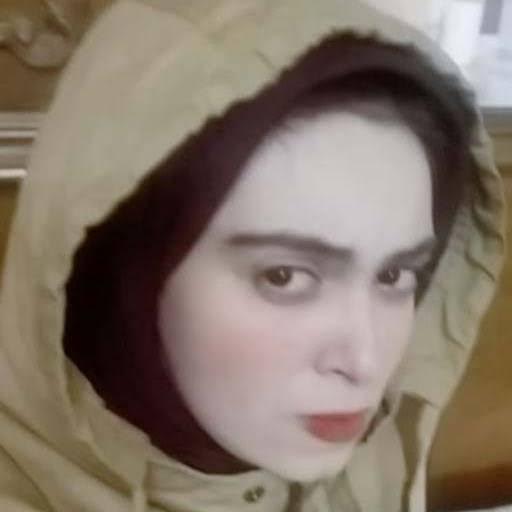
AMIRAH AL WASSIF is a freelance writer (28 years old) from Egypt. She has written articles, novels, short stories poems and songs. Five of her books were written in Arabic and many of her English works have been published in various cultural magazines. Amirah is passionate about producing literary works for children, teens and adults which represent cultures from around the world. Her first book was published in 2014 and her latest illustrated book, The Cocoa Book and Other Stories is forthcoming.
Mom and me, Christmas, late ’80s, San Francisco, California
Poet and writer, I was once columnist and associate editor of a regional employment publication. I currently run this site, The Poet by Day, an information hub for poets and writers. I am the managing editor of The BeZine published by The Bardo Group Beguines (originally The Bardo Group), a virtual arts collective I founded. I am a weekly contributor to Beguine Again, a site showcasing spiritual writers. My work is featured in a variety of publications and on sites, including: Levure littéraure, Ramingo’s Porch, Vita Brevis Literature,Compass Rose, Connotation Press, The Bar None Group, Salamander Cove, Second Light, I Am Not a Silent Poet, Meta / Phor(e) /Play, and California Woman. My poetry was recently read byNorthern California actor Richard Lingua for Poetry Woodshed, Belfast Community Radio. I was featured in a lengthy interview on the Creative Nexus Radio Show where I was dubbed “Poetry Champion.”
“What if our religion was each other. If our practice was our life. If prayer, our words. What if the temple was the Earth. If forests were our church. If holy water–the rivers, lakes, and ocean. What if meditation was our relationships. If the teacher was life. If wisdom was self-knowledge. If love was the center of our being.” Ganga White, teacher and exponent of Yoga and founder of White Lotus, a Yoga center and retreat house in Santa Barbara, CA
“Every pair of eyes facing you has probably experienced something you could not endure.” Lucille Clifton
Thank you for sharing your love of words. Comments will appear after moderation.
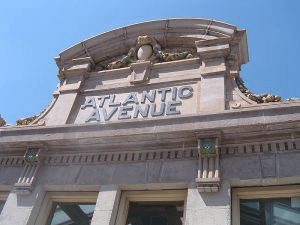 I remember it well: my first encounter with Sidonie-Gabrielle Colette. Picture it. Brooklyn. A Lebanese restaurant someplace on Atlantic Avenue, ambiance of the Middle East, redolent with fragrances of cinnamon and cardamom and the mouth-watering smell of lamb roasting.
 At Julia’s my special treat was one cup of Lebanese coffee with my baklava. On this day, Mom let Julia do a reading for me. It had none of Julia’s usual romantic niceties: “You are like the sun and the moon. He is the sun that warms your heart. You are the moon that reflects his strength.” Or, “I see a key. Many doors will open for you. And, see there? There are two bells entwined with a string. There will be much love shared.” There was to be no romance like the fictional Gigi’s for me. No. No. For me there was: “See that, Gigi. Two books. You must keep up your studies. Therein is your happiness.” Maybe Julia did have something of a seer’s eye. I turned out to be better at reading books than reading men and I’m content with that.



 AMIRAH AL WASSIF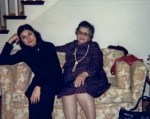

 Jamie Dedes' THE POET BY DAY Webzine