WEDNESDAY WRITING PROMPT, April 12, 2017 (1) Vacations: Well, this one is akin to the first composition assignment on returning to school after summer vacation: Tell us about your most fondly remembered vacations. Perhaps you enjoyed it because it involved family and childhood. Perhaps it was a dream vacation come true. Or, maybe it was an unexpected adventure. Or, perhaps your best vacation is the one you are planning now.
To Italy
you never expected this
we touch Florentine great black hog’s ringed cold snout
a ritual au revoir
taste best bitter coffee on the TGV
see snowed peaks of lower Apennine mountains
out of warm train windows
enter massive
Milan train Station
nine days coach trip
poke me in the side
when coach pace nods me off
stroll spiral down to medieval streets and a tilted horse race square
walk Rome’s cobbles amphitheatre
marvel at Vatican mosaics
we thought paintings
want to stroke cordoned vast
marble muscles
lilt up Venetian canals
wonder why when renovating buildings at home
builders don’t have picture tarpaulins
of the building beneath
you never expected this
for my fortieth
expected Wales or Scotland
then I request you order
a passport,
and live nine days
out of a suitcase
and thank your late father
our invisible companion
who made this possible
when one bottle of wine
seemed as if it was going to last forever;
the one I’m thinking of (purchased
one dinnertime in summer at 7/6d)
occupied a space in my life
a mile high and spanned the gap
all the way to Tibet; as you drank a glass
that dinnertime it seemed to refill itself
from the dregs of love
when one kiss would last
as long as the Rachmaninov cello sonata
whenever you put the record
on the turntable and let the needle fall –
obliterated in the so well-known cadences
which I could have been whistling
had my lips not been squashed against hers
when a bicycle ride would construct a day
down to the sea and back
across the long valley and over the downs –
magic ride often repeated –
I fill it from these dregs of memory
WEDNESDAY WRITING PROMPT, April 12, 2017 (2) Memories of those lost. Have there been people in your life that you don’t loose no matter what? Perhaps people like parents who are so much a part of you, you seem to sense their presence even after they have died. How good is that? Or, maybe you don’t think it is. Tell us about it in poem or prose.
One of My Tomorrows
for Celia
Our last goodbye was casual
as if I would see you again
on one of my tomorrows
I touched your arm
you flinched. In pain.
I felt persistent guilt
Born of carelessness
only nervous uncertainty
could freely demonstrate
Born of habitual presumption
that you were in charge
you weren’t. Not really.
You never were, save
your own sense of duty
to boss, nay care for everyone
Too much on small shoulders
that weren’t as strong as the
force of that inner being
the force that stopped being
that was someone once
whom I loved and miss
Some time after we’d helped you
to meet your God, one starlit night
I heard your voice as clear as the sky
O lamb of God, who takes away
the sins of the world, have mercy
and grant us peace. I swear
Lantern swinging down path —
I wonder if it is really there,
if that is you, or just some accident
of moonlight and wind.
How is it possible for the night
to be so black that no adjective
makes sense? Just black-black,
with shadows hovering and the wild phlox
lopped over reflecting greywhite back up.
No lantern, but there might as well be,
my heart lighting every moment,
bringing you back through memory
to stroll ahead telling me that story
I promised to never forget.
This is the first time Jennifer Cartland is featured on The Poet by Day. . She says of herself simply, “In between meetings, in between errands, seat cushions, and ‘oms’, I try to nab those little guys flying though my noggin’ and shake them up a bit, turn them into something humans can understand. Sometimes it works, sometimes not. Sometimes they are happy I did, sometimes they aren’t.”
Lavender & Whippoorwills
nasturtiums growing
in hollyhock fields
smelling of lavender
& blue whippoorwills
whose song bids me
follow the spirit
of you
entwined as we are
in consummate truth
i see you dancing
beneath the elm tree
with boughs your
dance partner
forever & free
as you slip transparent
from my view
the music plays softly
as it is never adieu
from the lemon bush
filtering meringue
soft dreams
to the orange orchard
citrus scenes
i knew you loved me
before i became a whisper
& held me near
before the dance…
taste of cinnamon cinders
nasturtiums growing
in hollyhock fields
smelling of lavender
& blue whippoorwills
Well, such wonderful responses to Wednesday Writing Prompts. I think it makes rather a lovely collection, which I hope you enjoy. I hope you’ll also visit these poets at their blogs and get to know them better. Look for another Wednesday Writing Prompt tomorrow.
LESSON NINE: Be kind to our languge. “Avoid pronouncing the phrases everyone else does. Think up your own ways of speaking, even if only to convey that thing you think everyone is saying. Make an effort to separate yourself from the Internet. Read books.” Prof. Snyder, On Tyranny, Twenty Lessons from the Twentieth Century
Thank you for sharing your love of words. Comments will appear after moderation.
the mindful peace of the cypress beckons,
she bows in the wind but doesn’t fracture,
she knows well the moments, but nothing of time
her poetry is written in presence, not words
in this business of life, of death and of poetry
yesterday is, i think, best forgotten ~
just a figment, after all, an old locked-room mystery,
stored among a million neurons, a trillion constellations,
sound proof, but for the occasional cerebral accident
with its quick crack of a gunshot fading into a yellow eye,
evaluating with a understandable skepticism
life, as it turns out, is a matter of imagination, or folly, nurturing the seesaw of grief and joy,
the contrapuntal pulls of yin and yang
we can reframe, but we can’t rewrite there are no encores
this business of life, of death and of poetry is what it is
and the past is not a salve nor the future a savior,
the same sun that warms words poemed into life
will dry our skin to leather and weld it to bone ~
moss, says Emily, will cover up our names
it’s best then, i think, to mimic the cypress
to let go the days, the clutter and the noise,
to bow from the winds but not shatter,
to know well the moments, but nothing of time
LESSON EIGHT: Stand Out. “Someone has to. It is esy to follow along It can feel strange to do or say something different. But wihtout that unease, there is no freedom. Remembr Rosa Parks. The moment you set an example, the spell o the status quo is broke, and others will follow.” Prof. Snyder, On Tyranny, Twenty Lessons from the Twentieth Century
Thank you for sharing your love of words. Comments will appear after moderation.
THE BeZINE submissions for the May 2017 issues (theme: Honesty and Transparency, the Post-truth Era) shoul be in by May 10th latest. Publication date is May 15th. Poetry, essays,fiction and creative nonfiction, art and photography, music (videos), and whatever can be shared online are welcome for consideration. Please check out a few issues first and the Intro./Mission Statement and Submission Guidelines. Email submissions to bardogroup@gmail.com
DOOR IS AJAR MAGAZINE invites submissions on a “broad range of topics under the umbrella of health and spirituality, which can include faith, eastern philosophy, meditation and mainstream religion; nutrition, wellness, yoga and holistic medicine; creativity, the inner life, social justice and issues of conscience; and public health, the human body and the environment. Our readers are generally spiritual “seekers” who may or may not be traditionally religious.” Details HERE.
BURNSIDE REVIEW accepts submission of three-to-five poems. They’re not accepting fiction. Payment if accepted is $25 plus a copy of the magazine. Details HERE.
CALLALOO: A JOURNAL OF AFRICAN DIASPORA ARTS & LETTERS is a publication of Princeton University and “is a journal of and on the literature, art, culture, and criticism of Africa and the African diaspora. For scholars, the journal offers a host of ways to publish, from journal articles to book reviews and annotated bibliographies.” Details HERE.
ATLAS POETIC, A Journal of World Tanka welcomes international submissions but translations into English are required. They accept submissions of articles and essays on tanka as well as poetry. There is a detailed submissions guideline HERE.
WATERWAYS: POETRY IN THE MAINSTREAM is publication of Ten Penny Players (New York) and was founded in 1979. It is a disability, children’s and animal right advocate, which dictates subject and content. Submission are welcome from both established and emerging writers. Wateways is published every month but August and each issue has a theme. The theme for June is “Such a humourous dance …” and the deadline is June 15th. Details HERE.
VOICES OF ISRAEL is an organization of 150 poets in Israel and other countries and was founded (1971) “to provide an outlet or writers of English poetry in Israel, to encourage new poets in their art, and to promote international friendships through poetry. An anthology is published annually. Details HERE.
VAN GOGH’S EAR: BEST WORLD POETRY AND PROSE is an annual anthology published by French Connection. I believe the deadline is March 15 each year, so make a note to submit to next year’s anthology. Details HERE and HERE.
LUMINA is a publication of Sarah Lawrence College MFA program. It publishes prose, poetry, multimedia and art from “emerging visual artists and writers alongside their established counterparts. We want art that pushes boundaries with eloquence.” Details HERE.
LITERARY.JUICE, An Online Literary Magazine is an “outlet for authors to share their most honest works without having to conform to conventional narrative guidelines, unlike many other literary journals.” Publishes poetry, fiction (including flash fiction) and art. Submission guidelines HERE.
LITTERAL LATTÉ publishes both online and in print and uses poetry, prose and art. Details HERE.
RENDITIONS, A Chinese-English Translation Magazine, a “Gateway to Chinese Literature and Culture” is published in the UK. It is an “international journal of Chinese literature in English translation, covering over 2000 years of Chinese literature from classical works of poetry, prose, and fiction to recently published works by writers representing the rich variety of contemporary Chinese literary expression. Articles on art, Chinese studies and translation studies are often included. Each issue is illustrated with complementary art, calligraphy and photographs. Renditions has been published by the Research Centre for Translation of The Chinese University of Hong Kong since 1973.” Details HERE.
MAGMA POETRY publishes prose features, articles and reviews as well as poetry. The deadline for issue #69 (“The Deaf Issue”) is 30 April 2017. Details HERE.
BRICK ROAD POETRY PRESS selects one or two poetry collections to publish each year. Submission period is from December 1 – January 15. Details HERE.
GEIST fact * fiction * North of America – but accepts submissions from outside of Canada for its contests. All other submissions must have a Canadian connection. Publishes fiction, non-fiction, poetry, photography, art, reviews, little-known facts of interest, and cartography. Details HERE.
CONTESTS
Opportunity Knocks
LITTERAL LATTÉpoetry awards for poems up to 2,000 words offers a first prize of $1,000, second of $300, and third of $200. There is a reading fee of $10 for a set of six poems and $15 for a set of ten poems. All poems are considered for publication. Deadline July 15th. Details HERE.
TOM HOWARD/JOHN H. REID FICTION & ESSAY CONTEST – DEADLINE APRIL 30 The award is “$1,500 each for the top story and the top essay. Ten Honorable Mentions will receive $100 each. The top 12 entries will be published online. Fee: $18 per entry.. Entries may be published or unpublished. There are no demographic restrictions. Length limit: 6,000 words. Submit online at winning writers.
BRICK ROAD POETRY BOOK CONTESTsubmissions start on August 1 and the deadline is November 1 for this year’s competition. There’s a $25 entry fee. The awards are: first place winner receives a publication contract with Brick Road Poetry Press and $1000 prize, publication in both print and ebook formats, and 25 copies of the printed book.” There’s a possibility of book contracts for finalists. Details HERE.
EVENTS
Poetry Reading with Grace Bauer and Hope Wabuke / April 18 / 7:00pm Great Plains Art Museum, 1155 Q Street 68508Lincoln, Nebraska
Haiku Writing for Ages 7 – 107 / April 19 / 7:00pm Newton Free Library, 330 Homer St. ,Newton, Massachusetts
Rooms Are Never Finished: The Legacy of Agha Shahid Ali / April 21 – “the life and work of Kashmiri poet Agha Shahid Ali (1949-2001). Celebrated for bringing the ghazal into English, Ali’s work explores cultural ties and divisions, the enduring qualities of love and friendship, and the difficulty of maintaining both.”/ Admission $10 / 7:00pm, Poets House, 10 River Terrace, NYC, New York
Friday Night Poetry Slam / April 21 / Admission $15-$28 / New York / Details HERE.
Poetry Vicenza (Italy) – Contemporary Poetry and Music Festival runs through 04 June 2017. Details on the variety of events is HERE.
Poets Resist: The First 100 Days / April 30 – 1-3 p.m. CDT/ Malvern Books, 813 West 29th Street, Austin, TX / “After 100 days the poets of Austin stand up and resist unjust practices and policies. The format will be fast, as we’d love to hear from many perspectives in this safe place reading. Outlaw Poet Justin Booth will host some of Austin’s best including W. Joe Hoppe, Joe Brundidge, Richard Acevado, Favian Harper, David Julian, Nikki Bruns, Rebecca Raphael, Stephany Morrissey, Brett Reeves, and Lyman Grant.”
Technicians of the Sacred, Third Edition (special 50th Anniversary Edition): A Range of Poetries from Arica, Asia, Europe, and Oceana, Jerome Rothenberg, University of California Press, release date August 8, you can preorder HERE. (I have the old edition. It’s something special.)
KUDOS
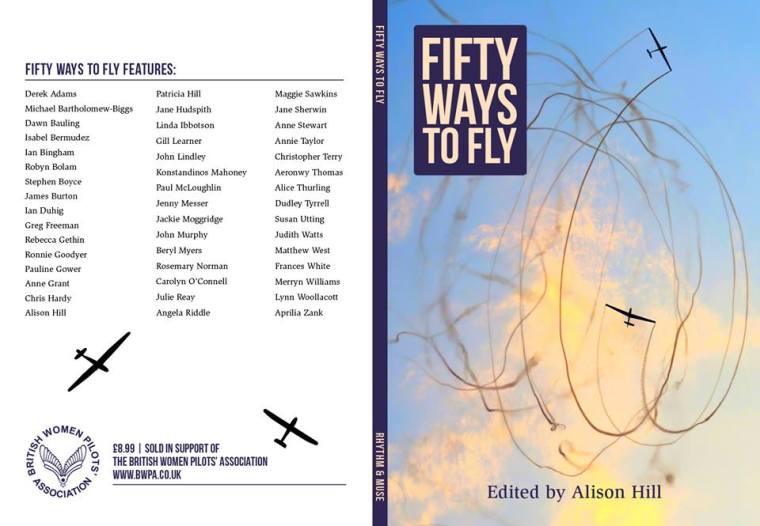
Congratulations to poet and photographer Aprilia Zank for the delightful cover photography and design for Fifty Ways to Fly by Alison Hill.
BONUS
If you are reading this from an email subscription, you’ll likely have to link through to view the video above. This is Shane L. Koyczan (born May 22 1976), a Canadian spoken word poet, writer, and member of the group Tons of Fun University. He is known for writing about issues like bullying, cancer, death, and eating disorders. He is most famous for the anti-bullying poem To This Day which has over 20 million views.
Originally published on The BeZine website, this issue was produced and introduced by Contributing Editor, Michael Dickel (Fragmentarily/Meta-Phore(e) Play). Much thanks to Michael for his work on this stellar poetry issue, which as he said turned out to be – in effect – an anthology. The last hours before putting out the Zine always end up to be an overnight effort. There is some work that can’t be done until just before publication and, of course, things do go wrong. Murphy’s Law. So really double kudos and much appreciation to Michael.
Thanks also to the poets and writers who contributed. We love having so many of you together and we are pleased as always to present established, emerging and talented amateur poets to delight you. Our hope is that you (readers and writers) now have some fine new (to you) poets to follow. You’ll find links to their books and websites in the bio pages at The BeZine.
Youth Chaplaincy Program Founder, Rev.Terri Stewart. (Photo: Christmas at the King County Youth Detention Center, Seattle, Washington) Terri is the minister at Riverton Park United Methodist Church, Seattle and founder of Beguine Again
Also thanks to our stalwart supporters, including Terri Stewart ( Beguine Again), Lana Phillips, Ruth Jewell, James R. Cowles (look for a fab piece by him in next month’s issue) and Chrysty Darby Hendrick.
Much thanks to all our readers who are a valued part of The Bardo Group Beguines (the publishers of the Zine), a virtual arts collaborative. Much appreciation to the many of you who have referred poets and writers and enriched the work of this Zine in doing so. And thanks most of all to readers and writers for your love of the arts and your peacefilled hopes for humankind and our Mother Earth. J.D. – And now here’s Michael with the introduction and the table of contents …
Poetry Month means that we have arrived at
…the cruelest month, breeding Lilacs out of the dead land, mixing Memory and desire, stirring Dull roots with spring rain. (T. S. Eliot, The Wasteland)
One of the most famous poems “about” poetry, Marianne Moore‘s poem, “Poetry.” It famously begins with
I, too, dislike it: there are things that are important beyond all this fiddle.
However, she goes on in the very next lines to say
Reading it, however, with a perfect contempt for it, one discovers that there is in it after all, a place for the genuine.
There is much that is genuine in this April issue of The BeZine, which celebrates Poetry Month globally with our celebration of interNational Poetry Month. We are proud to present a wide variety of poets and poetry from all over the world. We have 45 posts of poetry (many with more than one poem), an essay, and one short story. This issue of The BeZine is an anthology!
Over the years, questions of poetry’s health, suggestions of its “death,” and concerns over who, if anybody, might be reading it, continue to swirl around in various articles, essays, and round tables. While many of the debates one might encounter in this bubbling broth come from a perspective of poetry’s decline, it seems to me that the reasons that such questions arise come from two primary sources.
One is an anxiety about how society values what we do, as poets or readers of poetry. It seems that the writers from this vein often worry that, in fact, society does not value poetry—as recorded in statistics about readership or as suggested by some other perceived decline in attention to it. The other vein, in my view, is a more healthy concern with what poetry is and what we are doing when we “do” poetry (read, write, critique).
This past year, a lot of words spilled onto the screen and page regarding Bob Dylan receiving the Nobel Prize—is a song writer a poet? Of course, poetry comes from song, so a song writer is a poet. Is poetry still song, then, or has it gone “beyond”? These articles and essays seem to flow from both of the sources I’ve suggested: anxiety and reflection. If our modest zine is any indication, poetry thrives throughout the world.
While the anxieties and reflections continue—and they are not new, witness the 1919 date of Marianne Moore’s poem—poets continue to write, and readers continue to read. You are reading this, so you are evidence of readers who have an interest in poetry. Whether there are more or fewer readers in any year or decade might fluctuate, or the methods of measuring them might change. However, as there are poets, there are those who read poetry. And listen to it—as in spoken word and slam.
Billy Collins opens his essay, The Vehicle of Language, suggesting that a problem with the reception of poetry is how poetry is taught:
For any teacher of poetry with the slightest interest in reducing the often high-pitched level of student anxiety, one step would be to substitute for the nagging and ultimately pointless question, “What does this poem mean?” the more manageable question “Where does this poem go?” Tracking the ways a poem moves from beginning to end puts the emphasis on the poem’s tendency to travel imaginatively and thus to carry the reader in the vehicle of its language.
In principle, I agree that the emphasis should be on where poetry goes, how it plays with language—not on decoding “meaning.” The same approach could be applied to the concerns expressed about poetry. The concerns need not be about where poetry is as measured against expectations of its current quality, akin to the “meaning” anxiety of its teaching.
Although some express an anxiety about the “quality” of online poetry or spoken word or even “today’s” written word, we would do well to reflect instead on where poetry is going, for us as readers and writers—where we as writers of it want to go with our poetry, and where we as readers of it want poetry to go to be most satisfying.
Poetry invites us to take an imaginative journey: from the flatness of practical language into the rhythms and sound systems of poetic speech. (Billy Collins, The Vehicle of Language)
It is our hope that you will read the poetry here with an appreciation for poetry’s “place for the genuine,” and find satisfaction in the depth and breadth presented here. Whether or not you will have “a perfect contempt for it” as you read, we leave up to you…
—Michael Dickel Contributing Editor
TABLE OF CONTENTS
Celebrating interNational Poetry Month
To Read this issue of The BeZine
Click HERE to read the entire magazine by scrolling, or
You can read each piece individually by clicking the links below.
To learn more about our guests contributors, please link HERE.

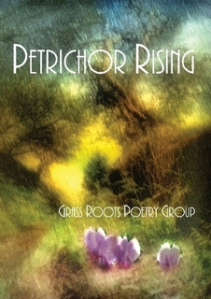 Poetry Group, he published a collection, Petrichor Rising (eBook and paperback), the profits from which go to charity. You can read more about John and his projects at: Petrichor Rising and how the Twitterverse birthed friendships that in turn birthed a poetry collection.