Page 6 of 16

THE BeZINE, Call for Submissions for June, September and December

The BeZine logo design and copyright by Terri Stewart.



The BeZine is published quarterly on the fifteenth of March, June, September and December. Please read our Intro and Mission Statement and at least one back issue of The BeZine before submitting work for consideration. Each issue is theme based.

Please be mindful that our core team (The Bardo Group Beguines), guest contributors and readers represent the world’s diversity. Nonviolence, respect and inclusion are core values.

All work must be submitted in English and properly edited for publication. Submissions in other languages are fine but only if they are accompanied by an English translation.

Please send submissions to bardogroup@gmail.com and put “submission” in the subject line.  If you were referred by one of our core team, please put their name in the subject line along with “submission.” Please include a brief bio not a curriculum vitae. If you have published the work submitted on your own website, blog, YouTube channel or other online venue you may send a link.

PLEASE NOTE: We apply the same standards with regard to content, quality, submission guidelines and reading policy that all high-caliber literary magazines do with the exception that we will consider work that is already published. The copyright, however, must be yours.

DEADLINE: The 10th of the month prior to the publication date, but for the June issue it is extended through May 20th. You still have some time.

Artwork by The Bardo Group Beguines team-member, © Corina Ravenscraft (Dragon’s Dreams) for The BeZine, 100,000 Poets (and Others) for Change, 2018.

Themes each year are consistent with the concerns of the global movement cofounded by Michael Rosenberg and Terri Carrion, 100,000 Poets (and others) for Change:

  • March, Peace;
  • June, Sustainability;
  • September, Social Justice

… and for December the shared value of The Bardo Group Beguines:

  • a life of the spirit.
.
On the fourth Saturday in September , we’ll hold our traditional 100,000 Poets (and other artists and friends) virtual event. Michael Dickel will be our master of ceremonies. Details in future announcements.
.

COPYRIGHT: You retain your copyright for work published in The BeZine. If you are doing multiple submissions, please let us know that you have submitted the work to other publications and advise us when and if the work is accepted elsewhere. From our perspective this does not preclude publication in The BeZine but we need to know if another publisher has contracted for first-time or exclusive rights.

We regret that we are unable to offer payment or editorial feedback. However, while we don’t offer payment we also don’t charge submission or reading fees or subscription fees. This effort is entirely volunteer run, a gift of love.

Some issues will include a subtheme and for June it is Domestic and Gendered abuse.  As of today (May 15, 2018) I have sufficient materal from women and would be interested in reviewing the work of other genders.)

All creative arts that lend themselves to online publication are acceptable for consideration: visual arts, literature and poetry, and music and film (video).

FICTION/NONFICTION/ESSAY: Should you have anything to submit for consideration that is over 1,000 words, please forward a brief one-paragraph summary description for preliminary evaluation.

POETRY: If you are submitting poetry, please don’t bomb us with work. Restrict your submissions to three at a time every three months. Be selective. Send your best.

VIDEO: One video at a time.

PHOTOGRAPHS and ILLUSTRATIONS: If you include these with your poems and features, then you must include the source with url and licensing information. We do not accept work that is not properly – respectfully – credited.

READING SCHEDULE: At the time of this writing, the reading schedule is variable but a regular schedule is forthcoming and will be announced.

Send your work for the zine to us at the bardogroup@gmail.com.

NEW THIS YEAR: We’ll submit nominations for The Pushcart Prize, probably in October. The BeZine welcomes – encourages – work from the world community, but The Pushcart Prize is only open to citizens of the United States.

We look forward to hearing from you.  Thank you!

Be the peace.
Jamie Dedes, Founding and Managing Editor

Update: May 15, 2018


CONNECT WITH US

The BeZine: Be Inspired, Be Creative, Be Peace, Be (the subscription feature is below and to your left.)

Daily Spiritual Practice: Beguine Again, a community of Like-Minded People

Facebook, The Bardo Group Beguines

Twitter, The Bardo Group Beguines

The World as I Remember It and 100,000 Poets for Change, 2018


“It is from numberless diverse acts of courage and belief that human history is shaped. Each time a [wo]/man stands up for an ideal, or acts to improve the lot of others, or strikes out against injustice, he sends forth a tiny ripple of hope, and crossing each other from a million different centers of energy and daring, those ripples build a current that can sweep down the mightiest walls of oppression and resistance.” ~ Robert F. Kennedy South Africa, 1966


I was born smack-dab in the middle of the last century when military men and women had come home from fighting the Second World War and when it seemed that most women on the home front took up childbearing and housekeeping again, leaving their paid employment to the men. Many ex-military went back to school – to college – on GI loans. Families moved from the cities to newly blossoming Levittowns and “atomic” kitchens were all the rage. Ambitious young people relocated from the country to the city to find employment and foster careers. In that post-war America, everyday citizens were doing their best to heal and to modernize for both good and ill. Life is never easy or fair though for the poor and minority.

Emmett Till before and after the lynching on August 28, 1955. He was a fourteen-year-old boy in Chicago who went to spend the summer together with his uncle Mose Wright in Money, Mississippi, and was killed by white men for allegedly whistling at a white woman. Photographs courtesy of 5EmmettTillAfter under CC BY 2.0 license

Family farms were still going concerns and our food system was  in the relatively early stages of its current degradation. I don’t remember the morbid obesity of today. Our world wasn’t as rife with allergies, gluten enteropathy, inflammatory disease, auto-immune disorders or diabetes 2 or 3. Our food then was still comparatively clean. So was the air, the land, the oceans and the rivers. We could fish and go swimming in places where you wouldn’t dip a toe in the water now. Roundup – Glyphosate -didn’t hit the ground until 1977.

The big supermarket chains that were founded in the late 1800s and early 1900s were expanding. Our first Safeway arrived when I was seven. This huge, fancy well-lighted store introduced us to TV dinners and frozen food, so-called convenience foods with all their dangerous chemical additives. This monster-sized store was the beginning of the end for the little mom-and-pop neighborhood groceries run by friends and neighbors who would sell to us on credit, using an index card file to keep a tab on each family’s debt. I have a vague – perhaps inaccurate – memory of Harold Robbins writing rather poignantly about the loss of family run groceries in the introduction to one of his books.

First Edition, 1957

The recession that started in 1948 flowed into the third quarter of 1950. Another recession came in 1953. There was the Korean War and the Vietnam War and, unforgettably, that geopolitical tension we call the Cold War. It inspired some thrilling espionage novels and movies. My mother wasn’t a reader and didn’t track my reading habits. Left to my own devices, I cut my spy-novel teeth on Ian Flaming’s work. Meanwhile, poor boys in skin-tight black pants sang a capella on our street corners at night.

As we moved into the ’60s the neighborhoods and occupational arenas were still as strictly delineated as a checker board. Some neighborhoods were referred to as “dark,” meaning browns and blacks lived there.  Shrafft’s hired “Irish girls just off the boat” to wait on elderly white women with silvery-blue rinses in their faded hair. The kitchen “help” was generally “colored.”  At Nedick’s and other food purveyors the food prep and wait-staff were always black or brown. If you could pass for white you probably did. It’s about survival. Management was uniformly white male wherever you went.  Women got low-paying clerical jobs in pink-collar ghettos.

First Edition, 1944

Sometime in the early to mid sixties I read an article about W. Somerset Maughm in Life magazine. The author referred to Maughm as a misogynist. I had to look the word up. How, I wondered, could someone write a good story if he or she hated half of humankind? To see, I got copies of The Razor’s Edge and Of Human Bondage. It turned out, of course, that “misogynist” was code for homosexual and sadly disrespectful of this compassionate and talented man. But the times they were ‘a-chaining.

The African-American Civil Rights movement that began in ’54 gained traction with sit-ins and marches and the continued heroic and dedicated work of Dr. Martin Luther King, Jr. and others.  There were heart-rending events but there was also some legal and social progress.

Betty Friedan (1921-2006) American writer, activist and feminist

In ’63 Betty Friedan’s The Feminine Mystique was published by W.W. Norton. The reaction was mixed. Women who were minorities and/or poor or lower middle-class (that would be me and mine) found it difficult to sympathize with Friedan’s privileged suburban housewives. Nonetheless, the book is credited for initiating the “second wave of feminism.”

The late sixties was marked by “consciousness raising,” a style of activism encouraged by American feminists. Things did get better. Not everyone appreciated diversity in their neighbors and coworkers, but many did and learned to work for and with “others” and to hobnob in racially/ethnically mixed neighborhoods and social organizations. Windows opened and employment, education and housing became certainly not perfectly fair but more equitable opportunities then they’d been in the past.  People were aware and vocal in their moral objections to inequality, to racial/ethnic, sexual and sexuality prejudice, to environmental degradation, to wars and conflicts. So many of us were dreamers and we had hope that one day “the world will live as one.”

Though the world continued to reflect human imperfection, we retained a certain optimism. We’d made progress that enabled us to envision and work for even more gains toward peace, social justice, environmental stewardship and environmental justice. These days, we need to remember our history. We can’t let  optimism die in the face of the fallout from the last U.S. election and the violence we see in so many areas of the world. If we do, all is lost and that guy, his cronies and others who think like him will win.

We poets, writers, other artists and our friends and supporters have a powerful vehicle for old-fashioned consciousness-raising and change: 100,000 Poets (and other artists and friends) for Change, a global movement founded by Michael Rothenberg and Terri Carrion in 2011.  Michael and Terri are wonderful at creating opportunities for activism and advocacy. Link HERE to learn more about what they’re doing and HERE to the official site. Become involved. Touch hearts. Speak truth. Embrace hope. Small steps – as our history teaches us – can lead to progress. Poem on …


NEWS, NEWS, NEWS: 100TPC Fund Raiser; Moe’s Books; Successful Launch of “Spearing Dreams” by poet Amy Barry; Sequestrum Editor’s Reprint Awards (2018) open for submissions

“What is a poet? An unhappy man who hides deep anguish in his heart, but whose lips are so formed that when the sigh and cry pass through them, it sounds like lovely music…. And people flock around the poet and say: ‘Sing again soon’ – that is, ‘May new sufferings torment your soul but your lips be fashioned as before, for the cry would only frighten us, but the music, that is blissful.”  Søren Kierkegaard, Either/Or


MICHAEL ROTHENBERG 100TPC Co-founder with Terri Carrion: Join Michael in support of this worthy cause from which so many poets benefit as they use their poetry for peace, sustainability and social justice. Michael is raising money for 100 Thousand Poets for Change (a modest $1,000). Whether you donate $5 or $500, your contribution will make a difference. Details HERE.


Join The BeZine 100TPC 2018 discussion page on Facebook.

This is our new poster for 100TPC 2018. It was designed by Corina Ravenscraft (Dragon’s Dreams)

MOE’S BOOKS, Berkeley, CA  is one of the most interesting bookstores. It has a long history.

“Since its inception back in the heyday of the Beatnik era, Moe’s Books has managed to become more than just a great bookstore–it has achieved the rarified status of a beloved landmark institution as well. Situated just four blocks from the University of California campus, Moe’s has managed to mirror the often turbulent and triumphant times that have come to epitomize all that is exciting and unique about Berkeley.”

Currently, novelist Todd Stadtman (Dec. 6) and poets Kevin Lozano, Jacob Kahn, and Shiloh Jines (Dec. 7) are scheduled to do readings. Details HERE.

The last time I was able to visit Moe’s there was a reading of Philip Whalen’s poems from Prolegomena to a Study of the Universe with photos by Tinker Greene.  Michael Rothenberg and Tinker Greene were among those reading that day.  (The woman in blue with the camera is Terri Carrion.)

This slideshow requires JavaScript.

“Do you know why the San Francisco Chronicle said ‘India has the Taj Mahal. Berkeley has Moe’s?’ Moe Moskowitz of Moe’s Books [est. 1959] was a kind of loud mouth beatnik father to a generation. Moe embodied radical politics, radical theater, and radical bookselling. He put fun into being an intellectual and helped democratize literacy. If you were young in the 1960s in Berkeley when he held court at his counter, sharing jokes and politics, opinions, both warm and offensive, maybe you have wondered why he opened his monumental bookstore?” Moe’s Books  on Radical Bookselling: A Life of Moe Moskowitz

Radical Bookselling by Doris Jo Moskowitz on her father offers a wealth of images, event posters, “happenings” on Telegraph Avenue through the 60s, and memorabilia from Moe’s life prior to his Berkeley days in 1955.


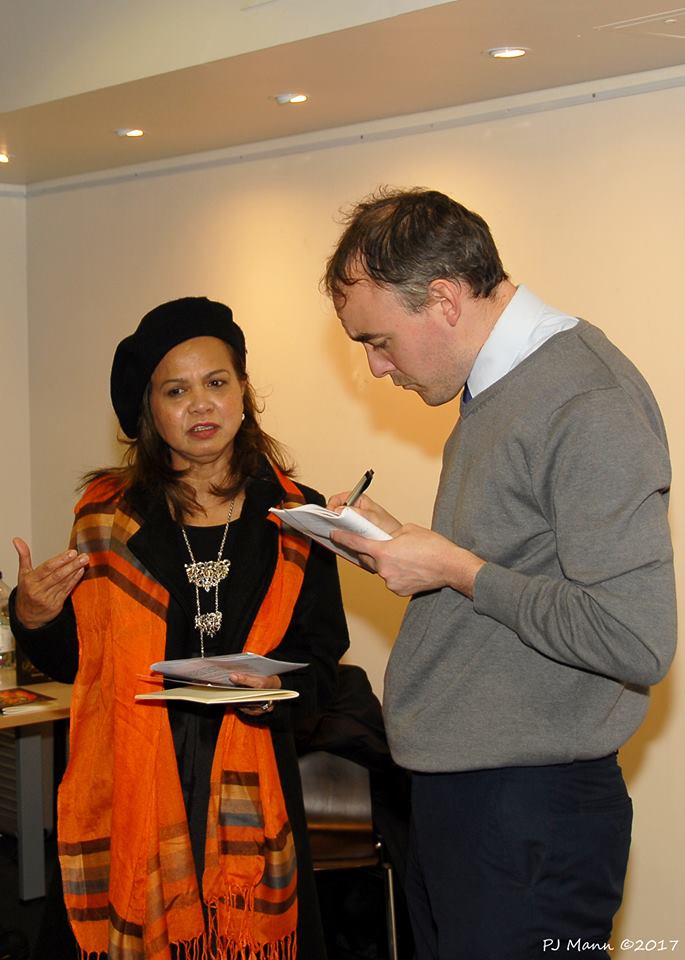
BRAVA! Amy Berry for the successful launch of Spearing Dreams on November 17 in Ireland and as reported by James Fogarty in the Rosecommon Herald, her hometown paper.  Direct message Amy on Facebook for info or check out the FB page dedicated to the book.

Poet Amy Barry (c) Philip Mann
Amy Barry being interviewed by James Fogerty of the Rosecommon Herald (c)  Philip Mann

I am tickled to note that Amy quoted me (Sweet, my friend. Thank you!) in her presentation:


SEQUESTRUM 2018 EDITOR’S REPRINT AWARD is open for submissions and deserves breakout from weekly Sunday Announcements because it’s rather unusual. There’s not all that much by way of opportunities for “reprints” and this one awards $500 to writers of fiction, nonfiction, and poetry. There will be a first-prize winner and “a minimum of two runners-up per genre.”  $15 entry fees. Deadline: April 30, 2018. Details HERE.


Value added courtesy of Michael Dickel (Meta / Phor (E) / Play) who shared it with us:


ABOUT THE POET BY DAY

Thousands and Millions, a poem by John Anstie

This is our (The BeZine) new poster for 100TPC 2018. It was designed by Corina Ravenscraft (Dragon’s Dreams)

One hundred thousand
Poets for change,
so many voices and
carefully chosen words,
at times decay into a void
of the anechoic chamber.

Earthly Fathers praying
for the Establishment,
that sets our stage,
and casts our values
in concrete, steel,
plastic … and carbon.

Leaders of the World,
whose balance sheets and
logical, numerate intellect
measure only a notion
of success. What is that?
Temper your ambition.

For aren’t we just that,
a wealth of rich and
creative intelligence,
maybe the only hope
for our universe
to understand itself?

Heavenly Mothers ask us
why digitise and monetise
and worship at the alter
of the great god, Thworg,
when we are in the face of
richness beyond measure.

Escape to the stars, if you will,
but answers will be found not
in the vanity of space-time travel,
but here, with this unaided vision
they lie in the green and blue,
right before your disbelieving eyes.

Permit your heart to rule
even if only one day a week, when
the visceral, and the common sense
will sit above logic and intellect, and
that subliminal noise in our head
will slowly rise to the conscious.

Maybe, one day we’ll be
Seven Thousand Million
Poets for Change!
Our time will come. Atonement beckons.
It’s in the wind, this beating heart,
a movement beyond the gaze of mortals …

© 2017 John Anstie, All rights reserved; posted here with John’s permission.  You can visit John at My Poetry Library.

This is John’s tribute to the 100,000 Poets for Change – 100TPC 2017 – movement, which had its annual celebration on 30th September.