Page 2 of 6

The BeZine, October 2017, Vol. 4, Issue 1, Music to the Eyes

October 15, 2017

After silence, that which comes nearest to expressing the inexpressible is music
~ Aldous Huxley


Reading Michael Dickel’s introduction to last month’s edition of The BeZine, sowing the seeds of the mindset at the roots of the ethos of this publication – promoting peace, sustainability and social justice – but in particular, overcoming anger and harnessing it for good, he quotes a good deal of Audre Lorde’s laudable speech and essay The Uses of Anger: Women Responding to Racism,  perhaps a reflection on what divides the world, what creates so much anxiety, political division, protective greed and selfishness.

So, we have music.

I don’t know about you, but there are few times in my life when music has done anything other than have a life enhancing and positive effect on me – with the possible exception of a Moody Blues concert I went to in 1969, in my university days, when I was left with a ringing in my ears for several days. This was, along with competitive shooting of Lee-Enfield .303 bore rifles at school, without ear defenders, probably the root of my tinnitus!  Subsequently, I carry ear plugs and try to avoid over amplified performances by groups of musicians, who employ sound engineers, who may be – shall we say – aurally challenged!

Music, particularly live and acoustic music has played and still does play an increasingly major part in most of my life; it provides a therapy against the rigours and stresses of everyday living. But it does more than this.

My personal perspective on the value of poetry has some relevance here. It is a belief that poetry should always be one step removed from the obvious, the logical and rational, in order for it to awaken the right brain, the creative side of our amazing abilities as humans; to stimulate the visceral (as opposed to the purely intellectual, rational, ‘logical’) response. In turn, this has the potential to stimulate a fresh approach to solving the challenges, be they personal or global. This hits on the core mission of The BeZine in a big way.

But if poetry has this potential power to stimulate a new way of thinking outside the framework imposed by a culture of consumerism, greed and material comfort, as opposed to our social well being, then music does so with a vengeance. It is truly visceral without the constraints of language. Of course, when the poetry of lyrics is introduced to create song, then there is the opportunity to create something that is greater than the sum of its parts; synergy. It can provide something that dwells in the conscious and even subconscious for a lifetime – whoever forgets the words and melody of a song that they heard at a very poignant moment in their lives, which continues to inhabit a special place in memory, resonate and invoke the most emotional response every time it is heard. There are a few who would argue this is ‘just an over-emotional response’, but it may well be the last resort for understanding and developing the insight to the human need for compassion as well as passion in our lives.

If music be the food of love, play on;” said Duke Orsino “give me excess of it”. The opening lines of Shakespeare’s “Twelfth Night” speaks much for music, even though he goes on, cynically “that, surfeiting, the appetite may sicken, and so die”.  Can you get too much of a good thing, I ask?

Music is so often a catalyst for romance. We could not even begin to count the number of songs that have ever been written over the ages on the subject of romantic or divine and spiritual love … and its consequences. However, I wonder how often we may contemplate how many instrumental or orchestral compositions there are, which, without words, in a different way, on a very different level, are capable of promoting a feeling of love and, equally, a sense of calm, peace, remorse, sadness, melancholy, a whole gamut of emotional responses that can and very often do bring about a state of mind that is elevated above the daily grind of our lives, the trauma, the tragedies, the disasters and injustices we witness every day in the news, and above all, the ability it has to help us cry. In this way, music can act as a protest against injustice and, in a sense, be ‘angry’, but still it can act as a relief for that anger, just as poets can find simply by writing a ‘political’ poem, which can relieve the frustration and anxiety brought about by political injustice. It is this value that I attach to music that I hold highest in my personal esteem for this art of arts.

It is, in fact, an art that can, like no other, combine the poetry of good lyrics, the rhythms of our roots, the vast array of instrumental sounds and voices, and the spine tingling harmonies they can create, into one; that can team itself with other art forms, particularly in photography, film and dance, but also notably in storytelling. What broadcast programme, be it documentary, drama, comedy, film (movie) is made without serious thought for the addition of music, a song, an orchestral piece, which so often includes a main theme along with incidental ‘tracks’ throughout its production, which then, of course, naturally leads to the merchandising of a soundtrack album.

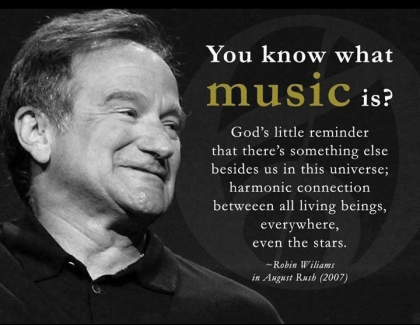
Even the latest generation of advertisers have realised the visceral value of music, sometimes combined with poetry (look at Apple’s poetic narration by the inimitable and dearly missed Robin Williams, who significantly quoted from Walt Whitman’s poem O Me, O Life to evoke the kind of emotional responses that are known to drive most human decisions … in this case, to buy!

As a test of how important a part music plays in teasing our wallets from our pockets, next time such an advert hits your screen, try turning off the sound. What are you left with … not a lot that is meaningful. Now here, I hope the photographers and cinematographers amongst us (Naomi Baltuck) will not take exception to this notion that still and moving pictures cannot move us, which of course they can and a similar thesis to this could be written for the visceral value of great pictures, but I know you will trust that my meaning, in this context, is well intended!

This month, as lead editor for the anniversary edition of The BeZine, the first of its fifth year, we feel quite frankly blessed with the quantity and quality of contributions we have received from our regular core contributors, and I take my hat off to our new guest contributors, including some very talented young writers and musicians. The sizeable response of quality submissions makes this, I believe, our largest issue yet; like a big fat magazine, but without any adverts, in itself, says something about the importance we attach to music.

We have poems galore, almost all of which touch the music theme or contain subtle references to it. Two fellow Brits are amongst the new contributors to The BeZine. From musician and composer, Joseph Alen Shaw, a piece that addresses the core of the Bardo Group Bequines mission, Music Beyond Belief, on the subject of faith and musical composition in the 20th Century. Joseph has also contributed another account of one of his recent compositions, the Wentworth Cantata. British newcomer, historian and musician, Emily Needle, has written an account of her research on her travels through Eastern USA in 2005, into the achievements of a remarkable and little known Charleston man, who had a surprisingly big influence on Jazz music in the early 20th Century.

Beside Joseph and Emily, other new contributors have all embraced the music theme in such creative ways, mostly poetry but also some lyrical prose, with very interesting results. Stephanie Williams’ Singing Man is a charming prose piece that evokes a child’s certain view of what they like. S.R. Chappell has written a couple of poems in praise of music. Kakali Das Ghosh, in her poem, presents us with some very mystical feelings. Andrew Scott gives us a story of a gritty performer with all the emotional baggage that can accompany that way of life, and JB Mulligan writes three deeply insightful and thought provoking poems.

All of our regular contributors have also given us a wealth of musical delight and I thank them all for their excellence that has made this issue very special.

Further Acknowledgments

Thanks are due to Glen Armstrong (his deeply nostalgic plea for vinyl records that ‘once had purpose’), Naomi Baltuck (for your photo essay with a family musical conclusion), Sonja Benskin Mesher (her beautiful reflective on ageing, remembering, companionship ends with music), Paul Brookes (fine poems, particularly clever is his onomatopoeic on a Bodhrán), Miki Byrne (whose poems about performance are both clever and revealing), Bill Cushing (and his handful of poems with oh so subtle musical references), Jamie Dedes (whose Orchestra of Impossible Beauty relates the moving story of the British ‘ParaOrchestra’ comprised of people with a variety of disabled conditions), Renee Espriu (and who can resist the image of how a child can hear the recording in a seashell of the sound of the sea or how they can bring home from school a musical instrument that’s bigger than themselves!), Denise Fletcher (on a trip to a Country Music Festival or the intrusive quality of loud music), Priscilla Galasso (for her usual insightful qualities), Mike Gallagher (for his remarkable, lyrical prose piece), Mark Heathcote (and his Whispering Muse), Charles Martin (and his ekphrastic haiku / senryu triplet), Liliana Negoi (for super imaginative variety of expression), Phillip Stephens (with a further challenging ekphrastic poem), John Sullivan (whose poems include a conversation with his radio, deeply embedded with the blues and a call to the Tripitaka of Buddhism), Lynn White (for not allowing us to forget the importance in our lives of birdsong), and the artful collaboration of photograph Amy Bassin and poet Mark Blickley in Screaming Mime.

So much delight from each and every one of our writers, I can’t tell you what a pleasure this has been, to write about one of my favourite pastimes.

Enjoy.

John Anstie, Contributing Editor and Team Leader for the Music Issue

Illustrations are courtesy of From: ‘Notable Quotes’ hand carved code


THANK YOU!

It seems somehow right that we dance into our fifth year on a musical note and John’s perceptive and passionate introduction to this month’s The BeZine. It is no exaggeration to say that the longevity of this 100% volunteer effort is the outgrowth of the stalwart support of readers and contributors and the work, creativity, vision and perspicacity of our core team: John Anstie, Naomi Baltuck, James R. Cowles, Michael Dickel, Priscilla Galasso, Chrysty Hendrick, Joseph Hesch, Ruth Jewel, Charlie Martin, Liliana Negoi, Lana Phillips, Corina Ravenscraft ,Terri Stewart (founder of Beguine Again, our sister site), and Michael Watson.

There are so many other ways readers, contributors and team could choose to spend valuable time, but you have all chosen to invest a portion in this small effort to build a community of others.

This site was founded in 2011 with three American Buddhist friends. Two have passed on. Since that time as both blog and zine we have published the works of like-minded representing all races, at least six religions, agnosticism and atheism and, I believe, nearly thirty countries. We have stood in solidarity for kindness and joy and raised our voices for peace, environmental sustainability and social justice.  

HAPPY ANNIVERSARY to all of us. Thank you everyone and may peace and friendship prevail.

On behalf of the Bardo Group Beguines
and in the spirit of peace, love (respect) and community,
Jamie Dedes
Managing Editor

MUSIC TO THE EYES

How to read this issue of THE BeZINE:

Click HERE to read the entire magazine by scrolling, or
You can read each piece individually by clicking the links in the Table of Contents.
To learn more about our guests contributors, please link HERE.
To learn more about our core team members, please link HERE.


TABLE OF CONTENTS

Poetic Musical Musings

Underneath The Stairs, John Anstie

Cannonball Adderley Adrift, Glen Armstrong

Post-Punk, Glen Armstrong

Used Records, Glen Armstrong

Under A Rainbow. Somewhere., Mendes Benito

First Time, Paul Brookes

Bodhrán, Paul Brookes

When I Used to Play, Miki Byrne

Beginners Night, Mike Byrne

Applause, Miki Byrne

For Gilly Dangerous, Miki Byrne

Music Crashing, S.R. Chappell

Music Within, S.R. Chappell

Ode to Nina Simone, Bill Cushing

On Modest Mussourgsky’s “Bydlo”, Bill Cushing

La Rosa & El Dragon (impressions from the music of “Pan’s Labyrinth”, Bill Cushing

“Zooz’s Brasshouse” Busking, Bill Cushing

Blakeson, Bill Cushing

Harmonic Chanson, Kakali Das Ghosh

The Music of the Conch Shell, Renee Espriu

The Music of Prowess, Renee Espriu

Intrusion, Denise Fletcher

The Whisper of the Muse, Mark Heathcote

Three Notes, Charles Martin

As We Go Together, Sonja Benskin Mesher

String Quartet, JB Mulligan

Consolation #3 in D Flat by Liszt,  JB Mulligan

Canon, JB Mulligan

Song for Agriope, Liliana Negoi

Feathery Song, Liliana Negoi

Mr. Bluesman, Andrew Scott

Understanding the Flautist (Meditation on a Peace Painting), Phillip T. Stephens

Llano Estacado, John Sullivan

True Emergency, John Sullivan

Aubade on Royal Street,  John Sullivan

Chill, Lynn White

To The Passing of The Nightingale,Lynn White

~~~~~~~

Musical Insights

Press Play, Photo Essay from Naomi Baltuck

How Hawkwind Improved My Adolescence, Paul Brookes

A Christmas Reflection On Skepticism and A Confession, James R Cowles

Country Music, Cow Pokes and City Girls, Jamie Dedes

The Orchestra of Impossible Beauty, Jamie Dedes

 Stars In My Eyes, Denise Fletcher

Beyond Music Appreciation, Priscilla Galasso

The Clonmel Set, Mike Gallagher

From Rags Through Race to Ragtime, Emily Needle

The Presence of Sound,  Liliana Negoi

Music Beyond Belief, Joseph Alen Shaw

The Singing Man, Stephanie Williams

~~~~~~~

Music, Video & Special Interest

My (Sort of) Desert Island Discs, John Anstie

Wentworth Cantata, Joseph Alen Shaw

Screaming Mime, Amy Bassin and Mark Blickley

Stocksbridge Memorial Project, Ian McMillan

Translating Words Into/From Music, Liliana Negoi


Except where otherwise noted,
ALL works in The BeZine ©2017 by the author / creator


CONNECT WITH US

The BeZine: Be Inspired, Be Creative, Be Peace, Be (the subscription feature is below and to your left.)

Daily Spiritual Practice: Beguine Again, a community of Like-Minded People

Facebook, The Bardo Group Beguines

Twitter, The Bardo Group Beguines

Submissions:

Read Info/Missions StatementSubmission Guidelines, and at least one issue before you submit. Updates on Calls for Submissions and other activities are posted every Sunday in Sunday Announcements on The Poet by Day.


Music Beyond Belief: an explaination of the relationship between personal faith and musical composition by composer Joseph Alen Shaw


Musical notation from a Catholic Missal, c. 1310–1320 * This beautiful Missal made from parchment originates from East Anglia. It is considered a very important manuscript as it is one of the earliest examples of a Missal of an English source. Sarum Missals were books produced by the Church during the Middle Ages for celebrating Mass throughout the year – uncopyrighted/CC0

Here is a feature to whet your appitite for the upcoming (October 15) issue of The BeZine, which is themed music. This essay is by Joseph Alen Shaw, composer, musician and scholar. It is shared here with Mr. Shaw’s permission. He and his essay come to us via John Anstie. John, a musician and poet, is the lead for the October issue. You can visit John at My Poetry Library. J.D.


“Any discussion of modernity’s mainstream in music would be incomplete without a serious reflection on the spiritual values, belief and practice in composer’s minds.” – James Macmillan (2013)

Western music throughout its history has undoubtedly been shaped enormously by religious and/or philosophical beliefs. One can only vaguely attempt to imagine the plethora of alternative courses of development which may have unfolded if it were not for the original patronage of the church and the influence this had, particularly in terms of the composition and performance of music. The last two centuries however saw a change in the way religion is perceived and practiced in many parts of the world and this had an inevitable effect on music. As part of a lecture held at the University of Notre Dame in September 2013, the Scottish composer James MacMillan highlighted some very important points about how faith and music have co-existed in the past and furthermore how they are allied now. He states that ‘there are some forms of art where the connections with the numinous are more difficult to discern than others. In the case of music, there seems to be a veritable umbilical link with the sacred.’ He goes on to say that ’composers have always responded to society’s need for spiritual and religious feeling’ and examples of this attitude can be seen from Bach to Stockhausen, from Lutheran Chorales to Sternklang (Park Music), 1971. The former were essential to the churchgoer’s daily experience in prayer and ritual, whilst the latter had a similar impact on the public wherever Sternklang was performed in attempting to lift their spirits into a realm above our own. This evidently affirms the ‘umbilical’ link furthermore.

Stockhausen said that ‘a creative person is always most excited when something happens that he cannot explain, something mysterious or miraculous.’ And similarly Michael Tippett with his remark that ‘it is a great responsibility: to try to transfigure the everyday by a touch of the everlasting.’ Macmillan in his lecture poses the question ’can a religious artist still be understood and affirmed in our own time?’ The answer to this is not as simple as yes or no but just as important is the notion of non-belief, realism or atheism and how composers who fall into this category fit in on the spectrum of philosophy in music composition and performance. A similar question could be asked of composers who base their reasoning on science and a more skeptical view of the world around them as inspiration for composition. Are their ideas valid and as fruitful as those inspired by faith?

Kenan Malik in an article entitled What Is Sacred About Sacred Music? explores notions of how transcendence itself can be defined by humans as physical and social beings. For religious believers, the sacred of course is that which is associated with divinity and holiness, but as shown below it can have a meaning beyond divinity:

Transcendence does not, however, necessarily have to be understood in a religious fashion; that is solely in relation to some concept of the divine. It is rather a recognition that our humanness is invested not simply in our existence as individuals or as physical beings, but also in our collective existence as social beings and in our ability to rise above our individual physical selves and to see ourselves as part of a larger project, to project onto the world, and onto human life, a meaning or purpose that exists only because we as human beings create it.

Turning to the question of composers’ personal beliefs and how it may or may not affect the music they compose, it is certainly true that what composers do and indeed that which they create is not necessarily what they believe. Composers have to make a living and keep their ‘head above water’ and even with the wealth of material and knowledge available to musicologists at the present time the option to know the true thoughts and beliefs of composers from the early centuries in matters of faith cannot be readily available. Much of the information pertaining to these artists’ real personal beliefs have to remain shrouded in the realm of speculation. The most accurate piece of information would most likely be their confidential diaries and not letters that could contain bias towards certain ideas for reasons of personal circumstance. This applies much more to composers from the centuries past and less so to artists closer to the present day who could be vocal about their beliefs and, with the advent of new technologies, in the cases of living composers, still are.

The more interesting strand to emerge from this line of enquiry however is how a composer’s personal belief or faith feeds into the compositional process and the musical product thereafter, if at all. One could be argued that the key question to be asked is whether or not an artist whose convictions are so deeply rooted within themselves could possibly have produced the same music without their beliefs that they hold so dearly. Kevin Malone is an academic lecturer and composer at the University of Manchester. He refers to himself as a ‘realist’ and refutes the more common label of ‘atheism’ because of its tendency to ‘suggest there is theism in the first place’ which is an interesting idea in and of itself. In 2016 his new work Mysterious 44 was given its world premiere at the University, an opera that used the well-known Mark Twain story as its basis. In the story three young boys learn to read and thus begin to think for themselves, which angers a village priest and leads to consequences. The opera has a cast of fifteen live singers They interact with two invisible characters, video animation and a surround-sound electronic score. The ‘Richard Dawkins Foundation for Reason and Science’ funded the production of the opera twice and a voice recording of Richard Dawkins himself begins the opera with a reading from the Mark Twain text.

It is clear from this that religious texts and philosophical ideas nevertheless provide strong catalysts and even entire frameworks for composers who are not believers themselves. The twentieth century in particular has seen a wide range of composers from varying stylistic inclinations choose to write music which references the rich teachings and legacy of doctrinal liturgy, whether it is performed in actual services or not is irrelevant. As well as this composers have used a large amount of symbolism from faith as material, as did Kevin Malone in his opera where he comments that ‘just as religious composers may use tri-partite structures to symbolize what they see as a trinity of spirits, I too use some numerical devices.’ He also suggests that the use of structures relating to numbers are ‘composer’s conceits’ and nothing more:

Mysterious 44 is an entertainment. Good entertainment should also be educational and not just ear and eye titillation. By writing Mysterious 44 I strive to promote clear and individual thinking, self-determination and hopefully an expanded use of the musical arts to not beguile listeners into perpetuating group thinking but to stimulate the natural curiosity for truth of which each of us is capable.

The example below from earlier in the canon (Richard Strauss’ Also Sprach Zarathustra) shows a use of all the 12 pitches to represent science, which was written in response to Friedrich Nietzsche’s (1844-1900) ideas which would contend the ideas of Stockhausen in particular and suggest instead that our physical reality is all that exists and all that we are able to know. It becomes more difficult to associate musical composition and performance with a reach to the beyond as Stockhausen would with this model in mind. Again, here we can see that this manipulation of pitches in order to make a personal statement about the progress of science is a composer’s conceit and the effect is only achieved successfully because the music in itself is so sublime.

Example

One of the most influential composers and atheists of the twentieth century, chose to use part of the liturgical doctrine in a composition which brought about an entirely new style of composition in the middle of the 1960s.

György Sándor Ligeti was born on 28th May 1923 in a small town of only five thousand inhabitants which is now Transylvania. Despite not having any particular religious upbringing as a child, the young Ligeti had an interesting fantasy life and a strong grasp of the world around him simultaneously. He invented his own utopian society called Kylwiria in which there would be no suffering or death, and even created a whole new language for such a place also. These sorts of fantasies of course are very common amongst young children but Ligeti was an exception in that they persisted into his teens and the ideas which had formed in his mind from this cemented themselves into kernels of artistic vision which would go on to inspire even some of the last pieces he composed in his last years. Interestingly one of Ligeti’s first attempts at composition at the age of sixteen was a large symphony in A minor based on elements from Also Sprach Zarathustra which he worked on over two summers in a cemetery near to his home. As previously noted Ligeti was not a practicing Jew and became Jewish ‘only through persecution’ at the hands of the Nazi regime in World War II. His family suffered horrendously as the hands of the same forces, with his father and brother both being murdered in the concentration camps. For many years he believed his mother had died too in Auschwitz, but her medical training saved her as she was skilled as a doctor in the camp. Throughout much of this time Ligeti ‘stayed alive by coincidence.’ He fled Hungary in 1956 and began a new life in the West, earning his place as one of the key figures of the new musical establishment alongside those such as Boulez and Stockhausen.

In a radio interview broadcast on July 2006 with John Tusa (the managing director of the Barbican Centre at the time), Ligeti discussed in great detail various aspects of both his socio-political and religious beliefs. Ligeti was described as being ‘the great atheist composer’ by Tusa and this poses further questions on Ligeti’s personal relationship or lack thereof with the mysterious and miraculous, which Stockhausen refers to. It seems to suggest that in conversation with his colleagues both publicly and privately, he may have been very open about his lack of any true religious conviction of one kind or another. Thomas May (a contributing writer to the San Francisco symphony’s program book) explains that ‘Ligeti had developed an immunity to all ideologies’, and a strong case can be made that his lack of adherence to any of the major monotheistic religions is not surprising, having suffered both directly and indirectly at the hands of two severe dictatorships from the beginning of the twentieth century. Ligeti’s father was certainly considered to be ‘an atheist and socialist’and whether these characteristics would have been passed on without the tragedies in his life is of course unknowable but does branch outward into an interesting line of enquiry. Ligeti taught his students to be non-believers but at the same time he was fully aware that a certain naivety was necessary as a creative artist and particularly as a composer. This idea was most likely one of the key components of the elevation of Messiaen in Ligeti’s admiration, whose faith permeated into all areas of his life and not just the art of his music.

One of the pinnacles of the composer’s achievements which gained him international status in the avant-garde circles was his Requiem, a prime example of the textural style of his early output begun in the spring of 1963 and completed in January 1965. It is also a fine example of how religious themes and ideas can be used and translated into a secular non-doctrinal context as compositional material. Interestingly Ligeti chose to set the Lux Aeterna as a separate piece slightly later in 1966. Only a year after the completion of the Requiem, the text and the sound world was still clearly fresh in his mind. The requiem as a form of composition has had a long and rich history in the canon of Western classical music. James Macmillan emphasises that as time has passed and the relationship between sacred music and its intended specific use in liturgical services has changed, ‘the liturgical forms have found their place in the concert halls of today’ and the Requiem is certainly no exception to this observation. The Ligeti requiem is intended to be a concert work and as he explains:

My Requiem is not liturgical. I am not Catholic, I am of Jewish origin, but I do not follow any religion. I took the text of the requiem for its image of the anguish, the fear of the end of the world.’

Paul Griffiths refers to this piece as ‘the most overwhelmingly impressive product of Ligeti’s cluster style’ and the effect on the listener is certainly warranted a similar description. As the composer himself said, his work is principally inspired by and revolves around the day of judgements and a primeval fear of the end of the world. It is essential a funeral mass for the whole of humanity, a personal statement about death which does not rely on its creator being a practicing believer of Catholicism or indeed any belief system to be able to relate to it.

The instrumentation of the orchestra at the start of the work reflects Ligeti’s natural instinct for extremes in the exploration of texture and timbre. It is scored for trombones, bass trombone, horns, contrabassoon bass tuba, contrabass clarinet, double bassoon, bass clarinet and double basses. For much of the piece Ligeti splits the chorus into four-part groupings of sopranos, altos, tenors and basses. Using this twenty-part texture to weave dense patterns of what Ligeti liked to call ‘micro-polyphony’. The clustered, harsh brass tones combined with the urgency of the vocal line both within solos and in unison throughout the piece provide the perfect response to the liturgical text. It has an overriding sense of desperation and helplessness which is inherent in the Dies Irae text. This piece is most certainly one of the finest examples of a religious work by a non-believer to have entered the repertoire so far.

Attitudes towards music and religious belief/philosophy have certainly changed dramatically over time as has been shown. A deep sense of religious conviction merely serves as a vehicle by which he/she is able to express him/herself. Performers and indeed listeners may benefit in some way from knowing the inspiration and/ compositional processes behind the music. However a composer in the most general sense is a creator who concerns him or herself with the sound as the building block materials of their art. The priority of any composer first and foremost therefore should be the creation of sound. Just as Ligeti was adamant that ‘the experience of terror does not lead to the creation of art’, nor necessarily does a personal experience of the divine for that matter.

Extra-musical inspiration is essential in the composition of music, whilst the relevance and transparency of the personal motivation of the composer within a piece itself is limiting and questionable at best. Although impossible to prove of course, it could be argued that Ligeti (because of the strong commitments to his new and particular musical language at the time in the 1960’s) would have written a similar Requiem if he had been a Catholic for instance. Similarly, a case could be made that Stockhausen’s experiments for most of his life in the electronic studio in Cologne would have been undertaken without his inclinations towards the mystic and otherworldly domains. Experimentation with sounds is the key factor here which draws composers to creating their work. Music as an art form is not a language although it can be treated as one in a variety of ways. Its syntax is that of a young child who can speak few words but is able to express an indeterminate amount more depending on the perceptiveness of the listener. Personal faith and music therefore are inextricably linked to varying degrees in the minds of composer, performer and listener.

© 2016, essay and illustration, Joseph Alen ShawAll rights reserved

Bibliography

Books:
Duchesneau, Louise, György Ligeti: Of Foreign Lands and Strange Sounds
Griffiths, Paul, György Ligeti. London: Robson Books, 1983
Harvey, Jonathan, Music and Inspiration, London: Faber and Faber, 1999
Stienitz, Richard, György Ligeti: Music of the Imagination, London: Faber and Faber, 2003
Toop, Richard, György Ligeti, London: Phaidon, 1999

Websites:
Macmillan, James, Conversations with Composers,  (accessed on 02/04/2016)
Mallick, Kenan, what is sacred about sacred music?, (accessed on 02/04/2016)
May, Thomas, Ligeti: Lux aeterna (accessed on 02/04/2016)
Sabbe, Hermanna, Conversation with Ligeti (1978), (accessed on 02/04/2016)
Tusa, John, Interview with Ligeti

Scores:
Ligeti, György. Requiem, for SMez soli, 2 choruses and orchestra. Folio score, London: Peters, 1965

Recordings:
Ligeti, György. Works, for orchestra. Selection. Compact disc , The Ligeti project IV, Hamburg: Teldec, 2003, 8573 88263-2

Country Music, Cow Pokes and City Girls

An old cowboy went a riding on one dark and windy day … Riders in the Sky: a Cowboy Legend (1948), Stan Jones (1914-1963), American actor and songwriter


Just a little warm-up for the upcoming Music issue of The BeZine (October 15th). 


When he was twelve, Stan Jones heard a tale from an old cowboy. It was the inspiration for Ghost Riders. This version by Johnny Cash and Willie Nelson sounds to my fancy a bit like something of the Old West (1865-1895), not that I would really know.

I was born and educated in the Eastern U.S. about half-a-century after the Old West died. One day, I landed in the Western U.S., California, and stayed. Like most Americans of my time, I was reared on accounts (fiction and nonfiction) of the romanticized and reprehensible wild wild West. After having been fed on everything from Bret Harte’s short stories to cowboy songs and poetry to cowboy shows and movies, I was anxious upon arrival in California to explore the places that were legendary like San Francisco, Sacramento and Stockton.  


A cowboy posing on a horse with a lasso and rifle visibly attached to the saddle, a quintessential Old West image. Public domain photograph courtesy of United States Library of Congress’s Prints and Photographs division under the digital ID cph.3a15520

For me part of the mystique of the Old American West and its music, poetry and culture was that so many of the famous and infamous characters were actually not all that long dead when I was born. Buffalo Bill Cody died in 1917. Annie Oakley died in 1926, just ten years before my sister was born. Bat Masterson (lawman, marshal, buffalo hunter, gambler, and army scout) had retired from one of the most violent and lawless eras in the West to work as an East Coast sports editor and writer at my hometown paper, The New York Morning Telegraph (now defunct). He held that job in 1914, the year my mom was born. He died in 1921, after several more of her siblings came into this world. Although I very much doubt that my grandfather read about sports, it’s not unlikely that my mom’s older brother, Daher, read Masterson’s columns.

Ghost Riders was one of those songs that made me feel connected to the colorful characters of the Wild West who’d so recently tread this earth.  It also made me feel connected to the wider world. It’s probable that the story that inspired Stan Jones was some version of the almost universal tale of “the hunt,” which predates Christianity in Europe and arrived in the States with settlers from Europe, perhaps especially Germany and the Scandinavian countries. It’s a lyrical version of a lost soul caught in a never-ending hunt lead by a devil, shape shifter or psychopomp. Think of Gabriel Hounds or Woden’s Hunt. The German folklorist Jacob Grimm wrote about the hunt.

“Another class of spectres will prove more fruitful for our investigation: they, like the ignes fatui, include unchristened babes, but instead of straggling singly on the earth as fires, they sweep through forest and air in whole companies with a horrible din. This is the widely spread legend of the furious host, the furious hunt, which is of high antiquity, and interweaves itself, now with gods, and now with heroes. Look where you will, it betrays its connexion with heathenism.”
 .
Music has such a wonderful way of linking personal history and shared history. For me, Ghost Riders is just one example of this decidedly satisfying interconnection.
.

© 2017, Jamie Dedes


Ghost Riders in the Sky

An old cowboy went riding out one dark and windy day
Upon a ridge he rested as he went along his way
When all at once a mighty herd of red eyed cows he saw
A-plowing through the ragged sky and up the cloudy draw

Their brands were still on fire and their hooves were made of steel
Their horns were black and shiny and their hot breath he could feel
A bolt of fear went through him as they thundered through the sky
For he saw the Riders coming hard and he heard their mournful cry

Yippie yi Ohhhhh
Yippie yi yaaaaay
Ghost Riders in the sky

Their faces gaunt, their eyes were blurred, their shirts all soaked with sweat
He’s riding hard to catch that herd, but he ain’t caught ’em yet
‘Cause they’ve got to ride forever on that range up in the sky
On horses snorting fire
As they ride on hear their cry

As the riders loped on by him he heard one call his name
If you want to save your soul from Hell a-riding on our range
Then cowboy change your ways today or with us you will ride
Trying to catch the Devil’s herd, across these endless skies

Yippie yi Ohhhhh
Yippie yi Yaaaaay

Ghost Riders in the sky

– Stan Jones


Last call for “The BeZine” October submissions; Logo Contest: Tell the Story of Gun Violence

Bone flute, over 41,000 years old, photo courtesy of dalbera under CC BY 2.0

 “Ah, music,” he said, wiping his eyes. “A magic beyond all we do here!” J.K. Rowling, Harry Potter and the Sorcerer’s Stone

THE BeZINE submissions for the October 2017 issue – themed Music – are open and the deadline is October 10thSend submissions to me at bardogroup@gmail.com. Publication is October 15th. Poetry, essays, fiction and creative nonfiction, art and photography, music (videos or essays), and whatever lends itself to online presentation is welcome for consideration. No demographic restrictions.

Submissions of work on your country and its history and culture are welcome no matter your citizenship, national origin, first language, religion or lack thereof. The more diverse the representation, the better. English only or accompanied by translation into English. Please check out a few issues first and the Intro/Mission Statement and Submission Guidelines. We DO NOT publish anything that promotes hate, divisiveness or violence or that is scornful or in any way dismissive of “other” peoples. The lead for the October issue is Sheffield poet and musician, John Anstie (My Poetry Library and 42).

Note: I’ll consider previously published work as long as you hold the copyright. / J.D.


LOGO CONTEST: Guns Don’t Save People, Poets Do

Asking yourself: What can I do about horrors like Las Vegas and Sandy Hook? Give your thoughts a platform, be apart of the solution…design our GUNS DON’T SAVE LIVES, POETS DO2017 logo. Facebook friends, fans and followers will be the judges. Send entry to poetsout@gmail.com.

FOUNDER: EVELYN AGUSTO

DEADLINE: December 1st, 2017


ABOUT THE POET BY DAY