She does not shirk, but does her work, Amid the world’s fast hustling whirl, And come what may, she’s here to stay, The self-supporting “bachelor girl.”
Effie Waller Smith (1879 – 1960) was an African-American poet of the late nineteenth and early twentieth century. She was smart, independent, and ahead of her time. Her collections are: Songs of the Month (1904), Rhymes From the Cumberland (1904), and Rosemary and Pansies (1909). Her work was featured in local newspapers and in some of the major publications of the day.
Effie Waller was born to former slaves in the rural mountain community of Chloe Creek in Pike County, Kentucky, on a farm located a few miles from Pikeville.Her father, Frank Waller, migrated to the East Kentucky mountains sometime after the Civil War, having spent most of his early life as a laborer on a Virginia plantation. Her mother, Sibbie Ratliff, was born and raised in East Kentucky and met Frank Waller in the early 1870s. Effie was the third of four children.
Frank Waller was a blacksmith and a real estate speculator. Chloe Creek, the area in which the Wallers lived, was unusual for the time. It was racially integrated. The Wallers were responsible, hard-working, and clean-living. Frank and Sibbie, realizing the limits of their own educations, were determined that their children would receive a quality education and Effie and her siblings were educated at Kentucky Normal School for Colored Persons in Frankfort, the capitol of Kentucky. Effie subsequently taught in Kentucky and Tennessee.
Effie Waller Smith’s work is worth reading. Unfortunately, the charges on Amazon and Alibris are outrageous and her work is not included in The Gutenberg Project, where you’d be able to download it for free. You might try connecting with Steve at Scholar and Poet Books, EB and Scholar and Poet Books, Abe Books to see what he has at what price. You can find a few of her poems around on the Internet. Her poems The “Bachelor Girl and The Cuban Cause are included in New Daughters of Africa: An International Anthology of Writing by Women of African Descent, Margaret Busby. The “Bachelor Girl” is also posted on Literary Ladies HERE. I clipped Apple Sauce and Chicken Fried (posted below the video) from Poem Hunter.
With a nod to Wikipedia; Illustration: Public Domain
It you are reading this post from an email subscription, it’s likely you’ll have to link through to the site to view this video of Effie’s life and work.
Apple Sauce and Chicken Fried
You may talk about the knowledge
Which our farmers’ girls have gained
From cooking-schools and cook-books,
(Where all modern cooks are trained):
But I would rather know just how,
(Though vainly I have tried)
To prepare, as mother used to,
Apple sauce and chicken fried.
Our modern cooks know how to fix
Their dainty dishes rare,
But, friend, just let me tell you what!-
None of them can compare
With what my mother used to fix,
And for which I’ve often cried,
When I was but a little tot,-
Apple sauce and chicken fried.
Chicken a la Française,
And also fricassee,
Served with some new fangled sauce
Is plenty good for me,
Till I get to thinking of the home
Where once I used to ‘bide,
And where I used to eat,- um, my!
Apple sauce and chicken fried.
We always had it once a week,
Sometimes we had it twice;
And I have even known the time
When we have had it thrice.
Our good, yet jolly pastor,
During his circuit’s ride
With us once each week gave grateful thanks
For apple sauce and chicken fried.
Why, it seems like I can smell it,
And even taste it, too,
And see it with my natural eyes,
Though of course it can’t be true;
And it seems like I’m a child again,
Standing by mother’s side,
Pulling at her dress and asking
For apple sauce and chicken fried.
A homebound writer, poet, and former columnist and associate editor of a regional employment publication, my work has been featured in print and digital publications including: ‘Levure littéraure,’ ‘Ramingo’s Porch,’ ‘Vita Brevis Literature,’ ‘Connotation Press,’ ‘The Bar None Group,’ ‘Salamander Cove,’ ‘I Am Not a Silent Poet,’ ‘The Compass Rose’ and ‘California Woman.’ I run The Poet by Day (jamiededes.com), an info hub for poets and writers. I am also the editor of a quarterly online publication, ”The BeZine’ (thebezine.com).
Thank you for sharing your love of words. Comments will appear after moderation.
This is a poem by Alan Lowe. You might remember that Alan is the gentleman who – along with Sue Clark, the members of the Poets Club of Lincoln, The Lincoln Library and The Friends of the Lincoln Library – invited readers to submit poems to be considered for the library’s annual poetry contest, no demographic or geographic restrictions, and no entry fee. Details on the 15th Annual Voices of Lincoln Poetry Contest HERE. I wanted to introduce you to Alan and what better way to do so than with a poem he wrote? It’s a poem that reminds us of just how vulnerable we can be as school-age youth.
My Special Angel
I’m trembling,
but I don’t know why.
She tells me
I shouldn’t be scared,
but I am.
I want to believe her—
my wonderful, special angel.
She has never let me down,
but this seems different.
I can’t put my finger on it—
it’s so hard to describe.
With dark, black clouds overhead,
gray shadows pervade my world.
Graceful ghostlike figures dance
to a tune I’m unable to hear.
They motion to me to join them,
to become a part of their show.
The trembling gets worse,
tears form in my eyes.
I want to run away
and hide from the things
I don’t understand and can’t explain.
But my angel tells me I must not.
“It’s just part of growing up,”
she declares.
“You have to face your demons,
conquer your fears,
and develop into a strong person.”
“But I’m only twelve-years old,”
I cry out in frustration.
“I know,” she says,
placing her hands on my shoulders,
as she turns to go back
to the front of the classroom.
ALAN LOWE (The Truth of the Matter Is ….) was born and raised in New York, but has spent over fifty-four years in California, the past seventeen living in Lincoln with his wife, Barbara. Earning a Ph.D. in Educational Psychology/Counseling from UCLA, he spent thirty-nine years working in higher education as a teacher, counselor, and administrator. He retired in 2008. His background in Psychology colors his writing, much of which centers on feelings, perceptions, and how people interact in our complex world. In retirement, he enjoys writing poetry, short stories, and plays. His poetry has placed in contests and has been published in newspapers and periodicals. Three of the plays he has written have been performed under his direction. As a member of the Poets Club of Lincoln, he has served as the Coordinator of the Voices of Lincoln Poetry Contest since 2009. The contest has grown steadily and has become international in scope.
Poet and writer, I am a former columnist and associate editor of a regional employment publication. Currently, I run this site, The Poet by Day, an information hub for poets and writers. I am the managing editor of The BeZine published by The Bardo Group Beguines (originally The Bardo Group), a virtual arts collective I founded. I am a weekly contributor to Beguine Again, a site showcasing spiritual writers. My work is featured in a variety of publications and on sites, including: Levure littéraure, Ramingo’s Porch, Vita Brevis Literature,Compass Rose, Connotation Press, The Bar None Group, Salamander Cove, Second Light, I Am Not a Silent Poet, Meta / Phor(e) /Play, and California Woman. My poetry was recently read byNorthern California actor Richard Lingua for Poetry Woodshed, Belfast Community Radio. I was featured in a lengthy interview on the Creative Nexus Radio Show where I was dubbed “Poetry Champion.”
“What if our religion was each other. If our practice was our life. If prayer, our words. What if the temple was the Earth. If forests were our church. If holy water–the rivers, lakes, and ocean. What if meditation was our relationships. If the teacher was life. If wisdom was self-knowledge. If love was the center of our being.” Ganga White, teacher and exponent of Yoga and founder of White Lotus, a Yoga center and retreat house in Santa Barbara, CA
“Every pair of eyes facing you has probably experienced something you could not endure.” Lucille Clifton
Thank you for sharing your love of words. Comments will appear after moderation.
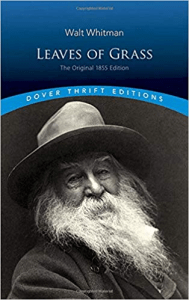
Walt Whitman (1819 – 1892) as photographed by Mathew Brady / Public Domain
“This is what you shall do; Love the earth and sun and the animals, despise riches, give alms to every one that asks, stand up for the stupid and crazy, devote your income and labor to others, hate tyrants, argue not concerning God, have patience and indulgence toward the people, take off your hat to nothing known or unknown or to any man or number of men, go freely with powerful uneducated persons and with the young and with the mothers of families, read these leaves in the open air every season of every year of your life, re-examine all you have been told at school or church or in any book, dismiss whatever insults your own soul, and your very flesh shall be a great poem and have the richest fluency not only in its words but in the silent lines of its lips and face and between the lashes of your eyes and in every motion and joint of your body.” Walt Whitman
My apologies to the people with email subscriptions for accidentally hitting the publish button before this was properly completed.
The Library of Congress will celebrate the 200th anniversary of American poet and change-maker Walt Whitman’s birthday with a series of exhibits, public programs and a digital crowdsourcing campaign to showcase the Library’s unparalleled collections of Whitman’s writings and artifacts.
The Library’s Whitman Bicentennial series will be part of the citywide Walt Whitman 200 Festival and other commemorations in the Mid-Atlantic where Whitman spent most of his life. He spent about ten years living and writing in Washington. During the Civil War, he volunteered in military hospitals in the city to offer emotional support to wounded soldiers.
Whitman worked as a schoolteacher, printer, newspaper editor, journalist, carpenter, freelance writer and civil servant, but he is best known as one of America’s most famous poets – and as a poet of democracy.
The Library holds the most extensive array of Whitman and Whitman-related collections in the world, including manuscripts, rare books, prints and photographs. Collection items range from handwritten drafts of poems and early prose writings to rare editions ofLeaves of Grass, Whitman’s eyeglasses and walking stick and the most famous studio portraits taken in his lifetime. The manuscript collections are digitized and available online, as are many photographs.
The Whitman Bicentennial series is part of a year-long initiative in 2019 inviting visitors to Explore America’s Change-makers. ___
By the People Crowdsourcing Campaign April 24 – June
The Library’s crowdsourcing initiative “By the People” will launch a campaign April 24 to enlist the public to help transcribe several thousand pages of Whitman’s writings and papers to make them more searchable and accessible online. Documents selected for transcription will include samples of Whitman’s poetry, prose and correspondence, including versions of poems such as “Oh Captain! My Captain!” and fragments of poems Whitman published in more finished form in “Leaves of Grass.”
This is also a special opportunity for teachers and students to engage with Whitman’s creative process. Drafts and portions of his poems at various stages of composition reveal his active, creative mind, as well as his innovative ways of seeing the world and wordsmithing poetic expressions.
The Library will collaborate with the National Council of Teachers of English to host a Transcribe-a-Thon webinar on April 24 at 4 p.m. Eastern time. The one-hour event will bring together experts from the Library, NCTE and educators to discuss how students can analyze, transcribe, review and tag the Whitman papers. Registration is open to all and available here.
___
Whitman Bicentennial Display May 16 – Aug. 15
To mark the 200th anniversary of Whitman’s birth, the Library will display poetry, images and ephemera from Whitman’s life in the Thomas Jefferson Building. Five cases will display Whitman’s handwritten drafts, published poems, original letters, portraits and other rarely seen materials.
The display will retrace Whitman’s life, from his birthplace on Long Island, New York, his rise as an American poet, his life in Washington – including his intimate relationship with Peter Doyle, his care for Civil War soldiers and his admiration for Abraham Lincoln – his hands-on involvement with the design and publication of his poetry collection “Leaves of Grass” and pop culture references to Whitman and his legacy. It was “Leaves of Grass,” his break-through work of free verse celebrating democracy, sexuality, human potential, universalism and the natural world, that would earn Whitman worldwide fame.
___
Whitman in Culpeper Thursday, May 23 at 7:30 p.m. at Packard Campus Theater, Culpeper, Virginia.
For two months in early 1864, Walt Whitman resided in Culpeper, Virginia, while serving as a volunteer in the Army of the Potomac’s nearby field hospitals. Despite the ravages the war had visited upon the area, Whitman described Culpeper as “one of the pleasantest towns in Virginia.”
Local historian Bud Hall will present a talk at the Library’s Packard Campus Theater in Culpeper about Whitman’s time in the area, followed by a screening of “Shenandoah” (Universal, 1965). Jimmy Stewart stars as a Virginia farmer intent on keeping his family out of the Civil War, but with the battles being fought almost literally on his doorstep, struggles to maintain his neutrality.
___
Happy Birthday Walt! – Digitized Walt Whitman Collections from the Manuscript Division Thursday, May 30, 1 p.m. to 2 p.m.
Manuscript Division historian Barbara Bair will host a webinar highlighting the content and research use of three digitized manuscript collections: the Walt Whitman Collection of miscellaneous manuscripts; the Charles Feinberg collection of Walt Whitman Papers; and the Thomas Harned collection of Walt Whitman Papers. She will also discuss programs celebrating Whitman’s birthday at the Library of Congress. More information is available here.
___
Walt Whitman’s Birthday Party Saturday, June 1, 10 a.m. to 4 p.m.
The Young Readers Center will host a day for families that will celebrate Whitman and his legacy on June 1 in the Thomas Jefferson Building. Activities will include an author talk from 10 a.m. to 11 a.m., featuring author Robert Burleigh and illustrator Sterling Hundley discussing their book “O Captain, My Captain: Walt Whitman, Abraham Lincoln and the Civil War;” a birthday party for Whitman at 11 a.m.; and a book signing at 11:15 a.m. A Whitman butterfly maker activity and handouts of “Walt Whitman’s Guide to Nature Walking” will be available all day from 10 a.m. to 4 p.m.
From 1 p.m. to 4 p.m., visiting families are also invited to join in the Library’s crowdsourcing initiative “By the People” and help transcribe selections from Whitman’s writings and papers to make them more searchable and accessible online.
___
Walt Whitman Open House Monday, June 3, from 2:30 p.m. to 5 p.m.
The Library of Congress will present a Walt Whitman Open House display in Room 119 of the Thomas Jefferson Building, supplementing the ongoing Whitman Bicentennial Display with even more treasures from the Library’s collections. The Open House will feature a special array of rarely seen Walt Whitman collection items from the Manuscript, Rare Book, Music, and Prints and Photographs divisions, as well as Serials and General Collections. The display will include items pertaining to Whitman’s time in Washington, but also other materials from throughout his life, including the walking cane given to him by nature writer John Burroughs, draft poems, artistic renderings of Whitman and rare editions of “Leaves of Grass.”
As part of the celebration, the Library’s Poetry and Literature Center will host a special showing of the new documentary short film “Walt Whitman: Citizen Poet,” directed by Haydn Reiss and Zinc Films and produced in association with the Poetry Foundation. Filmed in part at the Library of Congress, “Walt Whitman: Citizen Poet” features Poets Laureate Tracy K. Smith and Robert Hass, among other poets, discussing Whitman’s life, poetry and legacy.
A reading of Whitman’s poems from his Washington years will follow at the Folger Shakespeare Library that evening.
___
The Library of Congress is inviting visitors to Explore America’s Changemakers in 2019 through a series of exhibitions, events and programs. Exhibitions drawing from the Library’s collections will explore the fight for women’s suffrage, Rosa Parks’ groundbreaking role in civil rights history and artists’ responses to major issues of the day. Other events throughout the year will explore changemakers through music, performances and public programs.
This crowdsourcing initiative “By the People” reflects advancement toward a goal in the Library’s new user-centered strategic plan: to expand access, making unique collections, experts and services available when, where and how users need them. Learn more about the Library’s five-year plan at loc.gov/strategic-plan/.
The Library of Congress is the world’s largest library, offering access to the creative record of the United States – and extensive materials from around the world – both on-site and online. It is the main research arm of the U.S. Congress and the home of the U.S. Copyright Office. Explore collections, reference services and other programs and plan a visit at loc.gov, access the official site for U.S. federal legislative information at congress.gov and register creative works of authorship at copyright.gov.
This feature is courtesy of the Library of Congress and Wikipedia
Poet and writer, I am a former columnist and associate editor of a regional employment publication. Currently, I run this site, The Poet by Day, an information hub for poets and writers. I am the managing editor of The BeZine published by The Bardo Group Beguines (originally The Bardo Group), a virtual arts collective I founded. I am a weekly contributor to Beguine Again, a site showcasing spiritual writers. My work is featured in a variety of publications and on sites, including: Levure littéraure, Ramingo’s Porch, Vita Brevis Literature,Compass Rose, Connotation Press, The Bar None Group, Salamander Cove, Second Light, I Am Not a Silent Poet, Meta / Phor(e) /Play, and California Woman. My poetry was recently read byNorthern California actor Richard Lingua for Poetry Woodshed, Belfast Community Radio. I was featured in a lengthy interview on the Creative Nexus Radio Show where I was dubbed “Poetry Champion.”
“What if our religion was each other. If our practice was our life. If prayer, our words. What if the temple was the Earth. If forests were our church. If holy water–the rivers, lakes, and ocean. What if meditation was our relationships. If the teacher was life. If wisdom was self-knowledge. If love was the center of our being.” Ganga White, teacher and exponent of Yoga and founder of White Lotus, a Yoga center and retreat house in Santa Barbara, CA
“Every pair of eyes facing you has probably experienced something you could not endure.” Lucille Clifton
Thank you for sharing your love of words. Comments will appear after moderation.
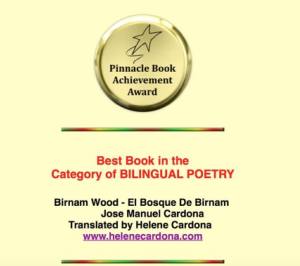
I know my Spanish isn’t anywhere good enough to fully appreciate José Manuel Cardona’s exquisite poetry, so it was with joy that I received the news of the publication of Birnam Wood: El Bosque de Birnam(Salmon Poetry; Bilingual edition, 2018) from Hélène Cardona along with a copy, her translation of her dad’s work.It has all the elements I most treasure in poetry. It is spiritually rich, vigorous, intuitive, conscious, disciplined and classic in its diction. It delivers warp and weave of Western mythology and, given his roots, it’s not surprising that his work sometimes puts one in mind of the Spanish mystic poets of the Catholic Church: Teresa of Avila and St. John of the Cross … And who better to translate his work, than his own daughter, a literary translator and a poet in her own right.
Señor Cardona, poet, writer, and translator from Ibiza, Spain, died last year. In his early life, the Franco regime forced him into exile in France. Years later, when the socialists came to power in Spain, he was offered a ministry position, which was ultimately denied him by the still heavily embedded Franquist administration. He remained blacklisted for several years.
Señor Cardona was also an attorney and translator who worked most of his life for the United Nations.
Here with permission are two poems from this collection, a highly recommended read indeed, most valued.
Ode to a Young Mariner
To my brother Manuel
The sea is a bride with open arms,
with stout rubber balls for breasts.
It is difficult to refuse her caress,
dryfrom the lips her brackish aftertaste,
forget her sweet bitterness.
Underneath her waters wails a rosaryof dead
centaurs, watchmen of the shadows.
Handsome men, hard as anchors torn
from the chest of a barbarian god.
It is difficult to refuse the call
of the sea, cover one’s ears,
grasp the neck with both hands
and become suddenly mute, or pluck out one’s eyes
and feed them to the fish. To ignore the gulls
and red masts and so many pennants,
and the ships arriving from unknown countries
and the ships departing for others
barely known, or perhaps for ours.
Because we carry within
like a blue keel or masts and spars
the marine bitterness of kelp,
the stripes on the back of fishes,
the tarry death
and our initials written in the sea.
Brother moving away to the bridge
like one more piece of our island,
the sea of mariners, your bride.
You know the smell of death
because you tread beneath a cemetery
that can be yours and you go brightly.
You know how the sea smells of life,
how at times she spits a ferocious foam,
how she wails wild and rises
like an atavistic being, a primitive creature.
We all carry death within written in furrows
like a name traced by the keel
of your boat in the sea. We are all sailors
of a sleeping bride with round breasts.
I don’t want to depart for the land,
to sprout like a eucalyptus branch
my eyes blinded by grass.
Wait for me, brother, when you anchor
your vessel in the sea you’ve loved.
No need to depart so alone, mariner
brother of a seaman gripped
by the earth’s open jaws.
From Birnam Wood / El Bosque de Birnam (Salmon Poetry, 2018), by José Manuel Cardona, translated by Hélène Cardona
Oda a un joven marino
A mi hermano Manuel
El mar es una novia con los brazos abiertos,
con los pechos macizos como balas de goma.
Es difícil negarse a su caricia,
secarse de los labios su regusto salobre,
olvidar su amargor azucarado.
Bajo sus aguas gime un rosario de muertos
centauros veladores de las sombras.
Hombres hermosos, duros, como anclas arrancadas
del pecho de un dios bárbaro.
Es difícil negarse a la llamada
del mar, taparse los oídos,
agarrar con las dos manos el cuello
y enmudecer de súbito, o arrancarse los ojos
y darlos a los peces. Ignorar las gaviotas
y los mástiles rojos y tantas banderolas,
y los barcos que llegan de países ignotos
y los barcos que parten para otros países
que apenas se conocen, o quizá para el nuestro.
Porque nosotros llevamos adentro
como una quilla azul o arboladura
el amargor marino de las algas,
las barras sobre el dorso de los peces,
la muerte alquitranada
y nuestras iniciales escritas en el mar.
La mar de los marinos, vuestra novia
hermano que te alejas sobre el Puente
como un pedazo más de nuestra isla.
Tú sabes el olor que huele a la muerte
porque pisas debajo un cementerio
que puede ser el tuyo y vas alegre.
Tú sabes como huele el mar a vida,
como vomita a veces fiera espuma,
como salvaje gime y se rebela
igual que un ser atávico, criatura primitiva.
Llevamos todos dentro la muerte escrita a surcos
como un nombre trazado por la quilla
de tu barco en el mar. Somos todos marinos
de una novia dormida con los pechos redondos.
Yo no quiero partir para la tierra,
brotar como una rama de eucalipto
con los ojos cegados por la hierba.
Espérame tú, hermano, cuando ancles tu nave
en la mar que has amado.
No has de partir tan solo, marinero
hermano de un marino atenazado
por las fauces abiertas de la tierra
From Birnam Wood / El Bosque de Birnam (Salmon Poetry, 2018) by José Manuel Cardona, first published in El Bosque de Birnam (Consell Insular de Eivissa, Ibiza 2007)
Poem to Circe IX
Humanly I’m illuminated.
I’m amazed every day by the roaring
Song that overflows like erosive
Blackberry juice, by the joyful
And boisterous song of men.
Voices stretch like branches,
Footprints like branches, flesh
Kindred to my flesh, and life’s
Juicy wind ripens.
I reincarnate with their centuries old footprints,
Their secular voices, their joy
So often painful, like a sick
Child carried on one’s back.
Oddly it’s on this island, Circe,
I have the strength to live.
Here humanity is embraced and screams
Mixing laughter with its colors,
Speaking the same language with varied
Accents. Love’s display
Becomes a ritual we officiate.
We arrived and the miracle happened.
It was the sea and the wind in the bells.
We came from far, from years
Thirsty as dust, from humble
fishermen’s nets on barren shore.
We arrived and the miracle with us.
It has jumped into the net like a liquid fish
And it has multiplied for all
And we satiated ourselves, and all of us
We walk through the sand as one.
You see, Circe, the miracle occurs
Whenever man wants it. The search
That is the mystery of all things.
From Birnam Wood / El Bosque de Birnam (Salmon Poetry, 2018), by José Manuel Cardona, translated by Hélène Cardona
Poema a Circe IX
Iluminado soy humanamente.
Me sorprendo a diario con el canto
Que ruge y se desborda como un jugo
Erosivo de moras, con el canto
Alegre y tumultuoso de los hombres.
Se distienden las voces como pámpanos,
Las huellas como pámpanos, la carne
Semejante a mi carne, y es el viento
Jugoso de la vida el que madura.
Reencarno con sus huellas de hace siglos,
Sus voces seculares, su alegría
Tantas veces penosa, como el hijo
Enfermo que se lleva a las espaldas.
Es en esta isla, Circe, donde siento
La fuerza de vivir extrañamente.
Aquí la humanidad se abraza y grita
Mezclando con la risa sus colores,
Hablando el mismo idioma con acentos
Variados. La evidencia del amor
Se transforma en un rito que oficiamos.
Llegamos y el milagro se produjo.
Ha sido el mar y el viento en las campanas.
Veníamos de lejos, de los años
Sedientos como polvo, de las redes
De humildes pescadores en mar yerma.
Llegamos y el milagro con nosotros.
Ha saltado a la red como un pez líquido
Y se ha multiplicado para todos
Y nos hemos saciado, y todos, todos
Andamos por la arena como un solo.
Ya ves, Circe, el milagro se produce
Siempre que el hombre lo quiere. La búsqueda
He ahí el misterio de todas las cosas.
From Birnam Wood / El Bosque de Birnam (Salmon Poetry, 2018) by José Manuel Cardona, first published in El Bosque de Birnam (Consell Insular de Eivissa, Ibiza 2007)
José Manuel Cardona
José Manuel Cardona (July 16, 1928 – July 4, 2018) is the author of El Vendimiador (Atzavara, 1953), Poemas a Circe (Adonais, 1959), El Bosque de Birnam: Antología poética (Consell Insular d’Eivissa, 2007).
He was co-editor of several literary journals and wrote for many publications. He participated in the II Congreso de Poesía in Salamanca and belonged to the Cántico group.
He worked for the United Nations most of his life, in Geneva, Paris, Rome, Vienna, Belgrade, Sofia, Kiev, Tbilisi, Moscow, St. Petersburg, and Panama, among many places.
Hélène Cardona
Hélène Cardona is the author of seven books, most recently Life in Suspensionand Dreaming My Animal Selves, and the translations Birnam Wood (José Manuel Cardona), Beyond Elsewhere(Gabriel Arnou-Laujeac), winner of a Hemingway Grant, Ce que nous portons (Dorianne Laux); and Whitman et la Guerre de Sécession: Walt Whitman’s Civil War Writings for WhitmanWeb. Her work as been translated into 15 languages.
Publications include Washington Square Review, World Literature Today, Poetry International, The Brooklyn Rail, Hayden’s Ferry Review, Asymptote, Drunken Boat, Anomaly, The London Magazine, The Warwick Review and elsewhere.
Acting credits include Chocolat, Jurassic World, Dawn of the Planet of the Apes, The Hundred-Foot Journey, Mumford, and Serendipity, among many.
Poet and writer, I am a former columnist and associate editor of a regional employment publication. Currently, I run this site, The Poet by Day, an information hub for poets and writers. I am the managing editor of The BeZine published by The Bardo Group Beguines (originally The Bardo Group), a virtual arts collective I founded. I am a weekly contributor to Beguine Again, a site showcasing spiritual writers. My work is featured in a variety of publications and on sites, including: Levure littéraure, Ramingo’s Porch, Vita Brevis Literature,Compass Rose, Connotation Press, The Bar None Group, Salamander Cove, Second Light, I Am Not a Silent Poet, Meta / Phor(e) /Play, and California Woman. My poetry was recently read byNorthern California actor Richard Lingua for Poetry Woodshed, Belfast Community Radio. I was featured in a lengthy interview on the Creative Nexus Radio Show where I was dubbed “Poetry Champion.”
“What if our religion was each other. If our practice was our life. If prayer, our words. What if the temple was the Earth. If forests were our church. If holy water–the rivers, lakes, and ocean. What if meditation was our relationships. If the teacher was life. If wisdom was self-knowledge. If love was the center of our being.” Ganga White, teacher and exponent of Yoga and founder of White Lotus, a Yoga center and retreat house in Santa Barbara, CA
“Every pair of eyes facing you has probably experienced something you could not endure.” Lucille Clifton
Thank you for sharing your love of words. Comments will appear after moderation.

 A homebound writer, poet, and former columnist and associate editor of a regional employment publication, my work has been featured in print and digital publications including: ‘Levure littéraure,’ ‘Ramingo’s Porch,’ ‘Vita Brevis Literature,’ ‘Connotation Press,’ ‘The Bar None Group,’ ‘Salamander Cove,’ ‘I Am Not a Silent Poet,’ ‘The Compass Rose’ and ‘California Woman.’ I run The Poet by Day (jamiededes.com), an info hub for poets and writers. I am also the editor of a quarterly online publication, ”The BeZine’ (thebezine.com).


 Poet and writer, I am a former columnist and associate editor of a regional employment publication. Currently, I run this site, The Poet by Day, an information hub for poets and writers. I am the managing editor of The BeZine published by The Bardo Group Beguines (originally The Bardo Group), a virtual arts collective I founded. I am a weekly contributor to


 Señor Cardona, poet, writer, and translator from Ibiza, Spain, died last year. In his early life, the Franco regime forced him into exile in France. Years later, when the socialists came to power in Spain, he was offered a ministry position, which was ultimately denied him by the still heavily embedded Franquist administration. He remained blacklisted for several years.


 Jamie Dedes' THE POET BY DAY Webzine