Walt Whitman (1819 – 1892) as photographed by Mathew Brady / Public Domain
“This is what you shall do; Love the earth and sun and the animals, despise riches, give alms to every one that asks, stand up for the stupid and crazy, devote your income and labor to others, hate tyrants, argue not concerning God, have patience and indulgence toward the people, take off your hat to nothing known or unknown or to any man or number of men, go freely with powerful uneducated persons and with the young and with the mothers of families, read these leaves in the open air every season of every year of your life, re-examine all you have been told at school or church or in any book, dismiss whatever insults your own soul, and your very flesh shall be a great poem and have the richest fluency not only in its words but in the silent lines of its lips and face and between the lashes of your eyes and in every motion and joint of your body.” Walt Whitman
My apologies to the people with email subscriptions for accidentally hitting the publish button before this was properly completed.
The Library of Congress will celebrate the 200th anniversary of American poet and change-maker Walt Whitman’s birthday with a series of exhibits, public programs and a digital crowdsourcing campaign to showcase the Library’s unparalleled collections of Whitman’s writings and artifacts.
The Library’s Whitman Bicentennial series will be part of the citywide Walt Whitman 200 Festival and other commemorations in the Mid-Atlantic where Whitman spent most of his life. He spent about ten years living and writing in Washington. During the Civil War, he volunteered in military hospitals in the city to offer emotional support to wounded soldiers.
Whitman worked as a schoolteacher, printer, newspaper editor, journalist, carpenter, freelance writer and civil servant, but he is best known as one of America’s most famous poets – and as a poet of democracy.
The Library holds the most extensive array of Whitman and Whitman-related collections in the world, including manuscripts, rare books, prints and photographs. Collection items range from handwritten drafts of poems and early prose writings to rare editions ofLeaves of Grass, Whitman’s eyeglasses and walking stick and the most famous studio portraits taken in his lifetime. The manuscript collections are digitized and available online, as are many photographs.
The Whitman Bicentennial series is part of a year-long initiative in 2019 inviting visitors to Explore America’s Change-makers. ___
By the People Crowdsourcing Campaign April 24 – June
The Library’s crowdsourcing initiative “By the People” will launch a campaign April 24 to enlist the public to help transcribe several thousand pages of Whitman’s writings and papers to make them more searchable and accessible online. Documents selected for transcription will include samples of Whitman’s poetry, prose and correspondence, including versions of poems such as “Oh Captain! My Captain!” and fragments of poems Whitman published in more finished form in “Leaves of Grass.”
This is also a special opportunity for teachers and students to engage with Whitman’s creative process. Drafts and portions of his poems at various stages of composition reveal his active, creative mind, as well as his innovative ways of seeing the world and wordsmithing poetic expressions.
The Library will collaborate with the National Council of Teachers of English to host a Transcribe-a-Thon webinar on April 24 at 4 p.m. Eastern time. The one-hour event will bring together experts from the Library, NCTE and educators to discuss how students can analyze, transcribe, review and tag the Whitman papers. Registration is open to all and available here.
___
Whitman Bicentennial Display May 16 – Aug. 15
To mark the 200th anniversary of Whitman’s birth, the Library will display poetry, images and ephemera from Whitman’s life in the Thomas Jefferson Building. Five cases will display Whitman’s handwritten drafts, published poems, original letters, portraits and other rarely seen materials.
The display will retrace Whitman’s life, from his birthplace on Long Island, New York, his rise as an American poet, his life in Washington – including his intimate relationship with Peter Doyle, his care for Civil War soldiers and his admiration for Abraham Lincoln – his hands-on involvement with the design and publication of his poetry collection “Leaves of Grass” and pop culture references to Whitman and his legacy. It was “Leaves of Grass,” his break-through work of free verse celebrating democracy, sexuality, human potential, universalism and the natural world, that would earn Whitman worldwide fame.
___
Whitman in Culpeper Thursday, May 23 at 7:30 p.m. at Packard Campus Theater, Culpeper, Virginia.
For two months in early 1864, Walt Whitman resided in Culpeper, Virginia, while serving as a volunteer in the Army of the Potomac’s nearby field hospitals. Despite the ravages the war had visited upon the area, Whitman described Culpeper as “one of the pleasantest towns in Virginia.”
Local historian Bud Hall will present a talk at the Library’s Packard Campus Theater in Culpeper about Whitman’s time in the area, followed by a screening of “Shenandoah” (Universal, 1965). Jimmy Stewart stars as a Virginia farmer intent on keeping his family out of the Civil War, but with the battles being fought almost literally on his doorstep, struggles to maintain his neutrality.
___
Happy Birthday Walt! – Digitized Walt Whitman Collections from the Manuscript Division Thursday, May 30, 1 p.m. to 2 p.m.
Manuscript Division historian Barbara Bair will host a webinar highlighting the content and research use of three digitized manuscript collections: the Walt Whitman Collection of miscellaneous manuscripts; the Charles Feinberg collection of Walt Whitman Papers; and the Thomas Harned collection of Walt Whitman Papers. She will also discuss programs celebrating Whitman’s birthday at the Library of Congress. More information is available here.
___
Walt Whitman’s Birthday Party Saturday, June 1, 10 a.m. to 4 p.m.
The Young Readers Center will host a day for families that will celebrate Whitman and his legacy on June 1 in the Thomas Jefferson Building. Activities will include an author talk from 10 a.m. to 11 a.m., featuring author Robert Burleigh and illustrator Sterling Hundley discussing their book “O Captain, My Captain: Walt Whitman, Abraham Lincoln and the Civil War;” a birthday party for Whitman at 11 a.m.; and a book signing at 11:15 a.m. A Whitman butterfly maker activity and handouts of “Walt Whitman’s Guide to Nature Walking” will be available all day from 10 a.m. to 4 p.m.
From 1 p.m. to 4 p.m., visiting families are also invited to join in the Library’s crowdsourcing initiative “By the People” and help transcribe selections from Whitman’s writings and papers to make them more searchable and accessible online.
___
Walt Whitman Open House Monday, June 3, from 2:30 p.m. to 5 p.m.
The Library of Congress will present a Walt Whitman Open House display in Room 119 of the Thomas Jefferson Building, supplementing the ongoing Whitman Bicentennial Display with even more treasures from the Library’s collections. The Open House will feature a special array of rarely seen Walt Whitman collection items from the Manuscript, Rare Book, Music, and Prints and Photographs divisions, as well as Serials and General Collections. The display will include items pertaining to Whitman’s time in Washington, but also other materials from throughout his life, including the walking cane given to him by nature writer John Burroughs, draft poems, artistic renderings of Whitman and rare editions of “Leaves of Grass.”
As part of the celebration, the Library’s Poetry and Literature Center will host a special showing of the new documentary short film “Walt Whitman: Citizen Poet,” directed by Haydn Reiss and Zinc Films and produced in association with the Poetry Foundation. Filmed in part at the Library of Congress, “Walt Whitman: Citizen Poet” features Poets Laureate Tracy K. Smith and Robert Hass, among other poets, discussing Whitman’s life, poetry and legacy.
A reading of Whitman’s poems from his Washington years will follow at the Folger Shakespeare Library that evening.
___
The Library of Congress is inviting visitors to Explore America’s Changemakers in 2019 through a series of exhibitions, events and programs. Exhibitions drawing from the Library’s collections will explore the fight for women’s suffrage, Rosa Parks’ groundbreaking role in civil rights history and artists’ responses to major issues of the day. Other events throughout the year will explore changemakers through music, performances and public programs.
This crowdsourcing initiative “By the People” reflects advancement toward a goal in the Library’s new user-centered strategic plan: to expand access, making unique collections, experts and services available when, where and how users need them. Learn more about the Library’s five-year plan at loc.gov/strategic-plan/.
The Library of Congress is the world’s largest library, offering access to the creative record of the United States – and extensive materials from around the world – both on-site and online. It is the main research arm of the U.S. Congress and the home of the U.S. Copyright Office. Explore collections, reference services and other programs and plan a visit at loc.gov, access the official site for U.S. federal legislative information at congress.gov and register creative works of authorship at copyright.gov.
This feature is courtesy of the Library of Congress and Wikipedia
Poet and writer, I am a former columnist and associate editor of a regional employment publication. Currently, I run this site, The Poet by Day, an information hub for poets and writers. I am the managing editor of The BeZine published by The Bardo Group Beguines (originally The Bardo Group), a virtual arts collective I founded. I am a weekly contributor to Beguine Again, a site showcasing spiritual writers. My work is featured in a variety of publications and on sites, including: Levure littéraure, Ramingo’s Porch, Vita Brevis Literature,Compass Rose, Connotation Press, The Bar None Group, Salamander Cove, Second Light, I Am Not a Silent Poet, Meta / Phor(e) /Play, and California Woman. My poetry was recently read byNorthern California actor Richard Lingua for Poetry Woodshed, Belfast Community Radio. I was featured in a lengthy interview on the Creative Nexus Radio Show where I was dubbed “Poetry Champion.”
“What if our religion was each other. If our practice was our life. If prayer, our words. What if the temple was the Earth. If forests were our church. If holy water–the rivers, lakes, and ocean. What if meditation was our relationships. If the teacher was life. If wisdom was self-knowledge. If love was the center of our being.” Ganga White, teacher and exponent of Yoga and founder of White Lotus, a Yoga center and retreat house in Santa Barbara, CA
“Every pair of eyes facing you has probably experienced something you could not endure.” Lucille Clifton
Thank you for sharing your love of words. Comments will appear after moderation.
Public domain photograph of American poet Walt Whitman (1819-1892) This image was made in 1887 in New York, by photographer George C. Cox. The image is said to have been Whitman’s favorite from the photo-session; Cox published about seven images for Whitman, who so admired this image that he even sent a copy to the poet Tennyson in England.
This is a much expanded version of an old post. In light of so many working on novels for [inter]National Novel Writing Month (NaNoWriMo), it seems a good idea to explore this topic again.
To self-publish or not: It’s an important consideration. Some people are against it. They seek out agents and publishers and we can’t blame them. There’s validation and credibility there. Maybe though, we should weigh our circumstances and the nature of our book before making a decision.
I have an elderly friend who has struggled for years to get a book published by an academic press. She’s a good writer and it’s a good book, expertly researched. Because her subject will appeal to the unique interest of a narrow population, an easily targeted audience, I suspect she might find her perspective readers and they her without too much trouble. This would bring her enormous pleasure and no doubt would please her prospective audience as well. As it is, she’s not open to self-publishing. The gift of her book is languishing in a file drawer where, given her circumstances and the nature of her book, it is likely to stay.
No matter how we feel about self-publishing books and those publishers we once called “vanity press,” one thing’s for sure, if we are blogging and/or posting our poems on Facebook, we’re already self-publishing. And why not? If we don’t believe in ourselves, who else will? (I rarely post a poem to Facebook, not because I think it’s bad but because the visual aesthetic – or rather lack of – doesn’t appeal to me.)
Frontispiece from Common Sense first edition, 1776
We writers have long and principled tradition of self-publishing that didn’t wait for blogging technology or Amazon self-publish, CreateSpace or Lulu. The American poet Walt Whitman (1819-1892) and the first edition of his Leaves of Grass always comes to mind when I think of self-published work. There’s also the English-American “pamphleteer” – Thomas Paine (1737-1809) – who anonymously self-published Common Sense, an American pro-independence monograph. It was a best-seller in its day.
Self-publishing is a tradition that spans the globe and started long before Paine and Whitman. Self-published books have been known to sell well, to get picked up by publishers and to win awards. My only suggestion would be to find a good editor to work with you. We all need an editor – a second set of eyes – to ensure logic, flow, and accuracy.
Here for hope and inspiration is a partial list of books that started out self-published:
No Thanks, e.e. cummings
Still Alice, Lisa Genova
My Blood Approves, Amanda Hocking
Dust, Hugh Howey
Eragon, Christopher Paolini
Peter Rabbit, Beatrix Potter
The Celestine Prophecy, An Adventure, James Redfield
The Riyria Revelations, Michael J. Sullivan
Ten Tiny Breaths, K.A. Tucker
Damaged, H.M. Ward
Started self-publishing after being traditionally published:
“In 2011 I decided it was time to start publishing my own books. The digital revolution had made that possible with retailers like Amazon, B&N, iBooks, Google and Kobo opening their doors to authors. I formed Fog City Publishing and became my own publisher. It’s been a thrilling few years since then. I’ve sold over 7 million books since going out on my own. I hit #1 on the NY Times Bestseller List with my novel Summer Secrets and since then twenty-two other titles have hit both the NYT and USA Today Bestseller Lists. In July 2014, I was named the Amazon KDP Bestselling Author of All Time! Did I say it’s been a thrilling few years?” Barbara Freethy (Women’s Fiction, Contemporary Romance, and Romantic Suspense / four star reads.) Read more HERE.
The women and men at their devices …
In fine Whitmanesque publishing tradition
Put out newfangled electronic edition
A word symphonic record to leave behind
Carefully tweaked, tempered and timed
Baring witness to love, history, and crime
All good-natured, well-reasoned, and rhymed
Poet and writer, I was once columnist and associate editor of a regional employment publication. I currently run this site, The Poet by Day, an information hub for poets and writers. I am the managing editor of The BeZine published by The Bardo Group Beguines (originally The Bardo Group), a virtual arts collective I founded. I am a weekly contributor to Beguine Again, a site showcasing spiritual writers. My work is featured in a variety of publications and on sites, including: Levure littéraure, Ramingo’s Porch, Vita Brevis Literature,Compass Rose, Connotation Press, The Bar None Group, Salamander Cove, Second Light, I Am Not a Silent Poet, Meta / Phor(e) /Play, and California Woman. My poetry was recently read byNorthern California actor Richard Lingua for Poetry Woodshed, Belfast Community Radio. I was featured in a lengthy interview on the Creative Nexus Radio Show where I was dubbed “Poetry Champion.”
“Any book that helps a child to form a habit of reading, to make reading one of his deep and continuing needs, is good for him.” Maya Angelou
A child said, What is the grass? fetching it to me with full
hands;
How could I answer the child?. . . .I do not know what it
is any more than he.
I guess it must be the flag of my disposition, out of hopeful
green stuff woven.
Or I guess it is the handkerchief of the Lord,
A scented gift and remembrancer designedly dropped,
Bearing the owner’s name someway in the corners, that we
may see and remark, and say Whose?
Or I guess the grass is itself a child. . . .the produced babe
of the vegetation.
Or I guess it is a uniform hieroglyphic,
And it means, Sprouting alike in broad zones and narrow
zones,
Growing among black folks as among white,
Kanuck, Tuckahoe, Congressman, Cuff, I give them the
same, I receive them the same.
And now it seems to me the beautiful uncut hair of graves.
Tenderly will I use you curling grass,
It may be you transpire from the breasts of young men,
It may be if I had known them I would have loved them;
It may be you are from old people and from women, and
from offspring taken soon out of their mother’s laps,
And here you are the mother’s laps.
This grass is very dark to be from the white heads of old
mothers,
Darker than the colorless beards of old men,
Dark to come from under the faint red roofs of mouths.
O I perceive after all so many uttering tongues!
And I perceive they do not come from the roofs of mouths
for nothing.
I wish I could translate the hints about the dead young men
and women,
And the hints about old men and mothers, and the offspring
taken soon out of their laps.
What do you think has become of the young and old men?
What do you think has become of the women and
children?
They are alive and well somewhere;
The smallest sprouts show there is really no death,
And if ever there was it led forward life, and does not wait
at the end to arrest it,
And ceased the moment life appeared.
All goes onward and outward. . . .and nothing collapses,
And to die is different from what any one supposed, and
luckier.
– Walt Whitman
Thanks to Craig Morris of the Grass Roots Poetry Group for citing this poem in honor of Michael Rothenberg’s 100TPC 2018 Global initiative, Read a Poem to a Child.
Poet and writer, I was once columnist and associate editor of a regional employment publication. I currently run this site, The Poet by Day, an information hub for poets and writers. I am the managing editor of The BeZine published by The Bardo Group Beguines (originally The Bardo Group), a virtual arts collective I founded. I am a weekly contributor to Beguine Again, a site showcasing spiritual writers. My work is featured in a variety of publications and on sites, including: Levure littéraure, Ramingo’s Porch, Vita Brevis Literature,Compass Rose, Connotation Press, The Bar None Group, Salamander Cove, Second Light, I Am Not a Silent Poet, Meta / Phor(e) /Play, and California Woman. My poetry was recently read byNorthern California actor Richard Lingua for Poetry Woodshed, Belfast Community Radio. I was featured in a lengthy interview on the Creative Nexus Radio Show where I was dubbed “Poetry Champion.”
Thank you for sharing your love of words. Comments will appear after moderation.
“We don’t read and write poetry because it’s cute. We read and write poetry because we are members of the human race. And the human race is filled with passion. So medicine, law, business, engineering… these are noble pursuits and necessary to sustain life. But poetry, beauty, romance, love… these are what we stay alive for.” Walt Whitman, Leaves of Grass
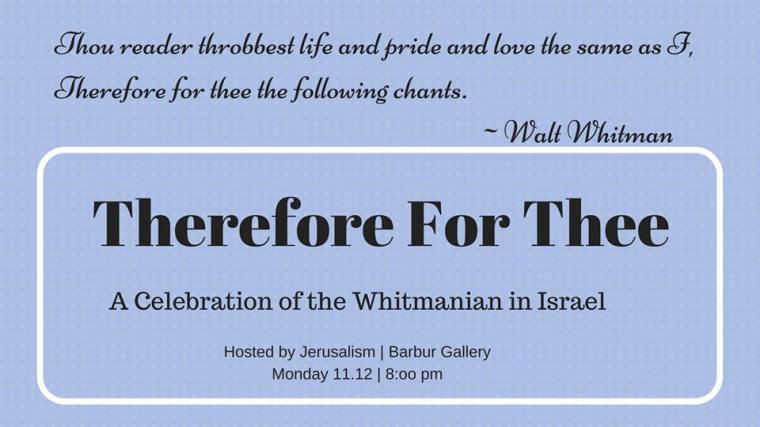
Monday, December 11, 8 pm – 1 pm UTC+2,
Therefore For Thee
hosted by Jerusalism, Fostering Local Literary Community
at the Barbur Gallery, 6 Shirzil Street, Jerusalem, Israel
“Walt Whitman is considered the father of American Poetry. Jerusalism invites all lovers of literature to an evening celebrating his work. Hosted at the illustrious Barbur Gallery, deep in the heart of Nachlaot, the evening will feature local Israeli poets, reading Whitman’s poems alongside their own original poems written in the Whitmanian tradition.”

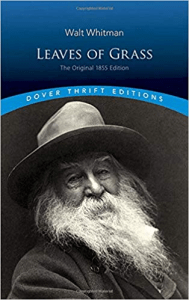 The Library holds the most extensive array of Whitman and Whitman-related collections in the world, including manuscripts, rare books, prints and photographs. Collection items range from handwritten drafts of poems and early prose writings to rare editions of Leaves of Grass, Whitman’s eyeglasses and walking stick and the most famous studio portraits taken in his lifetime. The manuscript collections are digitized and available online, as are many photographs.
 Poet and writer, I am a former columnist and associate editor of a regional employment publication. Currently, I run this site, The Poet by Day, an information hub for poets and writers. I am the managing editor of The BeZine published by The Bardo Group Beguines (originally The Bardo Group), a virtual arts collective I founded. I am a weekly contributor to Beguine Again, a site showcasing spiritual writers. My work is featured in a variety of publications and on sites, including: Levure littéraure, Ramingo’s Porch, Vita Brevis Literature,Compass Rose, Connotation Press, The Bar None Group, Salamander Cove, Second Light, I Am Not a Silent Poet, Meta / Phor(e) /Play, and California Woman. My poetry was recently read by Northern California actor Richard Lingua for Poetry Woodshed, Belfast Community Radio. I was featured in a lengthy interview on the Creative Nexus Radio Show where I was dubbed “Poetry Champion.”





 Jamie Dedes' THE POET BY DAY Webzine