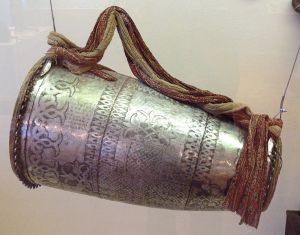
his hands flutter over and on the kebero
a world constructed in the moments of sound
a world razed in the moments of silence
a rhythm of birth and rebirth
of heartbeat and life-blood
he’d gone to Africa, this young man
to chase down his roots
to buy exotic drums
to make rhythms with his brothers
to sing with his sisters
to learn, to grow, to come home and teach
he was full of grace, brimming with jazz
just rocking his universe, rolling with spirit
alight with green and gold,
the breath of wild savannas and
wilder cheetahs, monkey pranks
and elephantine tuskedness
what, i had to ask, was the take-away
after the safaris and the drumming
after the injera, the wat, the niter kibby
and berbere spices, the many fine meals
downed with ambo wuhteh
I met a sister as i was driving a forlorn road. She was walking alongside, carrying a bundle of wood and I stopped, offered her a lift. No, she said, NO! If I ride today, I’ll want to ride tomorrow. It’s a recipe for unhappiness. She’s right, you know, he said, from wanting comes despair …
and so i drum, just drum, he said
his hands fluttering over and on the kebero
a world constructed in the moments of sound
a world razed in the moments of silence
a rhythm of birth and rebirth and peace of heart
Tell us in poem about the most important take-aways you experienced from a vacation or other travel. Leave your poem/s or a link to it in the comments section below. All poems shared on theme will be published next Tuesday. The deadline for response is Monday evening, 8:30 p.m. PDT. All are welcome – encouraged – to join in: novice, emerging or pro. It’s about getting to connecting with other poets, showcasing your talent and having your say. If it’s your first time sharing a poem for Wednesday Writing Prompt, please send a brief bio and photograph to thepoetbyday@gmail.com. These are posted with the work of first participants by way of introduction.
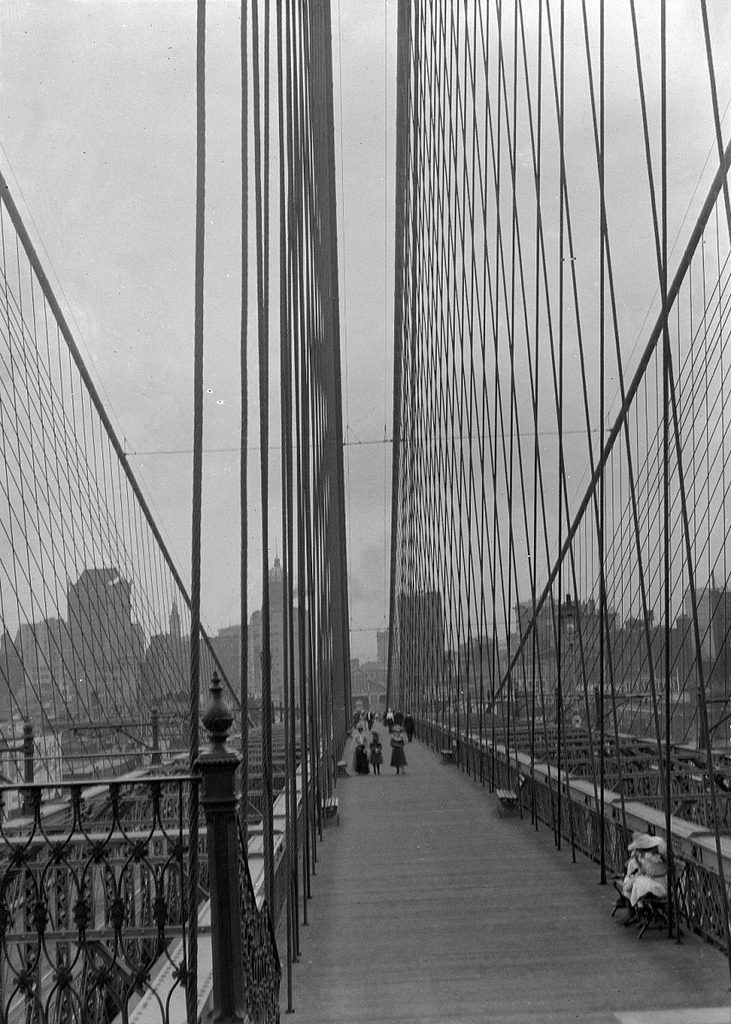
Brooklyn Bridge, looking west from Brooklyn, July 1899
The courageous immigrants of the elder generations cast the shards of their hopes and dreams across the landscape of this continent as prophecy. They worked hard and long for their visions. These people included my Lebanese maternal grandparents with their first-born children. They arrived in New York in 1897 on a boat from Syria. They petitioned for citizenship in 1925. Included also was my Turkish father who arrived here alone in 1919. He was just seventeen, eager to make good and to earn dowries for his four older sisters. The distaff side eventually settled in Brooklyn. That’s where they were when I was born and that’s where I was raised.
These were people who came to America in “the days of sail,” as the great New York writer, Irish-American Pete Hamill, would say. Today’s immigrants can and often easily do visit their countries of origin. They connect with their families and their linguistic and cultural roots. This was something that was generally not available to the people of my grandparent’s generation and before. Among the many reasons for this was an often crushing poverty. In Ireland “American wakes” were held for the sons and daughters who left for the United States. Heart-shattered parents knew it was unlikely they’d ever see their children again.
The immigrants I knew growing up worked hard. The immigrants that I know today work hard, often holding more than one job. They make real – though generally quiet – contributions to their communities, work places and their new country. They serve in the military. They make sure their children are educated.
Because of parents and grandparents who were resourceful and brave enough to come to this country, we had as children, not just economic opportunity, but a wealth of artistic and educational resources. On occasion we went, for example, to the Leonard Bernstein‘s Young People’s Concerts at the New York Philharmonic. I remember Mr. Bernstein with his charming and contagious enthusiasm calling our imaginations to Peter and the Wolf. We didn’t have to travel far to have access to talents like Mr. Bernstein or to visit museums, cathedrals, art galleries, music venues, theater (movies and stage), parks and so much more. It was all right there, ready to be plucked and savored like so many sweet and juicy summer plums.
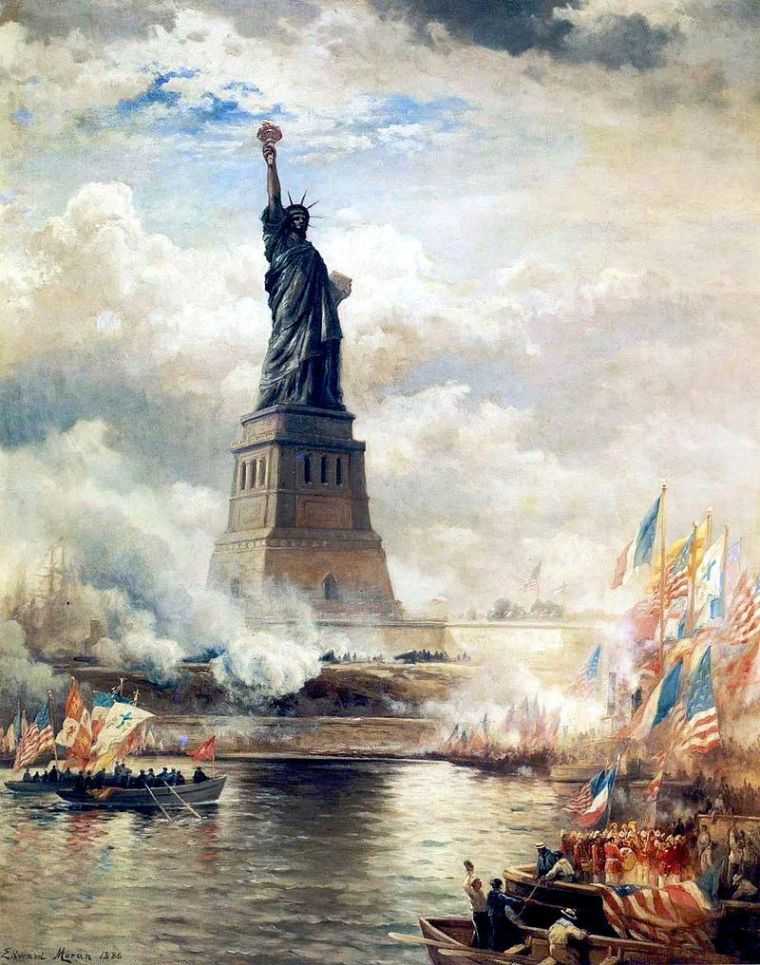
Unveiling of the Statue of Liberty Enlightening the World (1886) by Edward Moran. Oil on canvas. The J. Clarence Davies Collection, Museum of the City of New York. (Public Domain)
The schools were good, whether public or private. The libraries were ubiquitous. I will ever and always be in love with the Hudson River and the incredibly beautiful and historic Brooklyn Bridge. To my child-self, everything was magical, mystical, mythological and monolithic. Brooklyn’s proximity to Manhattan added to my enchantment. The Cloisters. Central Park. The magnificent Statue of Liberty, symbol of our highest ideal.
The New Colossus
Not like the brazen giant of Greek fame,
With conquering limbs astride from land to land;
Here at our sea-washed, sunset gates shall stand
A mighty woman with a torch, whose flame
Is the imprisoned lightning, and her name
Mother of Exiles. From her beacon-hand
Glows world-wide welcome; her mild eyes command
The air-bridged harbor that twin cities frame.
“Keep, ancient lands, your storied pomp!” cries she
With silent lips. “Give me your tired, your poor,
Your huddled masses yearning to breathe free,
The wretched refuse of your teeming shore.
Send these, the homeless, tempest-tost to me,
I lift my lamp beside the golden door!”
– Emma Lazarus (1849-1887)
I’m sure that had I been born in the mountains of Lebanon or in rural Turkey, these places would have offered their own joys and charms but I’m grateful for my Brooklyn, New York experience.
I too lived – Brooklyn, of ample hills, was mine; I too walk’d the streets of Manhattan Island, and bathed in the waters around it; I too felt the curious abrupt questionings stir within me In the day, among crowds of people, sometimes they came upon me, In my walks home late at night, or as I lay in my bed, they came upon me.
Walt Whitman (1819-1892), Leaves of Grass
This week’s prompt is “immigration.” Write in prose (up to 750 words) or poem about your experience or observation. Your work doesn’t have to be about immigration to the US. It can address or illustrate the refugee experience if you prefer.
There are so many on the move – and on the run – right now, historic numbers, and the world is fraught with anger and meanness on this topic. It seems a good subject to tackle through Wednesday Writing Prompt, though please know that I won’t publish and will delete anything encouraging of violence or hate.
Leave your prose or poem/s or a link to them in the comments section below. All work shared on theme will be published here next Tuesday. If it’s your first time coming out to play for Wednesday Writing Prompt, please send a short bio in the body of an email and a photo of yourself as an attachment to thepoetbyday@gmail.com for use as an introduction. You have until Monday evening, 8:30 p.m. PST, to respond to the prompt. You are welcome – encouraged – to join in no matter the status of your career: novice, emerging or pro.
We extend a warm welcome to poet and musician Dick Jones, new to Wednesday Writing Prompt, and a warm thank you to our treasured regulars: Colin Blundell, Paul Brookes, Kakali Das Ghosh, and Sonja Benskin Mesher and to occasional participants Gary W. Bowers and Denise Aileen DeVires. Welcome back!
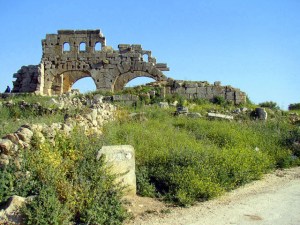
The Northern Maronite Basilica in Brad (Barad), Aleppo courtesy of Hani Simo under CC BY 2.0
I’m pleased that Dick chose to write about Abu Ward, a citizen of Aleppo, the city from which my family sailed from the Middle East to come to the United States a little more than a century ago. CNN called Abu Ward the “last Syrian gardener.” He’s not, of course, though there are few like him. Nonetheless, how some support their spirit in the face of a tragedy so monumental is remarkable.
Like my Lebanese grandmother before me, I season my cooking with Aleppo Pepper. I know that it no longer comes from these beautiful people and their cultured city, which was one of the oldest in world. To say the heart aches is understatement. Rest in peace, Abu Ward, and all victims of this multifaceted violence. The peoples of Syria are not forgotten.
Join us tomorrow for the next Wednesday Writing Prompt. All are welcome: novice, emerging or pro. See you then … Meanwhile, enjoy – and perhaps be inspired by – this rather special collection.
ABU WARD
‘The presence of the world is flowers’. Abu Ward
This was the man
who planted flowers
where the bombs
were falling.
This is his son
who kneels alone
by the garden gate.
The dust he pushes
around their stems
with his thumb is where
his father lives now.
And each flower
will lift some dust
as it rises in spring.
Abu Ward (from the Arabic for ‘Father of the Flowers’) maintained his carefully nurtured flower garden during the worst of Assad’s systematic bombing of Aleppo. He was killed by a bomb dropped near his home. His son Ibrahim left school at thirteen to help his father. After Abu Ward’s death, Ibrahim attempted to maintain the garden, which is now closed. Sadly, in this instance, environmental justice has been, as so often, a victim of warfare.
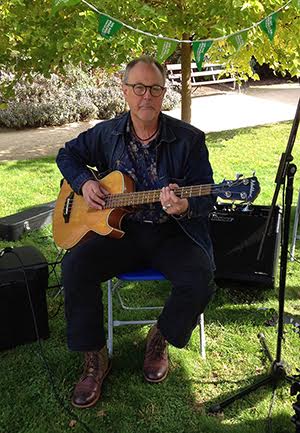
DICK JONES says he was initially wooed by the First World War poets and then seduced by the Beats. He has been exploring the vast territories in between since the age of fifteen. His work has been published in a number of magazines, print and online, including Orbis, The Interpreter’s House, Poetry Ireland Review, Qarrtsiluni, Westwords, Mipoesias, Three Candles, Other Poetry, Rattlesnake and Ouroboros Review. In 2010 he received a Pushcart nomination for his poem Sea Of Stars. His first collection, Ancient Lights was published by Phoenicia Publishing and is available from them or via Amazon. His translation of Blaise Cendrars’ epic poem La Prose du Trans-Siberien… was published in an illustrated collaborative edition with artist Natalie D’Arbeloff by Old Stile Press in 2014. Dick writes lyrics and plays bass guitar in acoustic/electric songwriting trio Moorby Jones.
as you take the road to Paradise
about half-way there
you come to an inn
which even as inns go is admirable
you go into the garden of it
and see the great trees and the wall
of Box Hill shrouding you all round
it is beautiful enough (in all conscience)
to arrest you without the need of history
or any admixture of pride of place
but as you sit in a seat in the garden
you are sitting where Nelson sat
when he said goodbye to Emma;
if you move a yard or two you will be
where Keats sat biting his pen
thinking out some new line of poem
bagged sugar cherry extract oil
of cloves buckminsterfullerene
essences pantheonized for delectation
bottled genies at our command
we so love purities
fleece white as snow
anthracite darkly dense
radial 24-caratotomy
kruggerrandom acts
and we feel godlike
magicmongering
we soupify the sky
we landfillet the lakes
sadsaturate soil
slagsilt the seven seas
it is a remorseless juggernaut
this megamodular magicker
and some of us are waking up
some of us want a different magic
the magic of the camper
who goes sees enjoys records
leaves the site none the worse
some of us want a reckoning
a calling to account
shame and punishment
some of us want to be sheriffs
but YOU STOP THAT NOW
is just like any other war
on any other badguy
and artificial value
has yielded unartificial power
and corruptive pushback
and corrosive continuance
deliverance must come
as with any other childbirth
spasmodically and with some blood
crowning and pushing through membrane
a slap and a gasp and a wail
our magical recording
and
transmitting devices will help
ill-gotten gains though they be
our one-person choices will help
at least
the enormity of the challenge
the size and perversity of the beast
will be revealed
as you yes you
give up your midas’s vehicles
stop eating the factory-farmed
children of hell’s misery
and reduce
the
“places you must see before you die”
to
zero
serve up justice to yourselves
and fire the single brick
of your life’s commitment
in the kiln
of paradise
Raise your head
I’m your benevolent mother
My eyes -your azure sky
When you are blown by caustic fervor
My brimming watery eyes turn into serene raindrops to alleviate you
My hands -your verdurous trees
When you lie wearily on my verdant lap
My hands spread florid twigs to shade you
My moist lips -your rivers
When your thirst touches me
Words of my lips turn into rivulets to kiss you to mitigate your thirst
Now -my son
Why are you burning my eyes with your voluminous black smoke
Why are you cutting my hands with your severe axe so grimly
Why are you tearing my lips throwing poisonous blues
I’m your mother earth
I’m your reason of survival -with snowy peaks
-golden flowers
-dancing rivers
Wouldn’t you be just to me
Wouldn’t you be fair to me
Not only for me but also
For your nourishment
For your children’s nutriment
For your future’s sustenance ages after ages …
When we talk about Environmental Justice, it is sometimes assumed that people will agree on what is ‘the right thing to do’. However, as with anything else, our decision-making about Justice is influenced by our values, by the things that we deem ‘special’, ‘important’, or ‘sacred’. We propose that there are (at least) three categories of valued environments, or ‘Holy Ground’: Nature, Place and Community. Think about these three different arenas and how you see Justice being applied to them.
For example, if Community is your value, you may feel that Environmental Justice has to do with how people are impacted and how human activity creates change. If Place is your value, then questions about Justice probably will involve a particular area with borders of a physical or conceptual nature. It may be that feelings of injustice are felt in terms of ‘This, not That’ or ‘Us, not Them’ or in a desire to see a Place resist change. If Nature is your value, then you may see Justice in more fluid terms as the balance of resources between producers/consumers and prey/predator is in a state of constant flux with perhaps no ultimate goal.
So, as you sit down to write about Environmental Justice in your unique voice, identify your values. Perhaps use the lenses of Nature, Place and Community to focus. What is important to you? Why? How does it affect your decision-making? What factors impact this ‘sacred’ ground? How do different cultural models or systems impact your cherished home? What feelings arise in you – what empathy for Living Things or Living Habitats? What fears?
Thank you for spending time with these concepts and these questions. Your presence, your life energy, and your embodiment of love is a gift that we are privileged and honored to receive. Please, share your poems with us!
All poems shared in response to the theme “Environmental Justice” suggested by Priscilla and Steve will be published here next Tuesday. You are welcome to come out to play no matter the status of your career: beginner, emerging or pro. Leave your poem or a link to it in the comments section below. You have until Monday at 8:30 pm PST to respond. If you are responding for the first time, please be sure to send a short bio and photo to thepoetbyday@gmail.com.Your bio and photo will be posted with your first poem by way of introduction.
PRISCILLA GALASSO (scillagrace, striving to live gracefully) is a member of The Bardo Group Beguines, the core team that publishes The BeZine. Her stellar essays and stunning photography are as outstanding as her commitment to environmental protection and the wilderness. She began blogging some time ago and this is what she has to say about that adventure: “Inspired by my sister’s Flickr 365 project on her 50th year, I began my own venture of self-discovery with my blog. My life had changed dramatically in the previous 5 years, and I had changed with it. My husband died, my kids moved out, I sold our home and moved in with a tall, dark Scorpio named Steve. I had a lot to process, a lot to learn about growing up and being responsible in this Universe. My eyes are open in a way they have never been before, and I want to share my vision and experiences.” Link HERE for an interview with Priscilla.
STEVE WIENCEK (Scholar and Poet Books, EBay and Scholar and Poet Books, Abe Books ) is the owner and founder of Scholar and Poet Books. He helped out with the September 2016 issue of The BeZine, which addressed environmental issues. You can read his feature article, Nature … Place … Community HERE. Steve says of his independent online store: “We are experienced book, music and video sellers. Our extensive and varied inventory includes a large collection of classical music CDs, LPs and sheet music; colorful and hard-to-find vintage GGA pulp fiction paperbacks; vintage children’s books and more! Find us and like us on Facebook, please!”






 Jamie Dedes' THE POET BY DAY Webzine