Page 7 of 8

Under the Mango Sky, a poem … and your Wednesday Writing Prompt
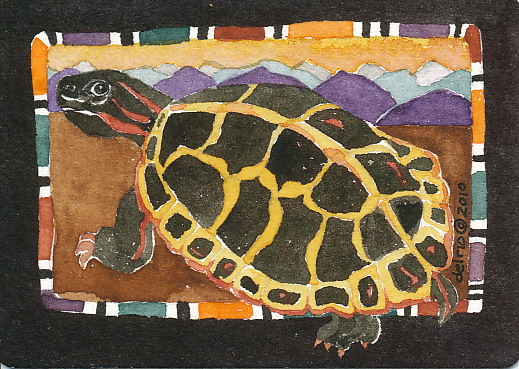
Painted Turtle by Gretchen Del Rio c 2010, rights reserved

our gray skies pass when mango sky comes,
warm with laughter, chanting its gentle way into
the space where turtle speaks in earthy colors,

speaks in that easy way only turtle can, as one who is
at home in herself, between her plastron and carapace,
wisdom in her slow ballet; her introversion, a model

for living well in this grinding war-spun world . . .
turtle is my totem and we live on our turtle island,
she is the everyday re-enchantment of my solitary

cosmos, my solidarity with life, i read her pastoral
letters in green on green, the sweet grasses and seas,
she speaks of connectedness, the basic constituents

of enigma, wizardry, and the madness of the times
and how best to dance the madness into light, she is
essence, the unrushed cure for wretched nature-deficit,

that consuming affliction, the spawn of modern day’s
backlit screens and relentless marketers of every bilk;
turtle healing is simple peace and master lessons in

self-containment, she draws us into our meditations
and back along the first path of Maka Ina, the lost or
forgotten primal path of the earth ways and feminine
energies and the lunar cycles that whirl us heavenward

  • Turtle ~ totem or power animal representing earth in Native American tradition
  • Turtle Island ~ in Iroquois tradition, when the earth was covered over with water, sundry animals attempted  to create land by swimming to the bottom of the ocean and hauling up dirt. Muskrat succeeded. He placed the dirt on the back of  Turtle, which grew into the landmass known today as North America. 
  • Maka Ina ~ Lakota (Sioux) ~ “maka” is earth and “ina” is mother, so Mother Earth. Earth teachings were/are considered a path to wholeness (heaven) by the First Peoples.

© 2013, poem, Jamie Dedes, All rights reserved; turtle watercolor courtesy of Gretchen Del Rio. 

WRITING PROMPT

Several years ago I had the rather odd experience of having three shamans, two Native American and one Mexican, tell me out of the blue (I never asked) that my totem is Turtle.  I think these good people had a fine sense of intuition and of the sacred and possibly were good observers. It would not be surprising or illogical for anyone to decide that an obvious introvert is a Turtle.

If you’ve never been given a totem animal, imagine one yourself. Write a poem about your personal totem. HERE is a list of Native American totems and their meanings to help you along.  Take your time. Enjoy! … and if you feel comfortable, leave the poem or a link to it in the comments section below.


This is Paul Brooks’ (thewombwellrainbow) response to the prompt given two weeks ago: Blown Across Timelessness. Bravo, Paul!  🙂

The Need

The need to remember
The never to forget
This list of essential tasks
On mobile, in my head.

Milk, bread, light bulbs, to live,
To bury my Nanna
Beside my Mum, Sister
Lay her casket to rest.

The need to remember
Why this delay, dither
To fulfill my Nannas
Wish to be buried here.

Join daughter, granddaughter.
I have kept her ashes
Stored in my room at home.
Close to their photographs.

I have told myself ‘Do
It!’ and nothing is done.
I cannot, will not let
Go of her. I am done.

Let her and myself down.
Must get hold of myself.
Must call the vicarage.
Must say a last goodbye.

The never to forget
As I shop these shelves
Everything on my list
That needs to be done.

My Nanna, Sister, Mum
Were my bread, milk, light.
My wife, daughter, grand
Kids are essentials now.

The need to remember,
Never to forget
One list to another
An urgent task undone.

© Paul Brooks (a.k.a. dragonwolfpaul)
unnamedPAUL BROOKS was shop assistant, security guard, postman, admin. assistant, lecturer, poetry performer, with Rats for Love and his work included in Rats for Love: The Book, Bristol Broadsides, 1990. His first chapbook was The Fabulous Invention Of Barnsley, Dearne Community Arts, 1993. He has read his work on BBC Radio Bristol and had a creative writing workshop for sixth formers broadcast on BBC Radio Five Live. Recently published in Clear Poetry, Nixes Mate, Live Nude Poems and others. Forthcoming in the spring 2017 an illustrated chapbook The Spermbot Blues, published by OpPRESS.


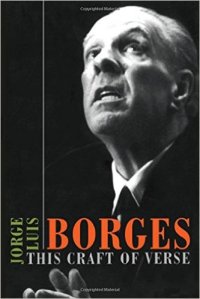
The recommended read for this week is Borges’ The Craft of Verse. (One of my faves.) 41-mshkw5pl-_sx331_bo1204203200_These are the famed lost lectures given in English at Harvard University (1967/68) by Jorge Luis Borges that were transcribed (c. 2000) and published in 2002.
The WordPlay Shop offers books and other tools especially selected for poets and writers. By making your Amazon purchases through this site, you help support it.

THE WORDPLAY SHOP: books, tools and supplies for poets, writers and readers

LITERATURE AND FICTION oo Editor’s Picks oo Award Winners oo NY Times Best Sellers

Nothing “so called” about the world’s journalists: seventy-eight died in 2016 to bring us accurate reports and important information

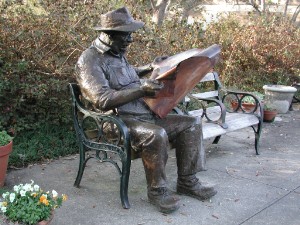
"Len Ganeway" by Derek Wernher (in Brookgreen Gardens, South Carolina) Statue by Derek Wernher
Man reading a newspaper by Derek Wernher (in Brookgreen Gardens, South Carolina) Statue by Derek Wernher

There are some institutions that are necessary to support healthy democracies … public libraries, good public education, freedom to assemble, free speech …. and a free press that is allowed to carry-out its moral mission with impunity. While our occupational cousins – professional journalists – are coming under attack from certain quarters, there are dedicated journalists who brave dangerous territory, horrible work and living conditions, and long stays away from family and friends to bring us important information, correct and timely reports. Many end up with PTSD. They are often physically wounded, maimed or killed in torn and sometimes out-of-the-way-places that politicians and oligarchs wouldn’t fly over much less dare to set foot to ground.

The Committee to Protect Journalists [CPJ] reports today that in 2016 seventy-eight journalists (representing a diversity of counties, races, genders and religions) died to bring us accurate news reports. CPJ investigates the death of each journalist to confirm the motive. It reports that among the seventy-eight killings the motives for forty-eight are confirmed. Among the seventy-eight are also two media workers and twenty-eight journalists for whom the motive is unconfirmed. The deaths have been by murder, crossfire, or  while covering dangerous assignments. Beats covered in 2016 were:

4% Business
19% Corruption
17% Crime
13% Culture
17% Human Rights
38% Politics
4% Sports
75% War

According to the CPJ the numbers are rounded up and the percentage is over 100% because many covered more than one beat. The chart belongs to the CPJ and is protected under Attribution-NonCommercial-NoDerivatives 4.0 International license.

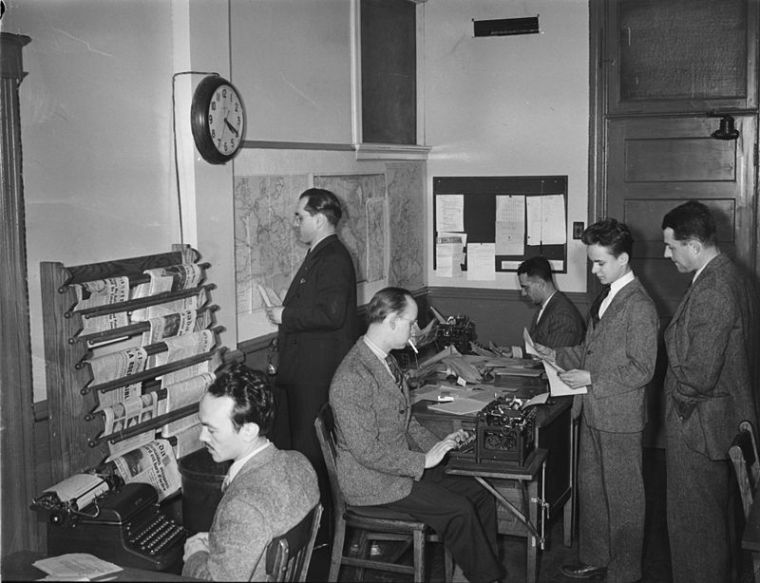
Journalists at work in Montreal circa 1940s

I would also submit at this time that discussions of fake v true news are too simple and among other things they don’t often acknowledge the reader’s responsibility for careful selection, analyses, sharing and wide reading. Anyone who clicks on “click bait” for example, those links that start with “you wouldn’t believe what happened next” or ” he was walking down the street and …”  are accessing sites for sales and marketing not news outlets. On Facebook these are rife on the roll to the right of the screen. Shared posts on Facebook or Twitter or other social media like blogs should not be our primary sources of news information.  Conspiracy theories, satire, comedy “news” media and news aggregates (v. original stories) are not reliable resources nor are news sources that are partisan and consistently confirm our biases, whatever they may be.

Among the more balanced and accurate news outlets are: AP and Reuters news agencies, The Christian Science Monitor, The New York Times, The Washington Post print news, and the BBC and NPR for broadcast media.

If we want our news outlets to hire the very best journalists and to fund in-depth research and reporting, we must use them, pay for them or donate to them as appropriate. I’m pleased to see that so many people are now subscribing to the New York Times in an effort to help keep this, the premier American newspaper, afloat.  The New York Times was founded in 1851. It has been in continuous publication since then and is widely considered to be “the newspaper of record” for the United States of America.

The video below is of Christiane Amanpour’s 2016 Burton Benjamin Memorial Award Acceptance Speech. She addresses the responsibilities of journalism and journalists in the context of a post-truth post-values era.It’s about fifteen minutes. There’s good substance here, much to chew on.  If you are reading this feature from an email subscription, you’ll have to link through to the site to view the video.

Photo licensing: Reading the newspaper header photograph is under CC BY-SA 2.0 license; Canadian journalists by Conrad Poirier from Bibliothèque et Archives nationales du Québec, reference number P48,S1,P23104 Public domain

RELATED:

Freaks were born with their trauma. They’ve already passed their test in life.

51avpd8brdl-_sx335_bo1204203200_

American Photographer, Diane Arbus (1923-1971)

Poet and writer, Michael Rothenberg, co-founder of 100,000 Poets for Change and editor at Big Bridge Press (which he also co-founded) suggested that we take a mental health break and assigned each of us an artist to feature. I’m sure you know why we need a mental health break.

My assignment is the American photographer, Diane Arbus. She was known for her artistic documentation of “freaks.” –

“There’s a quality of legend about freaks. Like a person in a fairy tale who stops you and demands that you answer a riddle. Most people go through life dreading they’ll have a traumatic experience. Freaks were born with their trauma. They’ve already passed their test in life. They’re aristocrats.” Diane Arbus

Arbus was also known for her manner of engaging with her subjects, helping them to get comfortable with being photographed. She once went naked at a nudist camp to get the camp members to trust her.

The photograph I first thought of when I saw my assignment was “Child with a Toy Hand-grenade in Central Park.”

I vividly remember seeing it featured in the ’60s in the New York Times. Colin Wood, the subject of the photo, wrote as he reflected on his childhood encounter with Arbus. “She catches me in a moment of exasperation. It’s true, I was exasperated. My parents had divorced and there was a general feeling of loneliness, a sense of being abandoned. I was just exploding. She saw that and it’s like . . . commiseration. She captured the loneliness of everyone. It’s all people who want to connect but don’t know how to connect. And I think that’s how she felt about herself. She felt damaged and she hoped that by wallowing in that feeling, through photography, she could transcend herself.”

“If you scrutinize reality closely enough, if in some way you really, really get to it, it becomes fantastic.”  Diane Arbus

The video below features Diane Arbus portraits and other photographs.  If you are view ing this from an email subscription, you’ll have to link through to the site to watch the video.

The photos featured are under copyright and shared here under fair use.


The recommended read for this week is Borges’ The Craft of Verse. (One of my faves.) 41-mshkw5pl-_sx331_bo1204203200_These are the famed lost lectures given in English at Harvard University (1967/68) by Jorge Luis Borges that were transcribed (c. 2000) and published in 2002.

The WordPlay Shop offers books and other tools especially selected for poets and writers. By making your Amazon purchases through this site, you help support it.

THE WORDPLAY SHOP: books, tools and supplies for poets, writers and readers

LITERATURE AND FICTION oo Editor’s Picks oo Award Winners oo NY Times Best Sellers

SUNDAY ANNOUNCEMENT: Calls for Submission, Contests and other News and Information

fullsizerender-2 CALLS FOR SUBMISSIONS

Opportunities Knock

VALLUM CONTEMPORARY POETRY was founded in 2000 and is based in Montreal. The publisher says, “As one of Canada’s top poetry journals with an international focus, Vallum encourages dialogue between Quebec and the rest of Canada and allows Canadian artists to exchange ideas with acclaimed and emerging artists from the United States, Britain, Ireland, Australia, India and other countries around the world.”  The magazine is in hardcopy and digital. Poetry is accepted by snail mail only, no electronic submissions. Details HERE. Submissions are accepted year-round, but I’m waiting to here back from the editors regarding theme and specific deadline for the next issue. I’ll post that for you when received and you can also watch the site for updates as well.

THE TISHMAN REVIEW publishes poetry, fiction, micro-fiction, flash fiction, short stories, creative nonfiction, interviews, book reviews and craft essays. Details HERE.

subTERRAIN, Strong Words for a Polite Nation “is published three times a year from modest offices just off of Main Street in Vancouver, BC. We strive to produce a stimulating fusion of fiction, poetry, photography and graphic illustration from uprising Canadian, U.S. & International writers and artists.”  subTerrain publishs art and commentary, creative nonfiction, fiction, photography, poetry and reviews. The deadline for Issue #77 is May 1, 2017 and the theme is “Interview Issue.”  The deadline for issue #78 is September 1, 2017 and the theme is “General Issue.” Details HERE.

THE BeZINE, a publication of The Bardo Group Beguines, a virtual arts collective, is a digital publication that is published on the fifteenth of each month. The deadline is always  on the tenth. Submit via email to bardogroup@gmail.com.  Each issue is themed and the themes for each month are included in Submission Guidelines.  Please read the guidelines, one or two issues AND the Mission Statement before submitting. Special issues are April for interNational Poetry Month and September when we host a virtual 100,000 Poets for Change (100TPC) event for reader participation. This year 100TPC will be on September 30 and the September issue will post on the fifteenth as usual. The site was established in 2011 and the Zine is in publication now for three years.

BRILLIANT FLASH FICTION is a digital publication that accepts submissions of fiction –  1,000 words or less – on a rolling basis. Submission is by email. NO poetry.  Details HERE. This magazine is published quarterly.

HAIK/UNIVERSE is a Zine that publishes daily haiku or micro-poem. Details HERE.

COMPETITIONS/CONTESTS

Opportunity Knocks

VALLUM CONTEMPORARY POETRY is accepting submissions for the Vallum Award for Poetry 2017 and the deadline is July 15. First Prise is $750 and Second Prize is $250. The award includes publication. Details HERE. There is a reading fee.

VALLUM CHAPBOOK AWARD 2017 considers original and unpublished work for this competion. The prize is publication and $125. Details HERE.

THE TISHMAN REVIEW holds annual contests. Their contest page hasn’t been updated.  Monitor it for updates HERE.

BRILLIANT FLASH FICTION holds quarterly contests.  The deadline for the next contest is March 16, 2017. The prompt for which is Overseas Travel.  There is no entry fee. Details HERE

2017 SCIENCE FICTION POETRY CONTEST – hosted by the Science Fiction Poetry Association – opens on June 1 and the DEADLINE is August 31. “The 2017 SFPA speculative poetry contest is open to all poets, including non-SFPA-members. Prizes will be awarded for best poem in 3 categories: Dwarf (poems 1–10 lines [prose poems 0–100 words]); Short (11–49 lines [prose poems 101–499 words]); Long (50 lines and more [prose 500 words and up]). Line count does not include title or stanza breaks. All sub-genres of speculative poetry allowed in any form. Entries will be read blind.” Details HERE.

GRANTS

Opportunity Knocks

SPECULATIVE LITERATURE FOUNDATION $750 working Class Writers Grant ~ “Working class, blue-collar, poor, and homeless writers have been historically underrepresented in speculative fiction, due to financial barriers which have made it much harder for them to have access to the writing world. Such lack of access might include an inability to attend conventions, to purchase a computer, to buy books, to attend college or high school, to have the time to write (if, for example, you must work two jobs simply to pay rent and feed a family, or if you must spend all your waking hours job-hunting for months on end). The SLF would like to assist in finding more of these marginalized voices and bringing them into speculative fiction. Details HERE.

SPECULATIVE LITERATURE FOUNDATION $500 Diverse Writers and $500 Diverse Worlds Grants ~  “The SLF offers two new diversity-centered grants: Diverse Writers and Diverse Worlds, both intended to foster the creation of speculative fiction work rich in diversity.

“The $500 Diverse Writers grant is intended to support new and emerging writers from underrepresented and underprivileged groups, such as writers of color, women, queer writers, disabled writers, working-class writers, etc. — those whose marginalized identities may present additional obstacles in the writing / publishing process.
The $500 Diverse Worlds grant is intended for work that best presents a diverse world, regardless of the writer’s background.”  Details HERE.

THE SPECULATIVE LITERATURE FOUNDATION Older Writer Grants ~ “The SLF currently offers four grants: The Older Writers’ Grant, the Travel Grant, the Working Class Writers Grant, and the Diversity Grant. All of our grants are free to apply, and are designed as ‘gateway’ grants, with easy and straightforward applications that should be quick to complete. We hope that they will both serve the community directly, and also encourage genre writers to explore the wide variety of grants, awards, and residencies available in the larger writing community.

“This grant is awarded annually to a writer who is fifty years of age or older at the time of the grant application, and is intended to assist such writers who are just starting to work at a professional level. The SLF offers two $500 grants annually, to be used as each writer determines will best assist his or her work. We will be accepting applications for the grant starting in January.” Details HERE.

EVENTS

PLUME POETRY reading with seven poets including Lyn Emanuel, Linda Paston, Thomas Lux, Nancy Mitchell, John FitzGrrsld, Hélène Cordona, Elizabeth Metzger,Philip Fried, Marc Encnez, Chard deNiord, and Ira Sadoff at The Atrium, Mount Vernon Place United Methodist Church, 900 Massachusetts Avenue NW, Washington, DC, Wednesday, February 8 from 7 – 9:30 pm.

POETS PUSH BACK Paris. Co-hosted by Moe Seager and Malik Crumpler in association with 100TPC NYC-San Francisco. Saturday, February 11. 7 p.m. Berkeley Books of Paris.

KUDOS

Congratulations to:

SUNDAY ANNOUNCEMENTS

Submit your event, book launch and other announcements at least fourteen days in advance to thepoetbyday@gmail.com. Publication is subject to editorial discretion.


41-mshkw5pl-_sx331_bo1204203200_The recommended read for this week is Borges’ The Craft of Verse. (One of my faves.) These are the famed lost lectures given in English at Harvard University (1967/68) by Jorge Luis Borges that were transcribed (c. 2000) and published in 2002.

The WordPlay Shop offers books and other tools especially selected for poets and writers. By making Amazon purchases through this site, you help support its maintenance.

THE WORDPLAY SHOP: books, tools and supplies for poets, writers and readers

LITERATURE AND FICTION oo Editor’s Picks oo Award Winners oo NY Times Best Sellers