It’s great to get a poem or story published. It’s about income and getting read and for some it’s validation as well. These are all important (even vital), but I was reminded recently that our poetry and other writing is about so much more.
“The title of David Cooper’s book on Kabbalah invites us to re-think the Creator as Creating: God is a Verb. While I don’t want to equate science to God in a religious sense, I want to borrow this re-conception. Science is creative, creating, if you will, knowledge of the world. Science is a verb.”
Jamie Dedes
A friend of mine came to visit and glowed when she told me she’d read Michael’s introduction. God is a Verb and Science is a verb popped out at her. Something she’d been struggling with suddenly fell into place. Other company arrived and I wasn’t able to get further explanation. I’m pleased but not surprised with her reaction to Michael’s piece. It demonstrates the power of words to bring joy, clarification and healing.
My own recent experience: a few people commenting or emailing me saying my post here – not with a bang but a whimper – helped release needed tears.
On another occasion a woman in Scotland wrote to say she’d read my poem – Wabi Sabi – to her wabi sabi group. They found it inspiring. Wow! While I do need my payments, it’s this sort of thing – this human connection – that is satisfying right down to the marrow of my bones.
Poetry is also important as an entry point into sacred space for both artist and audience. This is motivation for everyone to practice their art, whether professionally or as amateur, which is not a pejorative. I’m sure many of you – if not all of you – know what I mean. There’s a shift that happens. Sometimes it feels more like channeling than writing. The experience is illuminating, healing and peaceful. An unexpected insight often arrives just when you need it.
Our job as poets and writers goes even further: we bear witness, we give voice to the voiceless, and we observe and commemorate.
English Poet Myra Schneider at her 80th Birthday celebration and the launch of her 12th collection
Myra Schneider said in an interview HERE, that “I believe the role of the poet is to reflect on human experience and the world we live in and to articulate it for oneself and others. Many people who suffer a loss or go through a trauma feel a need for poetry to give voice to their grief and to support them through a difficult time. When an atrocity is committed poems are a potent way of expressing shock and anger, also of bearing witness. I think that the poet can write forcefully, using a different approach from a journalist, about subjects such as climate change, violence, abuse and mental illness and that this is meaningful to others. I very much believe too that poetry is a way of celebrating life. I think it deserves a central place in our world.”
So, as we celebrate poetry this month, be sure to give yourself time to read and write … for the sake of your spirit and for the rest of us too.
Please join us at The BeZine on April 15th for our special interNational poetry issue. Michael Dickel is the lead editor.
My apologies. When I logged in this a.m. I saw that I accidentally scheduled two prompts today. I’m leaving them both up since poets have started responding. 😦 At any rate, if you want to participate – and I hope you do – please feel free to do so for both if so inclined. Thank you!
.
like lucid dreaming, like light-infused rain drops and
the untarnished silver stars above country terrain,
my mother calls to me from the shadow of the moon
my father beams his smile at me from the milky way
gone and gone, still their essence scents my nights
Have there been people in your life that you don’t loose no matter what? Perhaps people like parents who are so much a part of you, you seem to sense their presence even after they have died. How good is that? Or, maybe you don’t think it is. Tell us about it in poem or prose. If you feel comfortable, put the link to the piece in the comments section below … or, if it’s short enough, you can just share the piece there. Work shared will be featured on The Poet by Day next Tuesday.
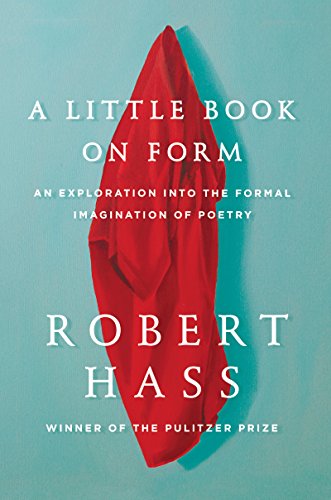
The recommended read for this week is A Little Book on Form: An Exploration into Formal Imagination of Poetryby Robert Hass (b. 1941), an American poet who was our Poet Laureate of the United States from 1995 to 1997. He won the 2007 National Book Awardand shared the 2008 Pulitzer Prize for the collection Time and Materials: Poems 1997-2005. In 2014 he was awarded the Wallace Stevens Award from the Academy of American Poets.
In A Little Book on Form: An Exploration into Formal Imagination of Poetry Hass brings to bear the same senisbility that marks his poetry with force, clarity and eloquence. From Rome in the time of Caesar to the Renaissance and our own times, Hass breaks down poetry, examining its components from a postmodern perspective. The book is ranging and intense. It’s over four-hundred pages – informed, witty, erudite – something we can go back to again and again. Never a boring moment. It’s all about love.
By shopping at Amazon through The Word Play Shopandusing the book links embedded in posts, you help to support the maintenance of this site. Thank you! (Some book links will just lead to info about the book or poet/author and not to Amazon.)
The WordPlay Shop offers books and other tools especially selected for poets and writers.
My apologies. When I logged in this a.m. I saw that I accidentally scheduled two prompts today. I’m leaving them both up since poets have started responding. 😦 At any rate, if you want to participate – and I hope you do – please feel free to do so for both if so inclined. Thank you!
Well, this one is akin to the first composition assignment on returning to school after summer vacation: Tell us about your most fondly remembered vacations. Perhaps you enjoyed it because it involved family and childhood. Perhaps it was a dream vacation come true. Or, maybe it was an unexpected adventure. Or, perhaps your best vacation is the one you are planning now. Tell us about it in poetry or prose and, if you feel comfortable, share your work in the comments section below or leave a link to it. Responses will be published here next Tuesday.
LESSON SEVEN Be reflective if you must be armed. “If you carry a weapon in public service, may God bless you and keep you. But know that evils of the past involved policemen and soldiers finding themselves, one day, doing irregular things. Be ready to say no.” Prof. Snyder, On Tyranny, Twenty Lessons from the Twentieth Century
LAST WEDNESDAY’S WRITING PROMPT: When people can’t speak-up and speak-out, they can give “voice” to their frustrations in odd ways. What kinds of strange rebellions have you observed? Tell us about that experience in poem or prose.
WEDNESDAY WRITING PROMPT, March 22: What would be your fantasy about the moon? Tells us in poem or prose and share the link to the piece in the comments section below if you are comfortable doing so that we all might read it. This is light one. Enjoy!
Invitation to Daring
Flimsy silver ladder
Dropping across the velvet black
Invitation to daring.
Climb to the silvery sand
Dazzling dunes
Dark gorges.
No moon shines above
The light shines from within.
In that gentle light
Fair beings dwell
Runaways from earth.
WEDNESDAY WRITING PROMPT, March 29: How do you generally receive the night? With joy, reluctance or fear? Do you sleep well or not? Tell us in poem or prose.
This is the first time we’re featuring a poem by Colin Blundell so an introduction is in order. Colin has what is probably the most eclectic blog I’ve encountered over the years. A former teacher, Colin says he escaped the daily humdrum of employment in 1999. I believe he was a teacher and quite a devoted one at that, but self-employment does offer its own special joy.
Colin now facilitates workshops on Neurolinguistic Programing, change management, problem-solving, time management in addition to Stephen Covey’s Seven Habits of Highly Successful People. He also gardens, writes, paints, and composes music. He makes hand-bound books and goes on long solo motorcycle trips. Colin Blundell doesn’t give in to the sound-bite world of the blogospher and entertainment news. His posts are long, luxurious reads with marvelous detail that betrays an acute mind and sense of irony.
Two haiku…
full moon
through a slatted blind
cuts me into white strips
Juli says, “We are as cosmic prisms, reflecting, connecting, with infinite vibrations that shake the physical and consume the spiritual. Intense awareness is ours – experience is sharp. We are our teachers and our pupils: scholars of the wisdom well; plunging into Truth and emerging as fountains, sprinkling little drops of consequence and potential.
“Thought, made manifest…
Spoons
When I wake to the day
And straight away
Feel bereft for the theft
Of my spoons in the night,
I must reset my pace
For the hours I face
And the fact I don’t keep
All my spoons in one place,
Is what lessens my plight
Though the day’s still a fight
And I grieve at the waste
Unless I stop pretending,
Surrender to fate and
Just focus on mending
And wait.
When I wake up renewed,
With all spoons am imbued,
I feel hope that I’ll cope
With the basics, at least –
Unless there’s a treat
Or appointment to keep.
I will try for an even keel
Mostly, unless I feel
Daring – spoons sparing.
And, if I succeed –
Which means no extra need –
I retire to bed with
A positive head.
Thanks and kudos to these adventurous souls who participated in Wednesday Writing Prompt challenges. They are not only devoted artists. They’re fine people with good values. I do hope you’ll visit their blogs, explore their work, and get to know them better. The next writing prompt will post tomorrow and responses will be featured here next Tuesday.
LESSON SIX Be wary of paramilitaries. “When the men with guns who have always claimed to be against the system start wearing uniforms and marching with torches and pictures of a leader, the end is nigh. When the pro-leader paramilitary and the official police and military intermingle, the end has come.” Prof. Snyder, On Tyranny, Twenty Lessons from the Twentieth Century






 Jamie Dedes' THE POET BY DAY Webzine