The Brooklyn Bridge, seen from Manhattan, New York City courtesy of Postdlf under CC BY-SA 3.0
“Brooklyn was a dream. All the things that happened there just couldn’t happen. It was all dream stuff. Or was it all real and true and was it that she, Francie, was the dreamer?” Betty Smith, A Tree Grows in Brooklyn
Knishes (knyshes) stuffed with mashed potatoes and fried onions courtesy of koritca under CC BY 3.0 license
At that time, we lived along a treeless street around the corner from the Li’s Chinese Laundry and Saul’s Jewish Deli and a five-minute walk from the neighborhood public school. I used to play with Ju Li on hot summer days when we’d pool our found pennies to buy a giant 5-cent Kosher pickle from Mr. Saul Levy and his wife. The pickles were cold, wet and salty. They were more invigorating than ice cream when the air was humid and temperature hit three-digits.
Eating with Ju was one of my favorite pastimes. I was enamored of the mischievous sparks that shot from the depths of her eyes, especially when it came to Kosher pickles. “Āiya! For once …” she was eating something that didn’t originate in her mom’s kitchen or the school cafeteria.
The Li’s lived above their laundry. Sometimes after school her mom would give us oolong tea and red bean cakes. Ju regularly complained about her mother’s cooking. “Always with the rice,” she’d say, mimicking Mrs. Levy’s manner of speaking. Ju said that to be fully “Americanized” you’d need to eat lots of potatoes: baked, stuffed, fried, or mashed. If Ju was to be believed, Mrs. Li never made potatoes and cooked pork almost as often as she cooked chicken. Mrs. Levy never cooked pork but she roasted beef in an oversized oven and it was known throughout the neighborhood that her potato knishes were to die for.
Occasionally on Friday when school let out, Mrs. Levy would call to us before sunset and Shabbas and invite us in to eat with Moshe, her eight-year-old son. At school and whenever his parents weren’t around, we called him Moose, which he much preferred. Moose wanted to be a baseball player, but I think the Levy’s had other plans for him.
Mrs. Levy would serve us a roasted beef sandwich, half for each of us along with half a potato knish, a slice of pickle, and a glass of creme soda. My mom would have been upset to know I ate meat on Friday, but I didn’t think Jesus would begrudge me such a meal. After we finished eating, she would close the deli. “Have a good rest,” we’d say politely as we left. “From your lips to God’s ears,” was Mrs. Levy’s inevitable response.
As for my own mom’s cooking, I should first explain that mySidto, my mother’s mother, was the cook in the family. She and my mom were mad at each other and hadn’t spoken since I was five or six. I do remember though that like Mrs. Li my Sidto was also “always with the rice,” which was typical for a Lebanese. I remember her bottomless pots of chicken-rice soup scented with cinnamon and carefully ladled into small bowls with pink roses on them. I remember her knobby fingers fussing over stuffed grape leaves and kibby, ground meat mixed with cracked wheat, onions, and seasonings. I remember Sidto’s tart yogurt in quart-sized Mason jars. She’d wrap the jars in a Navy surplus blanket and set them by the dining room radiator to ferment.
At my house we had bakery-bought ghreybah, Lebanese butter cookies, or chocolate chip cookies from Safeway, usually on a Saturday afternoon when my mom was home from work. Once my mom invited Ju for dinner but one look at our frozen dinners and Ju went home to her rice.
In fairness to my mother, I don’t want to give the impression that she didn’t cook. She did! She made tea with honey and buttered Wonder Bread with cinnamon sugar for breakfast. She prepared packaged chicken noodle soup with sandwiches of cream cheese and orange marmalade for lunch. She made good spaghetti – perfectly al dente – with canned marinara sauce that she topped with cheese dust that came in little green containers. She was great at baking those frozen dinners without burning them. Sometimes she’d make lamb chops in a pressure cooker with potatoes and carrots. There were three seasonings in her cabinet: salt, pepper, and allspice. I’m not sure why the latter. I don’t think Mom ever used it. Throughout my childhood the tin sat untouched, growing greasy brown pimples and collecting miniature dust bunnies. Though I gave Mom credit for what she could and did do, I figured that if I had to live with my mother’s rather stunted culinary repertoire, I better learn to cook in self-defense.
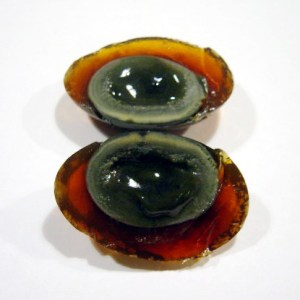
In those days, I only ate tidbits. Nonetheless, food had a habit of drifting through my imagination and my dreams: roasting beef a la Mrs. Levy, making chicken soup like my Sidto, and cooking the exotic Chinese dishes I imagined Mrs. Li did. Āiya! What, I wondered, were thousand-year eggs and bird’s nest soup? I prayed out loud from my lips to the Jewish God’s ears, silently at Mass on Sunday to Jesus and Mary, and in bed at night I whispered to Ju’s mysterious Buddha. I need to learn to cook, I told them. Please!
Then, early one September when I was nine, hope arrived in the person of Ju. She came around to our apartment with our first invitation to dinner at her place. It was for Sunday. The dinner would be to celebrate her parents’ newly acquired citizenship, but really it was all about me. I could think of nothing but watching Mrs. Li cook so I could steal her culinary magic. Her English was poor and I didn’t speak Cantonese but in our melting-pot world we were skilled at listening for the few words here and there that we might understand, watching facial expressions, hand gestures and body language, and taking context into account. In this way, we managed to communicate across cultures. And, well, you know, food has a way of speaking on its own. Sights and smells. Sizzle and crackle.
On our way home from noon Mass that Sunday, Mom picked up a congratulations card and a tray of baklava for us to take to the Li’s. At Mass, my mind had already eloped somewhere with bird’s nests and thousand-year eggs, but as we climbed the Li’s stairs, I was startled out of my imaginings. I shot a questioning glance at my mother. Something was wrong. No scent. No scent! No cooking? Slowly, I trudged the rest of the way. We were met at the landing by Mr. and Mrs. Li’s big smiles and warm welcome with their arms outstretched and ready hugs for me. They were nodding their heads, proudly drawing us inside to see a room filled with neighbors and relatives and a “real American dinner.” There were sandwiches and salads – potato and macaroni – and a platter piled high with knishes from the Levy’s. A fruit bowl and two apple pies sat at the end of the table and a punch bowl and glasses were on the kitchen counter next to a bowl of fortune cookies.
Ju ran up to me. “Do you believe it? Potatoes! Potatoes in the Li household.” Moose caught my eye, nodding at me from around the end of the buffet, munching on one of his mom’s knishes. He eyed the salads with longing but didn’t dare touch any with his parents there. The salads were probably from Mr. Bjornstad’s. He was given to putting smoky bacon in almost everything. He said it was his signature touch.
Mr. Li was calling to us. “More news,” he said, pulling Ju next to him. He patted her head. “Now better known as Judy.” Well, I thought, so much for Thousand-year Eggs and Birds’ Nest Soup, but how could I begrudge my friend her happiness. There she stood with her mouth full of potato salad, a new American name, and stars in her eyes. Well, I thought, somewhat dejected on my own account until my eyes landed on Mrs. Levy. Schmatz and gribenes. Chopped chicken livers. Potato knishes to die for. Prayers began afresh from my lips to the Jewish God’s ears, silently at Mass on Sunday to Jesus and Mary, and in bed at night I whispered to Ju’s mysterious Buddha. I need to learn to cook, I told them. Please!
Recent in digital publications:
* Four poems , I Am Not a Silent Poet
* Five by Jamie Dedes, Spirit of Nature, Opa Anthology of Poetry, 2019
* From the Small Beginning, Entropy Magazine (Enclave, #Final Poems)(July 2019) * Over His Morning Coffee, Front Porch Review (July 2019) Upcoming in digital publications:
* The Damask Garden, In a Woman’s Voice (August 2019)
A busy though bed-bound poet, writer, former columnist and the former associate editor of a regional employment newspaper, my work has been featured widely in print and digital publications including: Levure littéraire, Ramingo’s Porch, Vita Brevis Literature, HerStry, Connotation Press,The Bar None Group, Salamander Cove, I Am Not a Silent Poet, Meta/ Phor(e) /Play, Woven Tale Press, The Compass Rose and California Woman. I run The Poet by Day, a curated info hub for poets and writers. I founded The Bardo Group/Beguines, a virtual literary community and publisher of The BeZine of which I am the founding and managing editor. Among others, I’ve been featured on The MethoBlog, on the Plumb Tree’s Wednesday Poet’s Corner, and several times as Second Light Live featured poet.
Email me at thepoetbyday@gmail.com for permissions, reprint rights, or comissions.
“Every pair of eyes facing you has probably experienced something you could not endure.” Lucille Clifton
Thank you for sharing your love of words. Comments will appear after moderation.
Old Shrewsbruy Market in Shropshire County courtesy of Snowmanradio / Public Domain
“I, a stranger and afraid In a world I never made.” A.E. Housman, Last Poems
When I was one-and-twenty
I heard a wise man say,
“Give crowns and pounds and guineas
But not your heart away;
Give pearls away and rubies
But keep your fancy free.”
But I was one-and-twenty,
No use to talk to me.
When I was one-and-twenty
I heard him say again,
“The heart out of the bosom
Was never given in vain;
’Tis paid with sighs a plenty
And sold for endless rue.”
And I am two-and-twenty,
And oh, ’tis true, ’tis true.
– A.E. Housman
A. E. Housman by E. O. Hoppé from Google-hosted LIFE Photo Archive under the filename fd76be65c0baead9 / Public Domain
A. E. HOUSMAN (1859 – 1936) was an English classical scholar and poet, best known to the general public for his cycle of poems, A Shropshire Lad. When I Was One and Twenty is a part of that collection. Lyrical and almost epigrammatic in form, the poems wistfully evoke the dooms and disappointments of youth in the English countryside. Their beauty, simplicity and distinctive imagery appealed strongly to Edwardian taste, and to many early 20th-century English composers both before and after the First World War. Through their song-settings, the poems became closely associated with that era, and with Shropshire itself.
Housman was one of the foremost classicists of his age and has been ranked as one of the greatest scholars who ever lived. He established his reputation publishing as a private scholar and, on the strength and quality of his work, was appointed Professor of Latin at University College London and then at the University of Cambridge. His editions of Juvenal, Manilius and Lucan are still considered authoritative.
Recent in digital publications:
* Four poems , I Am Not a Silent Poet
* From the Small Beginning, Entropy Magazine (Enclave, #Final Poems)(July 2019) * Over His Morning Coffee, Front Porch Review (July 2019) Upcoming in digital publications:
* The Damask Garden, In a Woman’s Voice (August 2019)
A busy though bed-bound poet, writer, former columnist and the former associate editor of a regional employment newspaper, my work has been featured widely in print and digital publications including: Levure littéraire, Ramingo’s Porch, Vita Brevis Literature, HerStry, Connotation Press,The Bar None Group, Salamander Cove, I Am Not a Silent Poet, Meta/ Phor(e) /Play, Woven Tale Press, The Compass Rose and California Woman. I run The Poet by Day, a curated info hub for poets and writers. I founded The Bardo Group/Beguines, a virtual literary community and publisher of The BeZine of which I am the founding and managing editor. Among others, I’ve been featured on The MethoBlog, on the Plumb Tree’s Wednesday Poet’s Corner, and several times as Second Light Live featured poet.
Email me at thepoetbyday@gmail.com for permissions, reprint rights, or comissions.
“Every pair of eyes facing you has probably experienced something you could not endure.” Lucille Clifton
Thank you for sharing your love of words. Comments will appear after moderation.
Adeana Young plays Hlaaya in Gwaai Edenshaw and Helen Haig-Brown’s Film Sgaawaay K’uuna/Edge of the Knife. Photo credit Niijang Xyaalas Productions. Copyright Isuma Distribution International. / courtesy of and copyright of Smithsonian
“There’s no longer a need to make films with the intention of creating work that’s palatable to the mainstream; audiences are meeting the filmmakers where they are, and the Native Cinema Showcase is the museum’s way of supporting this effort.” Kevin Grover, director of the National Museum of the American Indian.
The Smithsonian’s National Museum of the American Indian presents the 19th annual Native Cinema Showcase in Santa Fe, New Mexico, Aug. 13–18. In this year’s installment, nearly all of the films were made by Native filmmakers; more than half were made by women, including the opening and closing films. This year’s event includes 53 films from 11 countries, representing nearly 40 Indigenous groups.
If you are reading this post from an email subscription, you’re likely have to link to the site to view this The Edge of Knife film trailer.
In an affirmation of the power of self-representation, and in recognition of the International Year of Indigenous Languages, the lineup includes films such as SGaawaay K’uuna (Edge of the Knife), the first feature-length film to be spoken entirely in the Haida language, and Wiñaypacha (Eternity), the first feature-length film shot entirely in the Aymara language. The showcase includes dialogue and narration in 20 Indigenous languages.
“More and more, Native filmmakers are able to use their medium to assert Indigenous identities on their own terms,” said Kevin Gover, director of the National Museum of the American Indian. “There’s no longer a need to make films with the intention of creating work that’s palatable to the mainstream; audiences are meeting the filmmakers where they are, and the Native Cinema Showcase is the museum’s way of supporting this effort.”
The showcase begins and ends with portraits of strong women. Tuesday evening’s feature film, Warrior Women, shows the role of women in the American Indian Movement of the 1970s from a female perspective. The closing film, Vai, incorporates languages of Oceania as it follows the journey of one woman across eight Indigenous communities throughout the Pacific Islands. Saturday’s family-friendly feature, Disney’s Ralph Breaks the Internet, brings together Disney princesses including Pocahontas as they question the stereotypical roles they fell into during past film appearances.
The showcase runs in conjunction with the Southwestern Association for Indian Arts Santa Fe Indian Market, the largest juried show of Native fine art in the world. The majority of the films will be screened at the New Mexico History Museum, and Ralph Breaks the Internet will screen outdoors at the Santa Fe Railyard Park. All screenings are free, and seating is available on a first-come, first-served basis.
Other highlights include an appearance by Pulitzer prize-winning writer N. Scott Momaday (Kiowa), who will make remarks before the screening of the biographical film N. Scott Momaday: Words From a Bear Thursday, Aug. 15, at 7 p.m. A “State of the Arts” talk is scheduled for Friday, Aug. 16, at 3 p.m. and will feature Tlingit glass artist Preston Singletary.
N. Scott Momaday (left) receiving the National Medal of Arts from U.S. president George W. Bush in 2007 /photo courtesy of the National Endowment for the Arts / Public Domain
Navarre Scott Momaday (born February 27, 1934) is a Kiowa novelist, short story writer, essayist, and poet. His novel House Made of Dawn was awarded the Pulitzer Prize for Fiction in 1969, and is considered the first major work of the Native American Renaissance. His follow-up work The Way to Rainy Mountain blended folklore with memoir. Momaday received the National Medal of Arts in 2007 for his work’s celebration and preservation of indigenous oral and art tradition. He holds twenty honorary degrees from colleges and universities, and is a fellow of the American Academy of Arts and Sciences.
“You see, I am alive, I am alive
I stand in good relation to the Gods
I stand in good relation to the earth
I stand in good relation to everything that is beautiful…
You see, I am alive, I am alive”
Navarre Scott Momaday, excerpt from The Delight Song of Tsoai-Talee
Followed by a discussion with activist Marcella Gilbert (Lakota and Dakota /Cheyenne River Lakota Nation) and directors Christina D. King (Seminole Tribe of Oklahoma) and Elizabeth A. Castle.
Followed by a discussion with filmmaker Gwaai Edenshaw (Haida) and musician and composer Kinnie Starr (Mohawk)
Saturday, Aug. 17
1 p.m.: Lensic Future Voices (90 min. total)
This program includes a selection of films by student filmmakers. Presented in collaboration with Lensic Performing Arts Center and Santa Fe Photographic Workshops. Introduced by Marcella Ernest (Bad River Band of Chippewa), Project Director, Lensic Future Voices.
3 p.m.: Our Stories Shorts (86 min. total)
This program reflects the best of Native storytelling as told through family history, language and tradition, often with a dose of Native humor.
The Smithsonian’s National Museum of the American Indian
In partnership with Native peoples and their allies, the National Museum of the American Indian fosters a richer shared human experience through a more informed understanding of Native peoples. The museum strives toward equity and social justice for the Native peoples of the Western Hemisphere through education, inspiration and empowerment. Through two locations, it features exhibitions and programs in New York City and the National Mall in Washington, D.C. For additional information, including hours and directions, visit AmericanIndian.si.edu. Follow the museum via social media on Facebook, Twitter and Instagram, where additional information will be available at #NativeCinemaShowcase.
About the Southwestern Association for Indian Arts
SWAIA’s (http://swaia.org/) mission is to bring Native arts to the world by inspiring artistic excellence, fostering education and creating meaningful partnerships. The 98th annual Santa Fe Indian Market will display the work of more than 1,100 artists from 100 tribes in more than 1,000 booths over a two-day period.
About the New Mexico History Museum
Opened in May 2009 as the state system’s newest museum, the New Mexico History Museum is attached to the Palace of the Governors National Historic Landmark, a distinctive emblem of U.S. history and the original seat of New Mexico government. The museum presents exhibitions and public programs that interpret historical events and reflect on the wide range of New Mexico historical experiences. It is a division of the New Mexico Department of Cultural Affairs and is located at 113 Lincoln Ave. in Santa Fe.
The content of this post is courtesy of the Smithsonian’s National Museum of the American Indian, The Southwestern Association of Indian Arts, the New Mexico History Museum, the National Endowment for the Arts, imbd and Wikipedia.
Recent in digital publications:
* Four poems , I Am Not a Silent Poet
* From the Small Beginning, Entropy Magazine (Enclave, #Final Poems)(July 2019) * Over His Morning Coffee, Front Porch Review (July 2019) Upcoming in digital publications:
* The Damask Garden, In a Woman’s Voice (August 2019)
A busy though bed-bound poet, writer, former columnist and the former associate editor of a regional employment newspaper, my work has been featured widely in print and digital publications including: Levure littéraire, Ramingo’s Porch, Vita Brevis Literature, HerStry, Connotation Press,The Bar None Group, Salamander Cove, I Am Not a Silent Poet, Meta/ Phor(e) /Play, Woven Tale Press, The Compass Rose and California Woman. I run The Poet by Day, a curated info hub for poets and writers. I founded The Bardo Group/Beguines, a virtual literary community and publisher of The BeZine of which I am the founding and managing editor. Among others, I’ve been featured on The MethoBlog, on the Plumb Tree’s Wednesday Poet’s Corner, and several times as Second Light Live featured poet.
Email me at thepoetbyday@gmail.com for permissions, reprint rights, or comissions.
“Every pair of eyes facing you has probably experienced something you could not endure.” Lucille Clifton
Thank you for sharing your love of words. Comments will appear after moderation.
“October extinguished itself in a rush of howling winds and driving rain and November arrived, cold as frozen iron, with hard frosts every morning and icy drafts that bit at exposed hands and faces.” J.K. Rowling, Harry Potter and the Order of the Phoenix
The gods of winter arrive windy, whooshing
and cackling to chastise autumn’s ripe reds,
casting cold nights darker than indigo, spinning
a whorl of days, steel-blue and hoary . . . . . .Like life sometimes
Rest is welcome after the frenzy of canning,
freezing fruit for deep-dish pies and the days
pass like the color of joy with shocks of silver ……….Not unlike my hair
One blink, gone the winter gods for those of spring
and my sixty-nineth year …………I’ll be here
An easy prompt, I think, this time around: write a poem or poems about a season or the seasons and you.
please submit your poem/s by pasting them into the comments section and not by sharing a link
please submit poems only, no photos, illustrations, essays, stories, or other prose
Poems submitted through email or Facebook will not be published.
IF this is your first time joining us for The Poet by Day, Wednesday Writing Prompt, please send a brief bio and photo to me at thepoetbyday@gmail.com to introduce yourself to the community … and to me :-). These are partnered with your poem/s on first publication.
PLEASE send the bio ONLY if you are with us on this for the first time AND only if you have posted a poem (or a link to one of yours) on theme in the comments section below.
Deadline: Monday, July 22 by 8 pm Pacific Daylight Time. If you are unsure when that would be in your time zone, check The Time Zone Converter.
Anyone may take part Wednesday Writing Prompt, no matter the status of your career: novice, emerging or pro. It’s about exercising the poetic muscle, showcasing your work, and getting to know other poets who might be new to you.
You are welcome – encouraged – to share your poems in a language other than English but please accompany it with a translation into English.
Recent in digital publications:
* Four poems , I Am Not a Silent Poet
* From the Small Beginning, Entropy Magazine (Enclave, #Final Poems)(July 2019) * Over His Morning Coffee, Front Porch Review (July 2019) Upcoming in digital publications:
* The Damask Garden, In a Woman’s Voice (August 2019)
A busy though bed-bound poet, writer, former columnist and the former associate editor of a regional employment newspaper, my work has been featured widely in print and digital publications including: Levure littéraire, Ramingo’s Porch, Vita Brevis Literature, HerStry, Connotation Press,The Bar None Group, Salamander Cove, I Am Not a Silent Poet, Meta/ Phor(e) /Play, Woven Tale Press, The Compass Rose and California Woman. I run The Poet by Day, a curated info hub for poets and writers. I founded The Bardo Group/Beguines, a virtual literary community and publisher of The BeZine of which I am the founding and managing editor. Among others, I’ve been featured on The MethoBlog, on the Plumb Tree’s Wednesday Poet’s Corner, and several times as Second Light Live featured poet.
Email me at thepoetbyday@gmail.com for permissions, reprint rights, or comissions.
“Every pair of eyes facing you has probably experienced something you could not endure.” Lucille Clifton
Thank you for sharing your love of words. Comments will appear after moderation.





 Jamie Dedes' THE POET BY DAY Webzine