Poets, Poetry, News, Reviews, Readings, Resources & Opportunities for Poets and Writers
Author: Jamie Dedes
Jamie Dedes is a Lebanese-American poet and free-lance writer. She is the founder and curator of The Poet by Day, info hub for poets and writers, and the founder of The Bardo Group, publishers of The BeZine, of which she was the founding editor and currently a co-manager editor with Michael Dickel. Ms. Dedes is the Poet Laureate of Womawords Press 2020 and U.S associate to that press as well. Her debut collection, "The Damask Garden," is due out fall 2020 from Blue Dolphin Press.
I’m untangling the past in night time stillness
with Pandora’s box lying under ferns of a fearsome
interpersonal jungle. I couldn’t see
what feet had tread here. The rains had come and washed
away footprints, coagulated into mud.
I released my grip on the chunk of granite curled
in my hand, soothed by the running of relentless water.
Memories of digging for hours in my best and only
friend’s back yard just trying to make it to the next level
of earth. Always hoping to find water.
Granite is made of several types of rock mashed together
by the pressure of the inner earth. Among them, K-Feldspar,
the sweet parts of the conglomeration. Bright pink spots of joy
peeking out from even the roughest earth. That’s where the gods
and goddesses are found.
The lump in the throat when life gets so heavy.
Truth rock, lodged right there in the center
of the neck where it can’t be ignored. It’s the shaky
voice. Truth lodged against the voice box.
But every experience vibrates waves of trauma
the world has offered me and I have excepted…
or not.
Eat the arrow before it’s launched.
It’s perception. Einstein told us that just before
he combed his hair. His wife thinking
she’d witnessed the impossible.
Buddhist monks, weeks of working
on colorful creations of delicate sand and splendor.
They wipe it all away.
Firesong
Fire in the belly of a one-man relief army
in Gatlinburg. Fire in the wounds of the locals
who fled the burning hills and hollers
of those Tennessee towns. Fire won’t ask you
who you voted for before it consumes
everything you knew. Fire won’t ask you
why you have no desire to run from the flames.
Fire won’t ask you about the cutting
on your forearms and legs. It won’t ask you
about the childhood scars that cut so deep
into your emotional cavity that you can’t
trust the burning embers of that longed for
first kiss.
Fire in the words of the digital
battleground. Civility and kinship charred
among the remains. Fire won’t ask you
about the rocks in your stomach
that won’t allow you to eat
after your best friend turned his back on you
leaving you curled up and weeping for days
at the end of that broken down old fishing dock
where you used to write poems together
on Sundays.
Fire on the tongue of a construction worker
singing folk songs in Detroit while nobody knew
but for the whole country of South Africa
and they turned him into an Anti-Apartheid
icon. Guitar pick fingernails in the workingman’s wheel
with the dust and soot of that city pulsing
through down to his capillaries. A song about a teenager having sex
that sparked a revolution. Fire in the sheets of a bed-in
in Montreal lasting two weeks just try to give peace
a goddammed chance. The image singed with the memory
of gunfire splitting open the Upper West Side night.
Fire in every syllable of a civil rights savior—
come to Memphis to stand
with the sanitation workers. The fire that still burns
through the words of Maya, Ta-Nahisi and Michelle.
Fire in the thin bones of a liberator making his own salt
from the sea, in the restless hands of a nun in Calcutta,
in the fire dancer’s visions of co-mingling
cultures. Creating a world without collisions.
Fire in the feat of the marching protestors
on Fifth Avenue, building their tower
of song for the South Shore social
workers and teachers, singers
and Salutatorians. Marine Biologists too late
to save the washed up whale beached on the South Fork
of this divided island. And the burning need to stick a fork
in both forks of that overdone East End of white privilidge.
Chants for the word mavens telling it slant.
Fire in the third chakra on a yoga
mat in Killington channeling the chi,
the life force—balancing
the breath into hope.
RUSS GREEN is a Graduate of Hofstra University. Over the years he has been co-editor at Great Weather for Media and has put on poetry and arts events around Long Island and New York city in addition to hosting and curating poetry stages at various festivals.
Russ has read his work from New York to New Orleans to Santa Fe and cities in between. He is currently focusing on humanitarian based events. His first book, Gimme Back My Radio, is out with Night Ballet Press. In addition, Russ has been published in a number of anthologies. He can usually be found communing with the mountains in Vermont with interesting artist friends or roaming the docks of Port Jefferson Harbor at night looking for signs of life in the starry night sky.
PHILIP ASAPH was a furniture mover for most of his life. He won scholarships and fellowships to Eckerd College, Bucknell University and New York University. His stories and poems have appeared in Glimmer Train, Poetry, The Huminist, Tampa Review and elsewhere. Philip’s new book, Four Short Stories and Ten Love Poems is recently published.
Here is Philip reading three of his poems. If you are viewing this via an email subscription, you’ll likely have to link through to The Poet by Day to listen to the reading.
TONIGHT @ THE SMITHTOWN LIBRARY
RUSS GREEN and PHILLIP ASAPH will read their poetry this evening from 6:30 pm – 8:30 pm EST at The Smithtown Library, 1 N Country Road, Smithtown, New York. The event is hosted by poet and writer, Gladys Henderson. She says, “You are in for an outstanding night of poetry. These men understand life, have experience; you will be mesmerized by their sonics and the quality of their work.”
Given the media reports on the U.S., you might think we are the only ones with gun violence problems. Unfortunately we are not alone. According to a Global Burden of Disease study in 2013, firearms were the cause of 180,000 deaths worldwide, up from 128,000 in 1990. Approximately 47,000 were unintentional.
“The death toll from small arms dwarfs that of all other weapons systems — and in most years greatly exceeds the toll of the atomic bombs that devastated Hiroshima and Nagasaki. In terms of the carnage they cause, small arms, indeed, could well be described as ‘weapons of mass destruction’.” — Kofi Annan, UN Secretary-General, March 2000
According to the University of Washington’s Institute for Health Metrics and Evaluation, there are many countries that surpass United States in gun violence. These are largely in the Caribbean and Central America, the result of gangs and drug trafficking.
A recent feature in Forbes Magazine reports that annual firearm-related deaths in the Philippines are 9.46 per 100,000 and 9.41 per 100,000 in South Africa. According to Kaiser Foundation the U.S. is at 11.1 per 100,000.
“From 1979 to 1997, almost 30,000 people in the United States alone died from accidental firearm injuries. A disproportionately high number of these deaths occurred in parts of the United States where firearms are more prevalent.” Wikipedia
The presence of guns in households and the ease of acquiring guns contribute to the numbers of successful suicides. In fact, my sister died from a self-inflicted gun-shot wound to the head. She was twenty-seven and I was thirteen. It’s been fifty-four years but I have never stopped wondering how and where she acquired a weapon and how she learned to use it.
“There are more than 875 million firearms in the world, 75 per cent of them in the hands of civilians.Guns outnumber passenger vehicles by 253 million, or 29 per cent. Each year about eight million new small arms, plus 10 to 15 billion rounds of ammunition are manufactured — enough bullets to shoot every person in the world not once, but twice.The authorised international trade in small arms and ammunition exceeds US $7.1 billion each year.” GunPolicy.org(hosted by the Sydney School of Public Health)
ACCORDING TO THE GENEVA CONVENTION ON ARMED VIOLENCE AND DEVELOPMENT:
More than 740,000 people have died directly or indirectly from armed violence – both conflict and criminal violence – every year in recent years.
More than 540,000 of these deaths are violent, with the vast majority occurring in non-conflict settings.
The annual economic cost ofarmed violence in non-conflict settings, in terms of lost productivity due to violent deaths, is USD 95 billion and could reach as high as USD 163 billion – 0.14 percent of the annual global GDP.
“I alone cannot change the world, but I can cast a stone across the waters to create many ripples.” Mother Teresa
Today, for Wednesday Writing Prompt, we tackle gun violence. In concert with poet Evelyn Augusto of Dueling with Words to Stop Gun Violence, I ask you to bare witness and to do the work of raising the communal consciousness of this critical issue, especially the consciousness of those who feel the need to carry guns, those for whom a gun is part of their identity. This is the first time I’ve invited a guest to post a prompt and I do so because Evelyn has made a commitment to this cause. You can read more about what she’s doing HERE.
“537 children under the age of eleven have been killed or injured by gun violence in the United States this year alone, according to Gun Violence.org.” Evelyn Augusto
U R Not Your Gun
(For Shaun)
You are: The sound of your mother’s voice calling your name and your father’s
chance for a better life–not his,
but yours, because it’s too late for him,
but not for you…not yet, unless you forget
U R Not Your Gun.
You are your greatest fantasy and
someone’s best friend and another’s
first love. You are shelter
from the storm.
You are memory and risk and reward.
You are tougher than your
disappointments, you are kinder
than you imagine, you are everything
that child you once were
wanted to be and more. But
U R Not Your Gun–
not grey and cold and lifeless.
Not unforgiving like that. Not hollow or predictable. Not dangerous.
If you feel comfortable, leave your work or a link to it in the comments section below. All work shared on theme will be published by The Poet by Day next Tuesday and also on GUNS DON’T SAVE PEOPLE, POETS DO…DUELING WITH WORDS TO STOP GUN VIOLENCE . Anyone is welcome to take part in Wednesday Writing Prompt no matter the status as a poet: beginning, emerging or established. You have until next Monday at 8 pm PST to respond.
HAPPY HALLOWEEN! Wishing you all treats and no tricks … and here’s your first treat of the day, a poetic Halloween celebration courtesy of Paul Brookes, Sonja Benskin Mesher, Colin Blundell, Renee Espiru, Kakali Das Gosh, and John Anstie with a link to Joseph Shaw’s audio of John’s poem to music. Enjoy! … and do join in tomorrow for a prompt from a special guest poet. All are welcome, no matter where you come from or whether you’re beginning, emerging or pro. The last Wednesday Writing Prompt was “Twas All Hallows Eve, October 25.
Time Fetches
Received English version
Watch yourself as it’ll soon be time
that the tall hawthorn hedge
that bars you from other worlds
becomes thin this season
in it’s cloud ghosted ditch
so folk from the other side
can bleed through to ours
and you’ll see these weird folk
walk outside your door.
Burn a candle in your home
and light lanterns, jack o’lanterns,
candles outdoors to show
the weird folk, spirits and all
the direct way back. We don’t
want them to detour where
they are not welcome. Respect them
and they’ll respect you.
This night light a fire
in your hearth
to protect yourself
or better yourself.
Write on a scrap a paper
a part of your life
that you wish to be rid off,
such as anger, a baneful habit,
misplaced feelings, disease.
Throw it in the flame
so you may lose
that part you’re ashamed of
Yorkshire Dialect version
Watch thee sen as time fetches on
as tall hawthorn hedge that bars
tha from t’other worlds
in its cloud ghosted ditch
gets thin this season so as folk
from other side can fetch them
sens over an bleed through to ours
and tha’ll see these weird folk
take a stride outside thee door.
Blaze a candle in tha home
and set a flicker lanterns, jack o’lanterns,
candles outdoors to show
the weird folk, spirits and all
direct way back to where
they bide from, so as they don’t
detour where they’re not welcome.
Respect them, they’ll respect thee.
This night light a fire
in tha hearth
for to protect thee sen
or better thee sen.
Scribe on a scrap a paper
a part of thee life
tha wish to be rid on
anger, a baneful habit,
misplaced feelings, disease.
Lob it int flame
so tha may lose
that part tha ashamed on.
This Samhain, All Hallows Eve
place on your table a skull,
small animal skeletons
of shrews, mice, rats disgorged by
forest owls. Lay your gravestone
rubbings as welcome placemats.
Down the centre carved pumpkins,
squash, carrots, swede amongst pine nuts,
walnuts and berries, and dark
breads, rye, pumpernickel, dried
yellow, red leaves, open fir cones.
Fill a cornucopia
with abundant fruit, apples, pears,
leeks. Fill each cup with apple cider,
sweet wine, or honey mead.
Light all with fragrant candles,
to flicker over the plenty.
The table is a thankyou,
a blessing on the goodness.
Go outside, collect dead plants,
to twist and turn and mold a man
or woman to bring inside,
and place on the table.
Give thanks to them and your dead
ancestors before you eat.
that compels you: perhaps it’s the flames
that leap and curl (free engulfing spirits)
or lick gently at the dead waste
calming to eat away at the centre of things
throughout the empty night
perhaps it’s the isolation –
you and Fire alone in the dark night
in which reflecting fires hang forever
perhaps it’s purification –
sterilisation of assembled dross… its reduction
to a usable commodity associated with
the neat feeling of arranging a garden
in the midst of the wilderness
perhaps it’s like death – convenient
tidy cleansing eradicating…
my father knew what he was doing ordering
‘No Mourners’: if they’d been there
it would have been attenuated
hypocritical unholy
It was the time of coming winter after fall
And she came from a ball
It was a Halloween evening
She loved and groped that Eve harmonizing
It was the time for feast
She loved the spirit though came from the east
It was the time for fun
She wore gleaming costumes with a bun
It was the time to unfold new spirit
The air blowing felt different autumn waved and heart enlightened bright
It was the eve when the pall between worlds was sleazy
And to rhyme melodies of worlds was so easy
It was the time to taste candy
She relished its flavour with a brandy
It was the time to sense eerieness lurking around the corner
And the eastern country girl addicted to all unknown being just a learner .

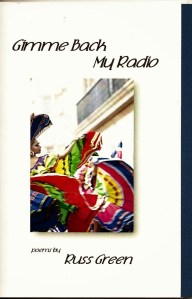 RUSS GREEN is a Graduate of Hofstra University. Over the years he has been co-editor at Great Weather for Media and has put on poetry and arts events around Long Island and New York city in addition to hosting and curating poetry stages at various festivals.
PHILIP ASAPH was a furniture mover for most of his life. He won scholarships and fellowships to Eckerd College, Bucknell University and New York University. His stories and poems have appeared in Glimmer Train, Poetry, The Huminist, Tampa Review and elsewhere. Philip’s new book, Four Short Stories and Ten Love Poems is recently published.



 Jamie Dedes' THE POET BY DAY Webzine