Poets, Poetry, News, Reviews, Readings, Resources & Opportunities for Poets and Writers
Author: Jamie Dedes
Jamie Dedes is a Lebanese-American poet and free-lance writer. She is the founder and curator of The Poet by Day, info hub for poets and writers, and the founder of The Bardo Group, publishers of The BeZine, of which she was the founding editor and currently a co-manager editor with Michael Dickel. Ms. Dedes is the Poet Laureate of Womawords Press 2020 and U.S associate to that press as well. Her debut collection, "The Damask Garden," is due out fall 2020 from Blue Dolphin Press.
Note: Priscilla Galasso (scillagrace, try to live gracefully) wrote this last year just before the 2014 event. (We’ve adapted it with current links and dates.) It seemed a good piece to share with you today to welcome and encourage you to join with us this year on 26 September for 100TPC, which is not just for poets but includes artists, photographers, musicians and friends of the arts. 100TPC is about Peace, Sustainability and Justice. We chose “poverty” for our theme this year and have devoted the entire September issue of “The BeZine” to that subject.
On the 26th, a post will go up on The BeZine blog with instructions on how you can share your work and view that of others. We look forward to your participation and to your works. J.D.
As a core team member of The Bardo Group, I am invited, encouraged, challenged to participate in the The BeZine’s 100 Thousand Poets for Change event to be celebrated virtually at this blog. For more information about this event, and to be stirred and prodded in you own artistic lethargy, click here.
I yearn to be a poet, an artist, a musician. I often find a piece that seems so right, so seemingly effortless, so fitting that I think it can’t be hard to craft a work like that…it simply lays over its theme like a glove. Not so. Listening to music on my way to work yesterday, I heard a poet’s frustration: “I don’t know why I spend my time / Writing songs I can’t believe / With words that tear and strain to rhyme.” (Paul Simon: Kathy’s Song.)
I feel these core values of Peace, Sustainability and Justice coursing through my life, my thoughts, my work, my hopes, and I wonder how hard it would be to write a poem about it. I talked to a young man half my age who has studied forensic justice and just interviewed for a position as a mentor, a parole partner, someone who will help perpetrators and victims get together and talk, face to face. I thought it was a great idea, for both parties, for all parties. Here’s my attempt to let that idea percolate:
Let’s Face It
Behind the veil, the dirty shroud, the black burka, the white Klan sheet,
the knit ski mask, the heavy gas mask, the transparent oxygen mask, the impenetrable death mask,
the dense fur, the redwood bark, the shiny scales, the matted feathers,
the protective shield, the official badge, the repeated slogan,
For the past five years, September has been the month of 100,000 Poets for Change (100TPC). All over the world, poets (musicians, artists, and, yes, mimes) have organized events on or near a Saturday in September each of those years, this year, on the 26th. For this, the fifth anniversary of 100TPC, there are over 500 events scheduled throughout the world. The readers of, contributors to and publishers of The BeZine have participated with a virtual event in the past and will again this year on the 26th.
Meanwhile, The BeZine’s theme for September also supports the 100TPC call for peace, sustainability, and social justice, with our focus on poverty in general and homelessness in particular. This focus relates to social justice in an obvious way. Yet, how could we speak of sustainability without social justice? If we still have poverty and homelessness, what is sustained other than inequality? And, without social justice could there be peace? For that matter, could peace be sustained without both justice and environmental plus economic sustainability? Our choice is not to put one of these three above the other, but to recognize that all of these three important themes, necessary areas of change interrelate in complex ways. So we chose one aspect to focus on, and in so doing, this issue clearly points to all three themes through the lens of poverty.
We open by featuring three incredibly powerful poems by Sylvia Merjanian, Refugee, Second Chance, and Collateral Damage. Refugee and Collateral Damage come from her collection, Rumor (Cold River Press—proceeds go to help Syrian refugees). Second Chance debuts here. These poems show the relationship of war to poverty, oppression, and sexual abuse. In reading these, one senses the immense personal costs of war, especially to women and children. They provide an important window into the staggering worldwide refugee crisis, currently the largest human migration since World War II. Refugees are homeless in so many ways, even when they have a house to live in. And, the world seems to conspire to keep them destitute.
That war directly and indirectly causes poverty does not surprise. You might not know, until you read James Cowles’ essay, The Roots of Institutionalized Poverty, that something called The Compromise of 1877, which ended the post-Civil War Reconstruction Era, provided the political and economic structures of poverty that continued strong through the Civil Rights Era and, in many ways, still exist today. Certainly we know that poverty is not new in the United States, and neither is homelessness. In this issue you will hear music of the Depression Era that sounds too familiar today. The first time I personally participated in an editorial and writing publication related to homelessness was in 1989, for the University of Minnesota student paper, the Minnesota Daily. We produced a special finals’ week issue, title Ivory Tower, dedicated to the theme.
Poverty and homelessness are evergreen issues historically, but issues also embedded in social and political complexity. They benefit the rich, whose economic system keeps most of the rest of us as, at best, “wage slaves,” and all too many of us in poverty, without enough to provide for basic needs or housing (including the “working poor,” who hold low-paying jobs while CEOs are paid record-breaking salaries and bonuses). Our second feature, Jamie Dedes’ poem, Some Kind of Hell to Pay, cries out against the structures of injustice, where the rich act as demigods and demagogues, and it asks of what use will all their riches be in the Hell realm of the inevitable backlash from the marginalized and disenfranchised.
photo credit: Sharon Frye
The poems, prose, photo essay, and art in the rest of the September BeZine will ask you to feel, to see with empathy, to hope defiantly, and always to resist the status quo. The writers often look beyond the borders of the U.S. or Western Europe to see the injustices of a world-wide economic system of war, greed and injustice that makes it difficult to live outside of its oppressive realities—and for those pushed out, choices do not sustain their lives, their dreams, or their spirits.
Yet, people live, they dream, and they hope with spirit—often in defiance, sometimes by dying (see John Anstie’s As if and Sharon Frye’s Jacob’s Ladder in this issue), sometimes by living despite all of the forces lined up against their lives. Victoria C. Slotto’s Homeless Man tells of a “destitute” man whose story reveals that he may in fact have the most rich life of any of us. Always, there is more than what we see.
Read these words. Think about the change that could help to heal creation as Michael Yost’s poem Who Am I to Judge and Michael Watson’s essay The Realm of the Unimaginable speak to. Remember the admonition to think globally but act locally. And, most of all, imagine.
Then, join us on 26 September 2015, on our blog. Add your own thoughts, your own poems, your own essays. Join in our virtual, worldwide 100TPC event from wherever you live. We will post a page with instructions on our blog on the 26th. The posts will go up live. And, after the 26th, we will organize and archive the event (see the 2013 and 2014 pages in the tabs at the top of the page).
—Michael Dickel, Jerusalem
My poem from the 1989 Minnesota Daily Ivory Tower
Soil
i The plow cuts, disk or chisel? How much of what lies below to bring up leave exposed to dry in the wind? What residue of last years’ crop to leave upon the soil, cover over to rot, return to the fertile land?
What fetish draws me along this furrow? Street and curb meet here.Step up or down into slime. Dust, trash tossed around and dropped by the blind wind. What fate ties strings to which embedded hooks, Pulls my flesh forward forever forward towards the street?
The Spring fete begins, seeds in muck anticipating dilettante dance of the chosen few. Weed out the hungry whose appetite starves wind-pressed grain shafts; water the rows of the obedient who face slick harvest, brittleness in the searing sun and death with Winter.
I move, farmer in these city streets, man among the chaff, I offer to fetch my elegant plow-tongue, to stop the wind, describe the deep earth and the rotted residue, the dry grasses and newspaper blown by, salvaged for shelter by the quick grasp of an old hand, pulled on top of gray hair to keep rain out.
ii I would pull the plow, but a voice from under the newspaper covers my shoes in mud and mire.
What d’you know ’bout all this? He spit
from mown rye-stubble fields, fetid earthen face Cracked crumbled creased
Caressed once, long ago
All you see’s a bum. Fuck you, you son of a whore.
At home I do not wash the dirt from me,
I scrape it off, place it in a box with a key I open my belly and
secure the box within, sated.
Sjofar, the ram’s horn that is blown to announce this holy day
For those who are not familiar with this holy day …
“Rosh Hashanah (Hebrew: רֹאשׁ הַשָּׁנָה, literally “head of the year”) is the Jewish New Year. The Biblical name for this holiday is Yom Teruah (Hebrew: יוֹם תְּרוּעָה, literally “day [of] shouting/raising a noise”) or the Feast of Trumpets. It is the first of the High Holy Days or יָמִים נוֹרָאִים Yamim Nora’im (“Days of Awe”) which usually occur in the early autumn of the Northern Hemisphere. Rosh Hashanah is a two-day celebration, which begins on the first day of Tishrei. Tishrei is the first month of the Jewish civil year, but the seventh month of the ecclesiastical year.” MORE [Wikipedia]
Recipes for a kindly vegan New Year feast HERE and HERE. May the core values of respect and nonviolence be expressed in every area of our lives.
“The Parkchester Library was my haven. To thumb through the card catalog was to touch an infinite bounty, more books than I could ever possibly exhaust.”Sonia Sotomayor, My Beloved World
This slideshow requires JavaScript.
We went to the library on Friday and were charmed by this cheerful little exhibit. Apparently we weren’t the only adults who liked it. There were no kids around, just a few grown-ups with bright eyes and big smiles, ostensibly collecting Snoopy coloring pages for their kids.
I wondered if the others were remembering the magic of their first card and their early trips to the library. Perhaps they also smiled to think about taking their own children to the library. My son used to love visiting “the girls” … that is, the librarians hosting pre-school story-hour.
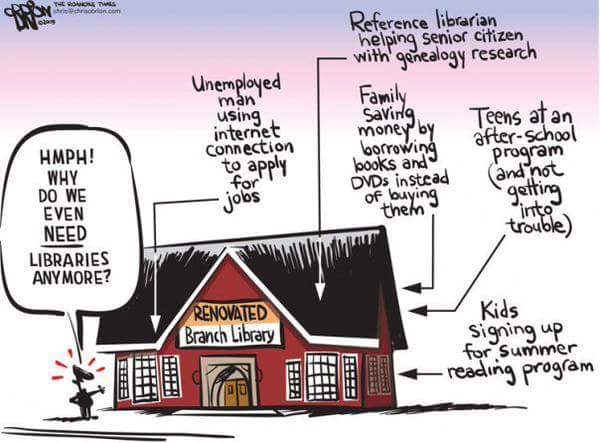
Thank goodness for free libraries, one of the foundations of democracy, of learning and refuge and wonder. And here we are again: September! now officially library card sign-up month for another generation of children. Some traditions are worth keeping. Some pleasures don’t fade with time.
The photographs are mine and the cartoon is the work of Chris OBrion, writer, illustrator, visual journalist and editorial cartoonist.
Thank you for sharing your love of words. Comments will appear after moderation.



 Jamie Dedes' THE POET BY DAY Webzine
