“That some of those labelled as enemies have crossed the lines to offer condolences at the mourning tents; that the mourning families spoke to each other as parents and cried on each others’ shoulders; that we cried for the children who died on both sides of the divide; that the war began anyway; that hope must still remain with those who cross borders, ignore false lines and divisions; that children should be allowed to live; that we must cry for all children who die”
“Thanks to musician and artist Zena Hagerty and HamiltonSeen (film-makers) for inviting me [Michael] to Ontario as a writer-in-residence to work in collaboration with other artists.
“Also, thanks to poet Michael Rothenberg and #100TPC for also inviting me to Florida for a residency, later in February.
“If any people in our wider poetry community seeing this in or around Hamilton-Toronto or Tallahassee areas and have connections to help with arranging potential readings or campus visits during February (first part in Ontarion, second in Florida), please be in touch with me via Facebook chat / messenger if you are willing to help. I expect to be in the NYC-Long Island area the last week of January (28 Jan–03 Feb), also. Paying gigs would especially be appreciated, to help cover my travel expenses (which the residencies don’t have funds to cover).”
—Michael
Watch for more details on time, days and locations to come under “Events” in upcoming Sunday Announcements. ./J.D.
You can read my [Jamie’s] interview of Michael: The Poet as Witness HERE and his essay A Defense of Activist PoetryHERE. Michael’s Amazon page is HERE.
Note: If you are reading this post via an email subscription, it’s likely you’ll have to link through to the site to view this video.
MICHAEL DICKEL a poet, fiction writer, and photographer, has taught at various colleges and universities in Israel and the United States. Dickel’s writing, art, and photographs appear in print and online. His poetry has won international awards and been translated into several languages. His chapbook, Breakfast at the End of Capitalism came out from Locofo Chaps in 2017. Is a Rose Press released his most recent full-length book (flash fiction), The Palm Reading after The Toad’s Garden, in 2016. Previous books: War Surrounds Us, Midwest / Mid-East, and The World Behind It, Chaos…He co-edited Voices Israel Volume 36(2010). He was managing editor for arc-23 and arc-24. With producer / director David Fisher, he received an NEH grant to write a film script about Yiddish theatre. He is the former chair of the Israel Association of Writers in English. Meta/ Phor(e) /Play is Michael’s blogZine Michael on Social Media: Twitter | FaceBook Page | Instagram | Academia Michael is also an a member of The BeZine core team.
Seen at my fave used-book store – B Street Books (San Mateo, CA) – a long time ago.
I once had a survival job* at a brick-and-mortar mega-bookstore. Authors would sometimes come in to see how their books were doing, where their books were displayed and so forth. Those of the narcissistic variety were sure to posture and try to throw their weight around. They would want to talk with the manager and a bookseller or two, hoping to get sales stats and to bully staff into recommending their books to customers. There was little trust. They were sure their publishers weren’t reporting sales honestly. This last, of course, would affect royalties. These writers were condescending as well as rude.
As you might imagine, strut-and-push strategies achieve nothing. Bookstore management and staff are forbidden to share sales data with anyone, including authors. Staff don’t have control over the placement of books in the store. That’s dictated by corporate, which has negotiated contractual agreements with publisher regarding book placement.
Having said that, it’s actually a good idea to go into bookstores and talk to staff. If it’s not a busy day, introduce yourself. You might ask about their jobs, how they like them, what kind of books they read. Show some interest in booksellers. Remember the adage about honey vs. vinegar.
“I did discover that if you’re interested in low wages, a bookstore ranks below retail clothing sales, except the hours are worse.” Sue Grafton, American novelist (detective stories)
Working in a mega-bookstore might sound romantic to a bibliophile, but it’s hard work. It’s pretty thankless and it’s not well-paid. It involves lifting and moving heavy boxes of books, pushing H-carts, dragging hand trucks, dealing with demanding customers and stressed managers. There are no civilized corner offices with windows. There are shabby lunchrooms and rushed-half-hour lunches, two ten-minute breaks. There are sore feet and aching backs. Our regional manager used to say that if you didn’t hurt at the end of a shift you weren’t doing your job.
Resetting the store after closing is not the sweet enchanted thing illustrated in the video below. It’s fast paced and onerous. Everyone is tired. Some people will close the store late at night and have to be back early in the morning without having had enough sleep.
If you do visit bookstores, say “thank you” for all the hard work. Congratulate the booksellers on the store’s appearance. Drizzle a little honey. Booksellers will remember you as kind and be more inclined to read and recommend your books.
* a survival job is not a career position just something taken to pay the bills until more appropriate work is found
Note: If you are viewing this post from an email subscription, it’s likely you’ll have to link through to the site to play the video.
GRAPHIC DESIGN BY Dale Houstman (c) Diaphanous Press
Diaphanous Press was founded in February 2017 to publish contemporary, cutting-edge poetry, short fiction (under 750 words), and art in the online journal, Diaphanous. As a poet, literary fiction writer, scholar of postmodern literature and poetics, and wannabe visual artist (my predilection as a child was to be a painter first, then a writer), I wanted to provide a free, high-quality, e-journal to showcase and promote the creative work of writers and artists—and in turn, offer a wide audience free access to the best contemporary literature and visual art that I can find.
logo (c) Diaphanous Press
I chose the title “Diaphanous,” as the word evokes an image of a light, gauzy material (such as gossamer); a veil or dress draped elegantly over a woman or the semi-sheer, wind-tossed curtain covering a window or storm door. The word “diaphanous” often elicits images of a fragile, intricately-constructed spiderweb that can be destroyed with the swift swat of a human hand or a broom. The word and its image have also been thought of historically—as a filmic layering over one’s vision, the ancient Sumerian, Hindu and Buddhist Veil of Maya that prevents humans from perceiving “true reality” or representation; reminding us, as philosophers have, that perception; experience; emotional, intellectual, psychological responses to art and life; and the meaning we confer upon all of these human facets—are subjective and take place in the non-transparent, human medium of language that is a bi-product of civilization and one that evolves in its historical and cultural contexts over time.
As the title “Diaphanous” implies, I’m interested interested in writing and art that is slightly opaque or hazy, like language itself—that invite the reader/viewer in to experience the process of creating the specific text/image that is embedded in the final product–and to ascribe/construct possible meaning(s) and values to/for the linguistic/aesthetic experience. My hand-picked, small editorial staff and I gravitate towards a postmodern poetics and aesthetics that, as aforementioned, engage the reader/viewer in the experience the texts and images offer each, subjective reader. We are interested in language-centered poetry that foregrounds the medium of literary texts as slippery at best versus traditional, “I-centered” lyrics or straight, narrative poetry. Similarly, we value short fiction with challenging uses of language, composition, and condensed plot.
We are huge fans of writing that blurs the boundaries of genre (prose poetry, hybrid, flash fiction, micro-fiction) and subsequently, choose to feature experimental writing or writing that “leans toward the experimental,” as I like to say. Our Art Editor, Dale Houstman and I, solicit visual images that like the writing we value, are postmodern, experimental, and for the most part, non-representational. At the end of the day, we appreciate and choose to publish amazing, arresting, and haunting works of art. We have featured paintings, photography (acrylics, watercolors, and mixed media), digital art, mixed media collages, visual poetry, collage poems, text-based art, asemic writing, communal calligraphy, architecture—and seek to incorporate sculpture into our 2018 issue.
In terms of submissions, we receive a ton of poetry, a lot of art, and some fiction (not enough yet) due to the tagging of members of our facebook community and creative peers, direct soliciting from writers and artists, and now–as a result of our incredibly well-received inaugural Spring 2017 and Fall 2017 issues, people who have seen what kind of writing and art makes us swoon as well as the high-quality of our journal. In addition to the continued flow of poetry submissions, we would like more art and fiction submissions as well as more submissions from non-US writers and artists.
In our first two issues, we have published writers and artists from Australia, Tunisia, South Africa, Iran, Macedonia, Hungary, Italy, and England. We would love to represent talented writers and artists aligned with our mission statement in even more geographical locations across the globe. We are proud of a balance of male and female, established and new contributors—and the inclusion of diverse contributors in the context of ethnicity, race, and social status. Well, let’s face it, many artists and writers, yours truly included, are a bit financially-challenged due to the life choices we make that enable us to create and work in creative and academic environments, when possible. Many of us hold non-creative day jobs or temp when needed to support our art. Others, like Dale Houstman, are “gleefully retired” per his facebook bio description.
It is critical for me to note that this labor of love would not have been possible without the beautiful website design of my dear friend and writing colleague, Michael Dickel (Meta / Phor(e) /Play). A shoe-string volunteer staff who are all passionate and talented writers and artists, including, Art Editor, Dale Houstman; Poetry Editor, Thato Andreas Mokotjo; and Managing Editor, Meg Harris–assisted in the stunning, well-received first two issues of Diaphanous. Dale will remain as Art Editor and Thato as Poetry Editor for our third, 2018 issue.
Due to time constraints with my own writing, the intense workload, and unfortunately, my own battle with a cluster of serious autoimmune diseases—beginning next year, Diaphanous will be an annual publication instead of biannual with a new, small staff in place working alongside Art Editor, Dale Houstman and Poetry Editor, Thato Andreas Mokotjo.
Our reading period and release date for our 2018 issue of Diaphanous is to be determined. We will update our Diaphanous Press facebook page and our website, as soon as we know.
I thank all of those involved with this amazing Diaphanous journey and look forward to reading and showcasing more of the highest-quality, cutting-edge, and exquisite poetry, short fiction, and art from around the world.
HOURGLASS STUDIES / XI
1. Sleeping close to the reef, the traveler holds a teal cup to the ear to hear the blue-green kelp gone lazy and dry, lost from the ink [stomach].
2. The chair in the suitcase packed to find the third shore, [w]here another narration varies.
3. In the dirt lit with Chinatown, the refrain apprehended in part; the loss of the second hand.
4. Send for the sample only to be plagued by more questionnaires.
5. The contents of the bag turned inside out. Borrowed and given back: a loose tooth, address book, bit of red mountain in a jar.
6. The lover’s eye spinning estuary coin.
7. Pulled out of slumber across the daybook filled to echo formulas for [sw]allowed halos.
8. The clock in hand the confused woman swallows the key to a diary the pages disappear waiting for the trump finale.
9. The [n]arrow boatride toward daybreak before the mountains crumbled [into] sound.
10. Pendulum’s dialectic of true and false, and all those shades of gray in between conspire hungry.
11. To prove the best design, the tincture couldn’t be documented to ensure the singular.
12. The hemlock given with an even hand, the logician attacked in the folds of a proposition, knotted in the tide’s undercurrent, wakes to find everyone missing–all of the main beams.
KRYSIA JOPEK‘s (Krysia Jopek, poems and poetic fiction) poems have appeared in many literary journals, including Great American Literary Magazine, Crisis Chronicles Cyber Litmag, Meta/Phor(e)/Play, Syllogism, The Woven Press, Columbia Poetry Review, and The Wallace Stevens Journal. She reviewed the poetry of Ann Lauterbach, Michael Palmer, Anna Rabinowitz, and Rosemarie Waldrop for The American Book Review as well as literary criticism for The Wallace Stevens Journal. Her first novel, Maps and Shadows (Aquila Polonica 2010), was praised as “a stunning debut novel, beautifully written, lyrical and poetic” and won a 2011 Silver Benjamin Franklin award in the category of historical fiction. Her sequence poem, Hourglass Studies (Crisis Chronicles, 2017) was nominated for a 2018 Pushcart Prize in Poetry. She holds four degrees: a B.A. and M.A. in English from the University of Connecticut, an M.Phil. in English from the City University of New York Graduate Center, and an M.F.A in Literary Fiction from Albertus Magnus. She is the Founding Editor of Diaphanous: an e-journal of literary and visual art. She can be contacted via Diaphonous Press or her author website (linked above).
“What is a poet? An unhappy man who hides deep anguish in his heart, but whose lips are so formed that when the sigh and cry pass through them, it sounds like lovely music…. And people flock around the poet and say: ‘Sing again soon’ – that is, ‘May new sufferings torment your soul but your lips be fashioned as before, for the cry would only frighten us, but the music, that is blissful.” Søren Kierkegaard,Either/Or
MICHAEL ROTHENBERG 100TPC Co-founder with Terri Carrion: Join Michael in support of this worthy cause from which so many poets benefit as they use their poetry for peace, sustainability and social justice. Michael is raising money for 100 Thousand Poets for Change (a modest $1,000). Whether you donate $5 or $500, your contribution will make a difference. Details HERE.
This is our new poster for 100TPC 2018. It was designed by Corina Ravenscraft (Dragon’s Dreams)
MOE’S BOOKS, Berkeley, CA is one of the most interesting bookstores. It has a long history.
“Since its inception back in the heyday of the Beatnik era, Moe’s Books has managed to become more than just a great bookstore–it has achieved the rarified status of a beloved landmark institution as well. Situated just four blocks from the University of California campus, Moe’s has managed to mirror the often turbulent and triumphant times that have come to epitomize all that is exciting and unique about Berkeley.”
Currently, novelist Todd Stadtman (Dec. 6) and poets Kevin Lozano, Jacob Kahn, and Shiloh Jines (Dec. 7) are scheduled to do readings. Details HERE.
The last time I was able to visit Moe’s there was a reading of Philip Whalen’s poems from Prolegomena to a Study of the Universe with photos by Tinker Greene. Michael Rothenberg and Tinker Greene were among those reading that day. (The woman in blue with the camera is Terri Carrion.)
This slideshow requires JavaScript.
“Do you know why the San Francisco Chronicle said ‘India has the Taj Mahal. Berkeley has Moe’s?’ Moe Moskowitz of Moe’s Books [est. 1959] was a kind of loud mouth beatnik father to a generation. Moe embodied radical politics, radical theater, and radical bookselling. He put fun into being an intellectual and helped democratize literacy. If you were young in the 1960s in Berkeley when he held court at his counter, sharing jokes and politics, opinions, both warm and offensive, maybe you have wondered why he opened his monumental bookstore?” Moe’s Books on Radical Bookselling: A Life of Moe Moskowitz
Radical Bookselling by Doris Jo Moskowitz on her father offers a wealth of images, event posters, “happenings” on Telegraph Avenue through the 60s, and memorabilia from Moe’s life prior to his Berkeley days in 1955.
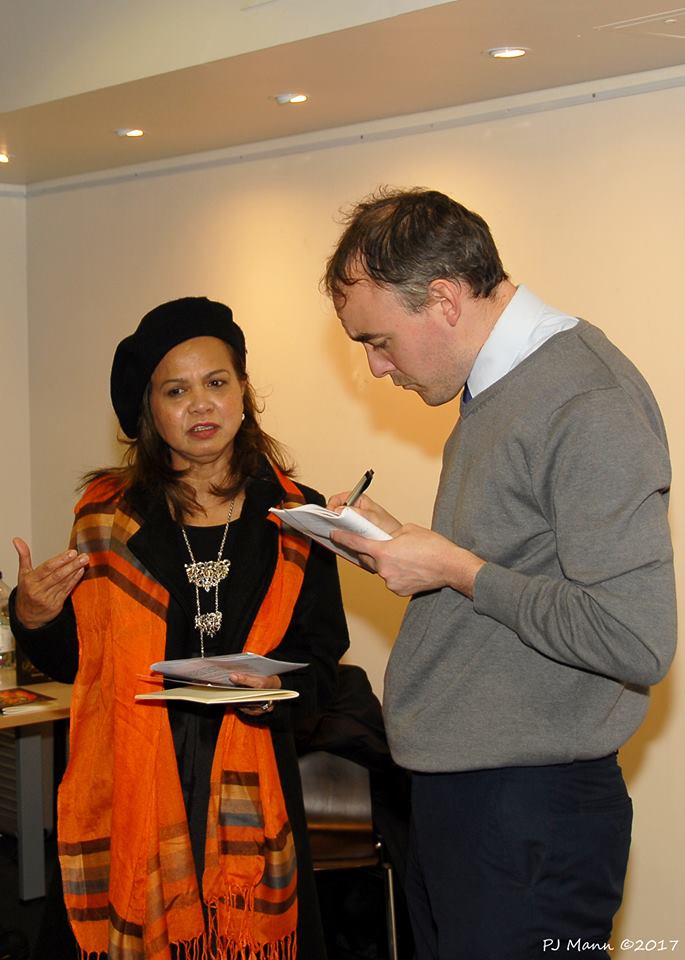
BRAVA! Amy Berry for the successful launch of Spearing Dreams on November 17 in Ireland and as reported by James Fogarty in the Rosecommon Herald, her hometown paper. Direct message Amy on Facebook for info or check out the FB page dedicated to the book.
Poet Amy Barry (c) Philip MannAmy Barry being interviewed by James Fogerty of the Rosecommon Herald (c) Philip Mann
I am tickled to note that Amy quoted me (Sweet, my friend. Thank you!) in her presentation:
SEQUESTRUM 2018 EDITOR’S REPRINT AWARD is open for submissions and deserves breakout from weekly Sunday Announcements because it’s rather unusual. There’s not all that much by way of opportunities for “reprints” and this one awards $500 to writers of fiction, nonfiction, and poetry. There will be a first-prize winner and “a minimum of two runners-up per genre.” $15 entry fees. Deadline: April 30, 2018. Details HERE.
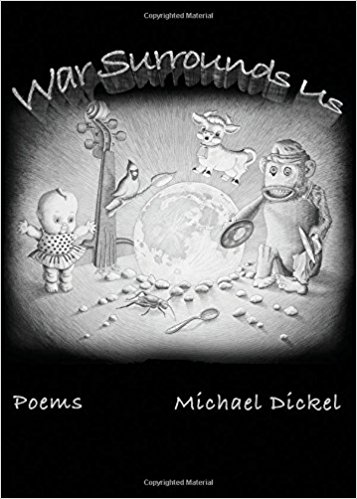
 MICHAEL DICKEL a poet, fiction writer, and photographer, has taught at various colleges and universities in Israel and the United States. Dickel’s writing, art, and photographs appear in print and online. His poetry has won international awards and been translated into several languages. His chapbook, Breakfast at the End of Capitalism came out from Locofo Chaps in 2017. Is a Rose Press released his most recent full-length book (flash fiction), The Palm Reading after The Toad’s Garden, in 2016. Previous books: War Surrounds Us, Midwest / Mid-East, and The World Behind It, Chaos… He co-edited Voices Israel Volume 36(2010). He was managing editor for arc-23 and arc-24. With producer / director David Fisher, he received an NEH grant to write a film script about Yiddish theatre. He is the former chair of the Israel Association of Writers in English. Meta/ Phor(e) /Play is Michael’s blogZine Michael on Social Media: Twitter | FaceBook Page | Instagram | Academia Michael is also an a member of The BeZine core team.







 Jamie Dedes' THE POET BY DAY Webzine