“I find myself “Dancing With Cancer”, problem is…I can’t dance. I stumble, bumble, and get pulled along. To keep my sanity, (humor me), I write short stories, a journal, musings and poetry….just about anything goes.” Renee Robinson
I’ve spent some time recently in hospitals and specialty clinics. It’s always heartening to witness how remarkably resilient some folks are, how they deal with their trials in good spirit. They remind me of one special person, a blogger and poet you might remember. With utter grace, she dealt with the fallout from a devastating disease. She was Renee Robinson.
A few years ago, I’m not sure why or how the impulse came to me, I suddenly had to see if Renee’s blog was still up. I discovered her WordPress domain had expired. Her other blog and Twitter account hadn’t seen posts since August 2014. It also appeared that no books were published after that date. Finally I searched for and found an obituary. Renee died in September 2014.
For about four years many of us watched this young woman produce a staggering amount of work, taking refuge in poetry as she struggled with metastatic colon cancer.
“Life is ever-changing. It is what we make of it. Though I have no control of when my life will end, I can paint my words out on a canvas. I can show my love for my family with each stroke.”
Renee’s love of writing combined with the knowledge that her life was on the wane. In this last thing, she was only different from her readers in that she was no longer in denial and was using her time consciously to do what she wanted most to do and to leave behind her own special blessings.
Renee self-published several poetry collections. The one I selected to read some years ago was Shadows of the Heart, which is still on my Kindle. The operative word here is not “shadow,” it’s “heart” . . . a collection of poems from a big heart evolved from a deeply prolific rhizome of courage. In that book were the young shoots and the adventitious roots of an old soul.
Renee’s poetry was that of someone with a passion and talent for writing and not enough time on this earth to refine either. Having said that, the collection is notable for its unbearably naked emotion: pain, fear, remorse, courage, gratitude, and for the intense feelings arising out of her unshakable affection and appreciation for her husband.
In 2013 and 2014, Renee self-published a series of Captain Chemo books for children. According to Amazon, they’re in Amazon’s Top 100 in Children’s Book Sales. Brava, Renee!
A magickal night
When death is life
And dark is light
Time stands still
Hail! The Samhain Night!
Two Souls, One Life
Poet and writer, I was once columnist and associate editor of a regional employment publication. I currently run this site, The Poet by Day, an information hub for poets and writers. I am the managing editor of The BeZine published by The Bardo Group Beguines (originally The Bardo Group), a virtual arts collective I founded. I am a weekly contributor to Beguine Again, a site showcasing spiritual writers. My work is featured in a variety of publications and on sites, including: Levure littéraure, Ramingo’s Porch, Vita Brevis Literature,Compass Rose, Connotation Press, The Bar None Group, Salamander Cove, Second Light, I Am Not a Silent Poet, Meta / Phor(e) /Play, and California Woman. My poetry was recently read byNorthern California actor Richard Lingua for Poetry Woodshed, Belfast Community Radio. I was featured in a lengthy interview on the Creative Nexus Radio Show where I was dubbed “Poetry Champion.”
“What if our religion was each other. If our practice was our life. If prayer, our words. What if the temple was the Earth. If forests were our church. If holy water–the rivers, lakes, and ocean. What if meditation was our relationships. If the teacher was life. If wisdom was self-knowledge. If love was the center of our being.” Ganga White, teacher and exponent of Yoga and founder of White Lotus, a Yoga center and retreat house in Santa Barbara, CA
“Every pair of eyes facing you has probably experienced something you could not endure.” Lucille Clifton
Thank you for sharing your love of words. Comments will appear after moderation.
“Language as the technology of human extension, whose powers of division and separation we know so well . . . ” Marshall McLuhan
For Mike’s poetry visit him at Uncollected Works. [recommended] / J.D.
What’s it really like to be an English-language poet in Israel? What’s it like to speak, read, and write in more than one language? I was inspired to write this post after reading an excellent article by Dara Barnat, entitled No One’s Mother Tongue: Writing in English in Israel, appearing in the English & French poetry journal “Recours au Poeme”. It is well worth your reading, but don’t be daunted by the French at the beginning of the article if you are monolingual; the original English follows immediately. For those Francophiles struggling along in English, Sabine Huynh translated Dara’s article into French. Sabine is a talented poet in both French and English, and translates six languages at last count.
To answer the first question, I suppose it’s somewhat like being a Hebrew-language poet in America; not because so few people read English in Israel or Hebrew in America, but because so few people read poetry in any country. More people would rather read a blog post on poetry or see a movie about a poet, than read an actual poem. But seriously, Dara makes a valid point that being an English-language writer in Israel makes one “different”, “not normal”, and casts one in the undesirable role of being an outsider, insiders being those who are “normal”, who eat out of the same mess kit as you, who love what you love and hate what you hate. The funny thing about that is that’s the way I felt in America too. Maybe it’s a Jewish thing, except that’s the way I feel in a synagogue too.
Now would be a good time to explain the title of my post, “Nisht a’hair un nisht ahin”. It’s Yiddish for “neither here nor there”. That’s how a true outsider feels.
As for the second question, I speak, read, and write in English and Hebrew. English is my native language, my mama lushin, but I’ve lived in Israel more than half my life, so I don’t have to translate my thoughts from English to Hebrew. I think in both languages. I used to speak Spanish and German too, but unfortunately those tongues have atrophied in my mouth. So a curious monolingual might ask “what’s it like?” We see the world around us through our eyes but we filter what we see through the structures of our language. Actually there are a lot of different filters that raw reality has to pass through before it enters our minds, such as the structures of culture, of religion, and of nationality, but language precedes them. If we experience something for which we have no word or form of word, then we are not likely to remember that thing. We may not even be aware of it. Most languages possess common structures, or else we’d never be able to translate from one language to another, but every language also has its own unique structures. Hebrew speakers see the world through both common and unique language structures, for instance the concurrency of biblical time with modern time, the timelessness of the Holocaust, the synesthesia between our children and our soldiers, our love-hate relationship with religion and politics, our dependence on and mistrust of the outside world, the suspicion of abandoned baggage, to name only a few of our unique language structures. These will never be translatable into English or any other language. So what I am saying is that I see the world through both sets of language structures at the same time. The realities I see are painted from a richer palette. Richer is not necessarily happier. In my case, it’s sadder.
There is so much to love, but there is so much to lose and it can be so lonely when you’re an outsider looking in.
MIKE STONE (Uncollected Works)was born in Columbus Ohio, USA, in 1947 and was graduated from Ohio State University with a BA in Psychology. He served in both the US Army and the Israeli Defense Forces. He’s been writing poetry since he was a student at OSU and supports his writing habit by working as a computer networking security consultant. He moved to Israel in 1978 and lives in Raanana. He is married and has three sons and seven grandchildren.
Poet and writer, I was once columnist and associate editor of a regional employment publication. I currently run this site, The Poet by Day, an information hub for poets and writers. I am the managing editor of The BeZine published by The Bardo Group Beguines (originally The Bardo Group), a virtual arts collective I founded. I am a weekly contributor to Beguine Again, a site showcasing spiritual writers. My work is featured in a variety of publications and on sites, including: Levure littéraure, Ramingo’s Porch, Vita Brevis Literature,Compass Rose, Connotation Press, The Bar None Group, Salamander Cove, Second Light, I Am Not a Silent Poet, Meta / Phor(e) /Play, and California Woman. My poetry was recently read byNorthern California actor Richard Lingua for Poetry Woodshed, Belfast Community Radio. I was featured in a lengthy interview on the Creative Nexus Radio Show where I was dubbed “Poetry Champion.”
“What if our religion was each other. If our practice was our life. If prayer, our words. What if the temple was the Earth. If forests were our church. If holy water–the rivers, lakes, and ocean. What if meditation was our relationships. If the teacher was life. If wisdom was self-knowledge. If love was the center of our being.” Ganga White, teacher and exponent of Yoga and founder of White Lotus, a Yoga center and retreat house in Santa Barbara, CA
“Every pair of eyes facing you has probably experienced something you could not endure.” Lucille Clifton
Thank you for sharing your love of words. Comments will appear after moderation.
“The word “palimpsest” helps to describe the trajectory of my poetry. I grew up as a pianist, practicing five hours a day—Haydn, Mozart, Bach. I played in recitals, long pieces of music I then memorized by heart. Music gave me a sense of both sequence and depth, the combined sense of which has never gone away.” Linda E. Chown
INTERVIEW
JAMIE: I know you’ve been writing poetry for most of your life. How has your writing evolved?
LINDA: Initially, I wrote poetry feeling and being rather locked in, in the confines of McCarthyism and terrible asthma. These poems were outcries, full of a sense of being an outsider and a non-success. This first stage of my poetry was full of words, big words sometimes, as I was reading a lot of Faulkner at a young age. And I think my poems were without much nominal direction.
A second stage took place as I went to SFSU and got a degree in Creative Writing. Then, I worked intimately with and heard truly great poets who encouraged me to write spare poems, to take off the loud pedals of my poetry piano. I wrote at this time very lean poetry, often of minute changes in the physical world, of bird calls, of colors blending. Sometimes, I also wrote at this time much longer narrative poems presenting moments of meeting, losing or finding. Then, there was a long time I lived and taught in Spain and the poetry stopped for some years, also when I went to get my Ph.D.
Now, in this third phase, I’m writing of the unforgettable, the personally traumatic, of artists in poems I call “intrications,” I find myself able and ready to write of traumas. I think my poetry has become freer and truer. Not now attempting to use strong fine words, but to allow language to match and measure the person I’ve become and am becoming. Also, now I write without immediate readers. That fact alone gives me a kind of freedom I didn’t have before when people “made suggestions.” My poems today draw upon the first period of Faulkneresque big word poems and the spare lean writing of my creative writing days. It’s as though I can now write of anything in a form which has more hybrid, mingling poetic terseness and prose expansiveness within a guiding imagery.
JAMIE: What were your original inspirations and who or what inspires you now?
First, I was affected by the Holocaust and its pictures of the opening of the Camps. Since I was mostly in bed at that time, I was dramatically changed by seeing this ghastly suffering objectified. Seeing the thinning bodies and expressionless faces. And the stripes in the stillness. Then Albert Camus’s The Stranger brought the world in my focus: I’ll never forget how Meursault wrote at the end, before being hung, about “resigning himself to the benign indifference of the universe.” I did not yet totally understand the kind of social repression Meurseult lived under, its deadening proprieties. I have always resisted imposed proprieties. I was enormously impressed by Camus as a writer and as a fighter, by his argument with Sartre over what was important.
Later at SFSU, I found Jack Gilbert’s writing to be enormously profound and compact. The great Samuel Johnson influenced me to mind myself, to take myself in hand. Linda Gregg’s poetry is beautifully simple and calls to me from everywhere. Her poems are like dense, language-smitten miracles.
Having worked at SFSU’s Poetry Center, I met Robert Creeley and was extremely impressed by his writing and the utopian spirit of Black Mountain College. Now the passionate simplicity of Dylan Thomas, as in “Fern Hill,” slides me into a happiness. I love Gerald Manley Hopkins and John Donne for their enormous reach and power of generalization, all the while growing in images. Poets who can draw together the terrible horror of an actual event and the beauty of a reflective mind captivate me.
Wisława Szymborska’s sense of mystery intrigues me and draws me to her. She said,” Poets, if they are genuine, must … keep repeating ‘I don’t know.’” Now I like a poetry which does not pretend to know but which charges ahead into mystery, into politics, love, parenting, learning with great curiosity and the power of imagery fresh. I don’t like poems of words, of mechanical play.
JAMIE: Why is poetry important?
LINDA: Poetry refreshes who we are and opens our eyes. It is a second sight on all that we’ve known and done. It penetrates into the invisible world we don’t speak of often and thus can bring us together. I heard many of the best poets reading in San Francisco and London. I was lucky enough to hear Voznesensky. Once, he said “metaphor is the motor of form.” Tomas Tranströmer, a genius of internal life and artistic form, wrote: “We look almost happy out in the sun, while we bleed to death from wounds we don’t know about.’ Poetry is the biggest surprise. It can be our double, echo, enhance our solitudes and tell us how the world is in its mysterious questioning ways. Poetry is a beautiful agent of radicalism in all ways.
POETRY SAMPLER
Part Payment
To Don
who came to see me reading poetry at the I-Thou Coffee House
and whom I visited later in a VA hospital
Compact, with wiry bones, you had the face
of a near criminal except for the sweet doe’s
eyes that would sparkle and lust.
You loved motorcycles and speed and solitude.
A man of incompleted skills, you were my
first lover in a dank drunken room
where I performed with such aplomb
you never knew it was a cherry
we so casually took together.
In the dark, I asked just what it meant
to have a “heart-on” and you laughed,
slapping my behind. Short-lived lovers,
when I had my fill, we drifted off
into others, without our moment of pain
or regret.
You grew enthusiasm as old ladies tend
their orchids: printing, Cuba, phoney ID’s
used to acquire tons of new TV sets to sell,
carrying big-time dope across the border
for small-time profits from other men.
These fruits were short-lived, too.
like brushing skin in the dark.
Somehow that does’s sense of honor in your eyes
kept you blinded to the way life juggles
fixed points and unambitious men.
Dead end street blues got you before the police
took both you and the haul
at some barren Texas border town.
Too clean to squeal on the commercial
zeals of your well-fed friends up north
one thing led to another as before—
handcuffs to a narrow cell in Leaven-
worth and bells and bars and guards
spare sunlight came about as often as Christmas
and the flowers of your hope withered
in unceasing and unfilled
promises of future parole.
You thoroughly marginal man,
to think our skins fit once
and I don’t know how you signed your name
or how you approached your mornings.
How was it, then, to get deathly sick in the glands
A Man Who Laughed in the Dark at Jackie Gleason Daddy, this one’s for you, whimsical father marooned in a sea of women. You appear by heart-light in the sheer pores of feeling. You appear lean and indelible stretched out at life like that from within. Your blue eyes raging truth at the sky. How we snickered like fools at you. At your cane’s tap-tap clattering. At your soundless chokings on food
in mid-afternoon deluxe restaurants.
Your eyes gasping about for help.
When Schatzki’s ring kidnapped your throat.
How you got fixed sometimes in a Victorian long-suffering, fixed to pretend, to smile tolerant in an eviscerating niceness. Long you. Long suffering. Badged in a dark-grey suit pitched against the sky here on a bare bridge in Grand Rapids. Inside feeling burbled strong, strong enough to burn the blue clamor of your eyes into concrete pillars.
To shatter the still airs and countermand finally
a long ingrown stillness: To rage that truth of yours at the sky— shedding passionate heart-light out
PART II CONTINUES TOMORROW WITH MORE OF LINDA’S POEMS. STAY TUNED …
LInda E. Chown
LINDA E. CHOWN grew up in Berkeley, Ca. in the days of action. Civil Rights arrests at Sheraton Palace and Auto Row. BA UC Berkeley Intellectual History; MA Creative Writing SFSU; PHd Comparative Literature University of Washington. Four books of poetry. Many poems published on line at Numero Cinq, Empty Mirror, The Bezine, Dura, Poet Head and others. Many articles on Oliver Sachs, Doris Lessing, Virginia Woolf, and many others. Twenty years in Spain with friends who lived through the worst of Franco. She was in Spain (Granada, Conil and Cádiz) during Franco’s rule, there the day of his death when people took to the streets in celebration. Interviewed nine major Spanish Women Novelists, including Ana María Matute and Carmen Laforet and Carmen Martín Gaite.
Poet and writer, I was once columnist and associate editor of a regional employment publication. I currently run this site, The Poet by Day, an information hub for poets and writers. I am the managing editor of The BeZine published by The Bardo Group Beguines (originally The Bardo Group), a virtual arts collective I founded. I am a weekly contributor to Beguine Again, a site showcasing spiritual writers. My work is featured in a variety of publications and on sites, including: Levure littéraure, Ramingo’s Porch, Vita Brevis Literature,Compass Rose, Connotation Press, The Bar None Group, Salamander Cove, Second Light, I Am Not a Silent Poet, Meta / Phor(e) /Play, and California Woman. My poetry was recently read byNorthern California actor Richard Lingua for Poetry Woodshed, Belfast Community Radio. I was featured in a lengthy interview on the Creative Nexus Radio Show where I was dubbed “Poetry Champion.”
“What if our religion was each other. If our practice was our life. If prayer, our words. What if the temple was the Earth. If forests were our church. If holy water–the rivers, lakes, and ocean. What if meditation was our relationships. If the teacher was life. If wisdom was self-knowledge. If love was the center of our being.” Ganga White, teacher and exponent of Yoga and founder of White Lotus, a Yoga center and retreat house in Santa Barbara, CA
“Every pair of eyes facing you has probably experienced something you could not endure.” Lucille Clifton
Thank you for sharing your love of words. Comments will appear after moderation.
All of the interviews on Paul’s blog – The Wombwell Rainbow – are interesting and worth your time. Paul’s doing a fabulous job. I have selected Bozhidar Pangelov’s interview to feature today because it includes a tidbit of a reference about what it is like to be a writer and lover of literature in times and places of repression. Though those of us who came of age during the Cold War are conscious of this, I often wonder about younger people. Perhaps I’m just out of touch. Bozhidar also shares some thoughts on authenticity that I appreciate as well as his practical perspective on the poet as professional.
At any rate, many of you are familiar with Bozhidar’s work since he is a frequent contributor to The Poet by Day, Wednesday Writing Prompt (as is Paul) and he has also been featured on this site before.
My thanks to both Paul and Bozhidar for permission to share this interview with you here today. And thanks to Paul for doing this series. I think it’s a real contribution. / J.D.
Prolific Yorkshire Poet, Paul Brookes
PAUL BROOKES (The Wombwell Rainbow): “I am honoured and privileged that . . . poets, local, national and international have agreed to be interviewed by me. I gave the writers two options: an emailed list of questions or a more fluid interview via messenger.
“The usual ground is covered about motivation, daily routines and work ethic, but some surprises too…”
Bozhidar Pangelov
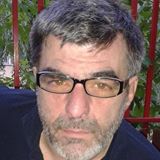
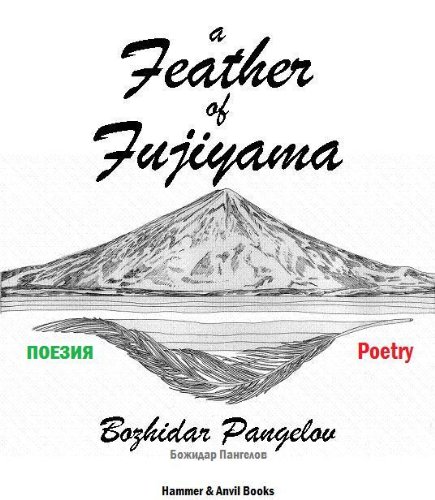
BOZHIDAR PANGELOV (bogpan – блог за авторска поезия блог за авторска поезия ) was born in the soft month of October in the city of the chestnut trees, Sofia, Bulgaria, where he lives and works. He likes joking that the only authorship which he acknowledges are his three children and the job-hobby in the sphere of the business services. His first book Four Cycles was written entirely with an unknown author but in a complete synchronicity on motifs of the Hellenic legends and mythos. The coauthor (Vanja Konstantinova) is the editor of his next book Delta. She is the woman to whom The Girl Who… is dedicated. Bozhidar’s last (so far) book is The Man Who. A bilingual poetry book A Feather of Fujiama is being published on Amazon as a Kindle edition.
Some of Bozhidar’s poems are translated in Italian, German, Polish, Russian,Chinese, Turkish, Arabic, Romanian, Portuguese and English languages and are published on poetry sites as well as in anthologies and some periodicals all over the world. Bozhidar Pangelov is on of the German project Europe .. takes Europa ein Gedicht. Castrop Rauxel ein Gedicht RUHR 2010 and the project SPRING POETRY RAIN 2012, Cyprus.
Bozhidar’s pen name “bogpan” means “god Pan” – in Greek religion and mythology.
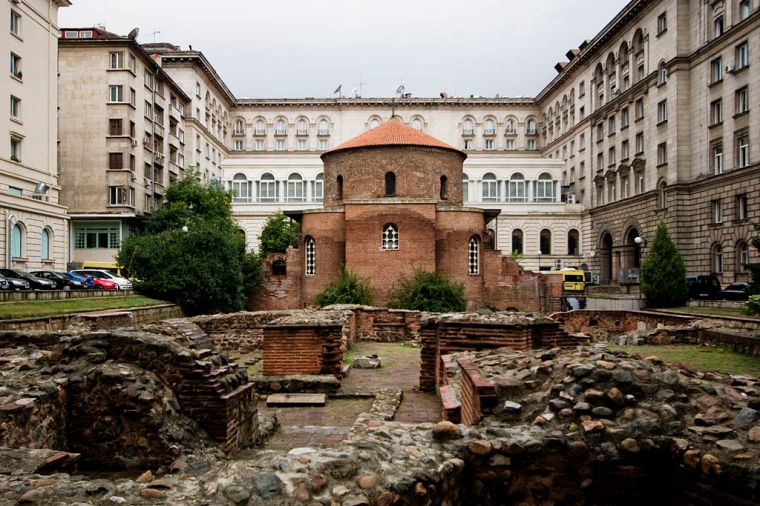
The Fourth Century St. George Rotunda is considered the oldest building in Sofia, the capital of Bulgaria, the city in which Bozhidar was born and lives. Photo courtesy of Sveti Georgi underCC BY 2.0 license.
The Interview
What were the circumstances under which you began to write poetry?
I have the feeling that I have always written poetry. At home we used to have quite rich book library. Throughout my awkward past the (the political system), reading was a way of having a life in another worlds. Can you imagine that there used to be long queues for each translated book from a foreign author! Well, eventually the cause of writing my first poem was quite funny. Me and a friend of mine used to be in love with the same girl. The conflict about who is going to meet her was resolved after each of us wrote a poem. Romantics of the youth.
2. Who introduced you to poetry?
To answer this question I would like to make some clarifications concerning the educational system in my country. In that system literature is considered as a compulsory subject and leads to serious exams that allow you to apply for a higher educational degree. In the study books are included national as well as international authors. In that aspect, if you like literature you just start writing.
3. How aware were you of the dominating presence of older poets?
During the time when I was young, the government used to dictate names of poets, but I have always been a rebel and that’s why I never accepted any names. Later on, when the political system changed what remained was my love and amusement by the great worldwide poets.
4. What is your daily writing routine?
I am not a professional poet and I don’t need to write every day to earn my living. Certainly I don’t trust poems written by professional poets because in most of the cases these poems have unclear aesthetic values and are there to satisfy the popular reader’s taste.
5. What motivates you to write?
The emotions. Despite the fact that everybody feels the defined emotions as love,pain and etc., each person senses them in their own unique way. The thought that inevitably exists in a poem rests between the conscious and unconscious. I think that a poem written only by the conscious effort of one’s mind is rather a short essay or a short novel. Still there should be a cross point between poetry and prose and for me that’s the emotions.
6. What is your work ethic?
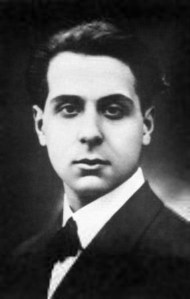
George Seferis [Georgios Seferiades] (1900 – 1971). One of the most important Greek poets of the last century, a diplomat and a Nobel laureate.I understand this question as related to writing. Ethic for me means to write a “real” poem. Now I sense the forthcoming question which would be what is the criteria or how would you determine what “real” is. A possible answer to this question is the one of the Nobel winner of Greek origin Georgius Seferis, who answers to a similar question in the following way: “But he must somehow have an instinct—a guiding instinct—which says to him: ‘My dear boy, my dear chap, be careful; you are going to fall. You are exaggerating at this moment.'” In this sense my instinct tells me that it’s an absurdity to expect everybody to understand poetry. Whoever wants to understand everything can read newspapers or magazine news. Still it’s uncertain that one will understand everything. At that point I would like to remind the following thought of T.S. Eliot: “Genuine poetry can communicate before it is understood.“
7. How do the writers you read when you were young influence you today?
Youngsters, who tend to get highly impressed after reading an author who relates to their inner self remember this artwork and this author which remains forever in their subconscious no matter if they are aware of it or not. That’s how the model works, which we reproduce in our own way. A poem doesn’t emerge from the nowhere.
8. Who of today’s writers do you admire the most and why?
Considering my experience and age it’s hard for me to get impressed. I just get extremely happy when I come across with an author, who has his/her own unique style, who is distinguishable from the majority. I would like to point at one single name, so I don’t miss out on some of my favourite authors. Stefan Goncharov – a young poet, who established his presence in a quite powerful and mature way just within few months time and having in mind that these were his first poems! As I can say – this man was born a poet.
9. Why do you write?
With writing I’m trying to express the inexpressible.
10. What would you say to someone who asked you “How do you become a writer?
In case that your question is – how can I become a professional writer, I can’t reply. I guess that this is something you can learn at the creative writing courses. For me this question has never been important. I just write. I think that if one wants to become a good writer, not only many books need to be read, but that person at a certain point needs to forget about all the knowledge and without a fear start writing in the way of expressing his/her own thoughts and feelings. To be honest with himself/herself and without thinking how to be liked by the readers. There isn’t an ultimate audience of readers that is there to like your writing. Here I would give a longer quote from the interview with Georgius Seferis – Henri Michaux “You know, my dear, a man who has only one reader is not a writer. A man who has two readers is not a writer, either. But a man who has three readers”—and he pronounced “three readers” as though they were three million—“that man is really a writer.”
11. Tell me about the writing projects you have on at the moment.
At the moment I don’t run my own projects. I’m engaged as an editor of the monthly magazine, New Asocial Poetry. We are preparing surprises for the published authors and new sections. There is already a new section for translations from mostly English language. At this point I would like to say that most of the young people know English, but unfortunately only few people for whom English is their mother tongue know my language. Maybe the reason for that the Cyrillic alphabet is mistaken for the Russian alphabet. Historically is exactly the opposite. Translations require hard work, especially when the literature is created in another language. For that reason we came up with the idea of having a new section for foreign literature dedicated to foreign authors who are a living example for language’s application and usage. All the authors, who are interested in participating in such project can read more about it HERE. .Whoever wants to learn more about the publishing requirements is kindly invited to apply with his/her literature by contacting me at newasocialpoetry@gmail.com.
Poet and writer, I was once columnist and associate editor of a regional employment publication. Currently I run this site, The Poet by Day, an information hub for poets and writers. I am the managing editor of The BeZine published by The Bardo Group Beguines (originally The Bardo Group), a virtual arts collective I founded. I am a weekly contributor to Beguine Again, a site showcasing spiritual writers.
My work is featured in a variety of publications and on sites, including: Levure littéraure, Ramingo’s Porch, Vita Brevis Literature,Compass Rose, Connotation Press, The Bar None Group, Salamander Cove, Second Light, I Am Not a Silent Poet, Meta / Phor(e) /Play, and California Woman.
Thank you for sharing your love of words. Comments will appear after moderation.


 Poet and writer, I was once columnist and associate editor of a regional employment publication. I currently run this site, The Poet by Day, an information hub for poets and writers. I am the managing editor of The BeZine published by The Bardo Group Beguines (originally The Bardo Group), a virtual arts collective I founded. I am a weekly contributor to Beguine Again, a site showcasing spiritual writers. My work is featured in a variety of publications and on sites, including: Levure littéraure, Ramingo’s Porch, Vita Brevis Literature,Compass Rose, Connotation Press, The Bar None Group, Salamander Cove, Second Light, I Am Not a Silent Poet, Meta / Phor(e) /Play, and California Woman. My poetry was recently read by Northern California actor Richard Lingua for Poetry Woodshed, Belfast Community Radio. I was featured in a lengthy interview on the Creative Nexus Radio Show where I was dubbed “Poetry Champion.”

 MIKE STONE (



 Jamie Dedes' THE POET BY DAY Webzine