Cynthia Gallaher, a Chicago-based poet and playwright, is author of three poetry collections and two chapbooks. Most recently, she made a 10-city book tour with her nonfiction guide & memoir Frugal Poets’ Guide to Life: How to Live a Poetic Life, Even If You Aren’t a Poet, which won a National Indie Excellence Award.The Chicago Public Library lists her among its “Top Ten Requested Chicago Poets.”
She said: “Among other themes and genres, I write food poetry, with my most recent effort being Omnivore Odes: Poems About Food, Herbs and Spices, a chapbook published by Finishing Line Press. The book was the result of studying, researching and working with a variety of spices, herbs, fruits, vegetables and sustainable animal foods.
“My latest effort, a manuscript in the works, Epicurean Ecstasy: More Poems About Food, Drink, Herbs and Spices will not include any of the poems from the chapbook but all new poems, including the two that appear on The Poet By Day, namely Cool Beans and Green Tea’s Ceremony Within.
“Regarding my philosophy surrounding my food (and drink!) poetry, I look to foods not only as life-giving nourishment and medicine, but also as a form of perennial cultural expression that remains a source of bonding throughout global communities. I select poem topics with a sense of what can heal as well as nourish, what we can celebrate, how we can bring ritual to every season as well as usher a feeling of gratitude for what we have granted us as stewards of the earth.”
garden speaks through its flowers,
a dharma talk on cosmic truth, its syntax
is the rush of joy in different hues
written on the harmony of loam,
on sturdy leaves and gray rock, …..an elemental symphony
webbed raiment as transient as foam, a
feral scent flirting with a lilting breeze,
sleepy stepping-stones along the path
and then the budding, the blooming, the
falling into decay, undisturbed by worldly
cares, a lively nirvana of prickly branches
and cherry trees, the wildish thorned
rose and the innocent daisy, palm fronds
and color spectrums, no burdens, just the
isness of small beings embracing the earth,
dancing in the sun, sleeping with the moon
Sherman Alexie (b. 1966) Spokane-Coeur d’Alene-American novelist, short story writer, poet, and filmmaker doing a book-signing at Kepler’s Books, Menlo Park, CA – 2017 (Awkward photo. I was trying not to capture the fans.)
Publishing is evolving in ways that are both disconcerting and exciting, but this exploration into what people think about submission fees (a relatively new aspect of the business) came up when I happened upon a publication that charged $23 for poetry submissions (not a contest) and didn’t seem to compensate writers. Hmmmm!
Within reason and budget – we’re all going to define those two areas differently – I don’t mind lending support to the lit mags I like, feel make an important contribution, use some of the funds to compensate writers, and to which I may aspire. But $23! Yikes! I started to ponder ethics, exploitation, vanity and desperation, and also what in human services we would refer to as “barriers to entry.” I wondered what others thought and I put out a call for opinions. It’s taken awhile to collect them and my own thoughts. I’m grateful to the folks who responded. I think this is a topic that calls for more than one person’s perspective.
I started out on my mom’s old Smith Corona portable. It was a big victory and boost to productivity to eventually get an electric IBM
If you started writing a hundred years ago like me, you remember the days of typed manuscripts, manila envelopes, postage stamps, self-addressed and stamped return envelopes (for the rejection letter or letter of acceptance) and trips to the post office. You remember spending days at the library – not comfortably at home with your computer – studying magazines and journals to figure out what they needed and to make sure the submissions or query letters you sent were appropriate. After all, it’s not like there’s never been a submission “fee.” There’s always been a cost to doing business. It was just differently configured and seemed cleaner.
For those who may not know, I should point out at this juncture that commercial publications (v. literary) are a different game. The big boys are supported by mega-dollar corporate advertising as well as subscriptions and newstand purchases. In my experience most offer writers compensation, either on acceptance or on publication. The later can leave you in limbo for some time. Sigh! No matter how you cut your writerly cloth, it’s not easy. This is why most writer’s have day jobs, or teach writing classes, or hold poetry workshops. Many do work for hire. I’ve done a lot of writing for hire, especially back in the days when I had three others to support. A good friend of mine says of himself, “I am a writer. I do accounting.” That sums it up nicely.
From the publisher perspective, journals come and go. They struggle to survive, especially now with fewer grant monies available and with competition from blogs and websites that are filled with content, often good, and often well-targeted to their readers’ interests. The easy and nominal cost of starting a zine online also creates competition for even well established literary print journals. Literary journals tend to be understaffed. Staff tends to be under-paid or unpaid. These publications are not exactly cash cows. They’re about literary love. So, short story: it’s not easy for publishers either.
The responses I got to my call ranged from resentment to the use of discretion. Clearly some people simply don’t submit work at all, preferring instead to post their poetry in the poetry groups (of which there are many) on Facebook or on their blogs. Some writers and poets feel it prudent to limit payments to competitions. To keep this post a reasonable length, I’ve included the responses that cover the most territory and the widest range of sentiments. It was enlightening to learn that there are almost no submission fees in some countries and others are worse than the U.S. Thank you to everyone who responded.
From U.K. Poet, Anne Stewart:
I think you have to assess each one by how much you want to support it and, if uncertain, trust your instincts. If your gut feeling is that they don’t care about what they’re publishing and just want your money, then it’s likely that they are, after all, money-grubbing vanity publishers preying on the dreams of vulnerable people. If your gut is feeling more generous today, then ask yourself a few simple questions.
Do you admire the work they’re publishing? If not – perhaps because it’s not good enough or because it’s publishing good work but is clearly biased towards a style or demographic, or has an agenda, that you’re not keen on – then don’t waste your money.
Do they pay the writers anything? Are they creating opportunities for their contributors? e.g. with launch readings, additional publicity via websites, events listings and so on. If ‘yes’ to any or more of these, then they have to be in funds to do it and, except perhaps for ‘the big ones’, that’s hard to do by subscription-base alone. There are too many for us to subscribe to them all (and not enough room in the house – I’ve just sorted out three crates of poetry magazines from the last 20 years to try to find good homes for because, otherwise, there’ll be no room in my house for any more coming in).
In the UK, Arts funding is hard to come by and, even if it’s gained for a period of time, there’s no guarantee that it will continue, and most of the small press magazines are run and administered, and funded for any shortfall, by volunteers, unpaid, and who are using their time outside ‘the day job’ to do it. Most of them wouldn’t dream of charging a fee to submit to their regular issues. Many run a competition annually to help with their funding and this is a concept I support. Would I pay to submit to a regular issue of a magazine? Very unlikely, though I have, on occasion. Would I pay $23 for the privilege? Not on your nelly.
Paying to have your work published is generally frowned on in the UK. Would I pay to have my work published in something other than a magazine? Not generally. But, yes, if I’m keen to be part of a project and know it won’t happen without support from contributors, then I would.
Last thought: support what you admire. Don’t encourage what you don’t.
Anne Stewart
ANNE STEWART is a poet, reviewer, and provider of services to poets and poetry organisations. In 2000, she began working towards a life with poetry at the centre of it, joining the Post-graduate Creative Writing programme at Sheffield Hallam University. In 2003, she was awarded an MA with Distinction and in 2005, was selected as one of the “Ten Hallam Poets” represented in the anthology published by Mews Press (eds. Sean O’Brien, Steven Earnshaw and EA Markham). The anthology attracted high praise from top-calibre poets (Don Paterson, Julia Darling, Helen Dunmore).
In 2008, she won the Bridport Prize for her sonnet, Still Water, Orange, Apple, Tea.Judge, David Harsent, said of it “…what marks it out is the way this emotional commonplace is adapted to language … no line lacked a surprise … I liked its briskness – celebratory, but never cloying – and liked too, the fine-tuning: … a tone of voice that promotes brevity … where the notes in question sing and tease and intrigue … ”
Her first collection, The Janus Hour (Oversteps Books, 2010), “is characterised by a view of the world that is quizzical, appraising, unflinching yet non-judgemental: this is how things look from here, it says; take it or leave it. Her poems address, with the same deft lightness of touch, both uncomfortable truths about our time and the surreal in the everyday, achieving a rare consistency of expression without ever being predictable.” – Jeremy Page, editor, The Frogmore Papers.
From N.Y. Poet and Editor, Russ Green
Jamie,
Thank you so much for doing this …
So, here are some of my thoughts on publications charging submission fees. I was co-editor for an NYC based independent press for 4 years. Our press did not charge for submissions. In fact we sent a check for $10. to those who’s work we accepted. We regularly received thank you notes and some were very surprised in a positive sense that not only didn’t we charge to submit, but we actually paid them. It really created some good PR. Later we changed it to a free book instead of the $10 check.
Of course, we need to put this into context. As I said, the press is based in New York City. When I was with them we sold a few hundred books a year and in addition, we also had a weekly reading where we passed around the hat. Also, there were a couple of special events a year where there was a small admission fee to see a high-profile name we would have featuring for us. While certainly no one was getting rich. Anyone who knows anything about small independent presses knows that to simply break even at the end of the year is a triumph and to actually turn a profit of any amount is cause for celebration. We were always able to achieve this at least one of these goals and sometimes both. All of the editors, including myself, were unpaid as is the case for most independent presses I believe. It was a labor of love.
Now, I can understand a press operating out of some small Midwest town where they are not going to sell the same volume of books as we did in New York or take in the same amounts at regular readings and special events, (Not that it was a lot). In this context I can see a small admission fee being perfectly justified. Now this is a double-edged sword though. While it takes care of the problem of funding a publication it will also cut down on the number of submissions. Lets face it, most poets and writers don’t exactly have a lot of disposable income if any. I think we all know of some exceptions, but by and large, not really. So, most are going to look for presses with free submissions and if there is a fee there would have to be some prestige in order to sway us to part with that money and we would be talking 5 or 10 dollars max. I think a better way to generate extra revenue in regards to small presses is to hold a contest, either a chapbook contest or a poetry contest where there is a prize, usually monetary with an award and sometimes a ceremonial reading event where there are often raffles to generate a few bucks.
To be perfectly honest I haven’t submitted to a lot of journals. I have here and there over the years in addition to having my book out, but I haven’t submitted enough to consider myself an expert in the workings of presses across the country and I only worked with the one publication. So, any inside perspective is limited to that. On the other hand I’ve been active on the scene for a good fifteen years now so I’ve seen and heard a lot in addition to my first hand experience. So, those are the thoughts of a former NYC based co-editor, host and curator living on Long Island now just enjoying the writing process and looking forward to receiving the rejection letters and hopefully a few acceptances instead of being the one sending them out.
Russ Green
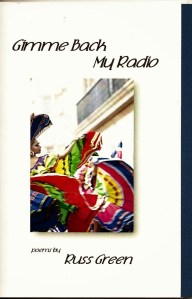
RUSS GREEN is a Graduate of Hofstra University. Over the years he has been co-editor at Great Weather for Media and has put on poetry and arts events around Long Island and New York city in addition to hosting and curating poetry stages at various festivals.
Russ has read his work from New York to New Orleans to Santa Fe and cities in between. He is currently focusing on humanitarian based events. His first book, Gimme Back My Radio, is out with Night Ballet Press. In addition, Russ has been published in a number of anthologies. He can usually be found communing with the mountains in Vermont with interesting artist friends or roaming the docks of Port Jefferson Harbor at night looking for signs of life in the starry night sky.
From poet and blogger, Kim Whysall-Hammond
Hi,
Personally, I will not submit to any journal that charges a fee on principle.
They have 2 advantages to the journal — a source of income, and a reduction in the size of their reading pile.
However, reading fees exclude those who cannot pay, are excluding and non-compliant with any sort of diversity policy. They will act to twist and distort the sort of poetry published.
What is even more invidious is the partial reading fee — “we don’t charge a reading fee, but if you pay us, we will read yours first”
Mendes Biondo speaks here of vanity book publishers. I am not opposed to self-publishing – in fact, encourage it under certain circumstances – but I am not a fan of vanity presses. A subject for another day.
From Poet, Journalist, Editor and Publisher, Mendes Biondo
I’m very near to the post you wrote about the literary journal that asked a large fee for a simple submission. I can understand that they need moneys to continue their efforts but I’m afraid that their behaviour could be the beginning of what is happening now in Italy. It’s a sort of “literary mafia” here. So I felt the need to speak about our situation. I love your work as The BeZine and The Poet By Day and I love American and English magazines because this kind of dirty thing is not as prevalent, especially in England. I give you the permission to quote my name. I’m too angry with those Italian publishing houses to hide myself.
Being an author in Italy is not an easy thing.
I’ve been an editor in a publishing house and the mantra in there (was and) is: “Ask moneys to the authors to publish their works”. I was obliged to ask more than 4000 Euros for a novel and 3000 Euros for a poetry collection. I decided to fire myself from that work because of my moral choices, but that Publishing House is just part of the majority that works in that way.
Asking moneys of the authors happens because – listening to authoritative voices – Italian readers are not interested in the literary panorama. So publishers need to ask that dirty fee to continue their work.
What about the magazines in Italy? If you want to be published you need to pay. And I’m not talking about a fee for the submission. That is a “normal” kind of payment that many printed journals require. In Italy it’s a sort of standard to pay an extra bribe, a silent extra payola, to find your literary voice in a magazine.
This is why I decided to move to English magazines. I tried to avoid those one that ask a fee to submit because I think that a magazine should be able to live on it own success. It can be difficult, many times it can be very hard, but it is necessary to give the same chance to every one.
And the most important point is quality. If you believe that publishing people able to pay means to publish high quality works, oh well, you’re completely wrong. Literature and Poetry in Italy is living its worst period thanks to this way of thinking.
Officially they present themselves to authors and to readers as traditional publishing houses but once you were selected, they ask you moneys. “Ask them moneys for the distribution in the bookshops – said to me one of those publishers – Authors do not know how it works here so they fall in our trap. You must tell them that distribution is not one of the elements we pay for. So they must do it on their own.”
This means that 3000/5000 Euros (3500/5800 $) were asked per title published at every author.
We have vanity publishers too and they are hated by authors, but if you think about it, when you ask them to publish your book, you already know that there is a fee to pay. In that case it’s a sort of extortion. This is why I decided to fire myself from those places.
A presto,
Mendes Biondo
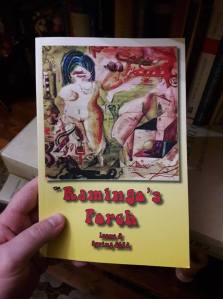
Co-Editor and Co-Founder of Ramingo’s Porch
MENDES BIONDO was born in Mantua (Italy) in 1992. He published two books: the novel Trappola di cotone (Nomadepsichico, 2008) and the collection of short stories and poems Amanti bendati (ExCogita, 2010). He has become a recognized journalist by the Italian Order from 2013. In 2015 he obtained the degree in Aesthetic Philosophy at the Università Cattolica del Sacro Cuore of Milan. He is as blogger, editor and journalist. You can find more about him at RAMINGO! La Cultura Come Non Te L’Aspettavi. His English works were published by Visual Verse and The Plum Tree Tavern.
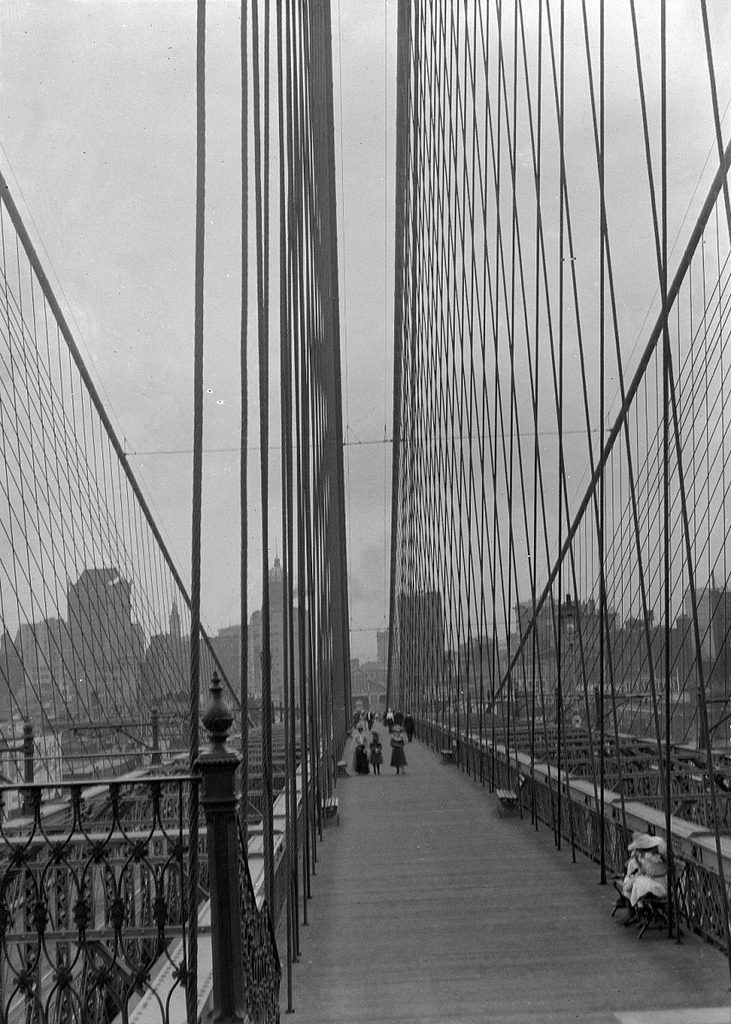
Brooklyn Bridge, looking west from Brooklyn, July 1899
The courageous immigrants of the elder generations cast the shards of their hopes and dreams across the landscape of this continent as prophecy. They worked hard and long for their visions. These people included my Lebanese maternal grandparents with their first-born children. They arrived in New York in 1897 on a boat from Syria. They petitioned for citizenship in 1925. Included also was my Turkish father who arrived here alone in 1919. He was just seventeen, eager to make good and to earn dowries for his four older sisters. The distaff side eventually settled in Brooklyn. That’s where they were when I was born and that’s where I was raised.
These were people who came to America in “the days of sail,” as the great New York writer, Irish-American Pete Hamill, would say. Today’s immigrants can and often easily do visit their countries of origin. They connect with their families and their linguistic and cultural roots. This was something that was generally not available to the people of my grandparent’s generation and before. Among the many reasons for this was an often crushing poverty. In Ireland “American wakes” were held for the sons and daughters who left for the United States. Heart-shattered parents knew it was unlikely they’d ever see their children again.
The immigrants I knew growing up worked hard. The immigrants that I know today work hard, often holding more than one job. They make real – though generally quiet – contributions to their communities, work places and their new country. They serve in the military. They make sure their children are educated.
Because of parents and grandparents who were resourceful and brave enough to come to this country, we had as children, not just economic opportunity, but a wealth of artistic and educational resources. On occasion we went, for example, to the Leonard Bernstein‘s Young People’s Concerts at the New York Philharmonic. I remember Mr. Bernstein with his charming and contagious enthusiasm calling our imaginations to Peter and the Wolf. We didn’t have to travel far to have access to talents like Mr. Bernstein or to visit museums, cathedrals, art galleries, music venues, theater (movies and stage), parks and so much more. It was all right there, ready to be plucked and savored like so many sweet and juicy summer plums.
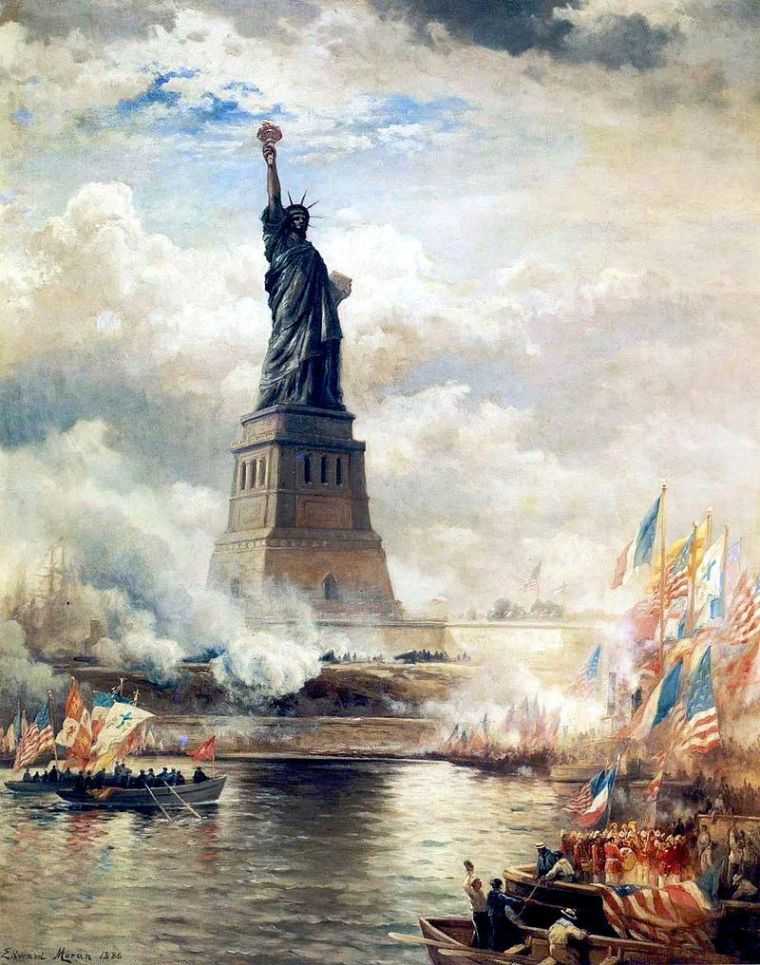
Unveiling of the Statue of Liberty Enlightening the World (1886) by Edward Moran. Oil on canvas. The J. Clarence Davies Collection, Museum of the City of New York. (Public Domain)
The schools were good, whether public or private. The libraries were ubiquitous. I will ever and always be in love with the Hudson River and the incredibly beautiful and historic Brooklyn Bridge. To my child-self, everything was magical, mystical, mythological and monolithic. Brooklyn’s proximity to Manhattan added to my enchantment. The Cloisters. Central Park. The magnificent Statue of Liberty, symbol of our highest ideal.
The New Colossus
Not like the brazen giant of Greek fame,
With conquering limbs astride from land to land;
Here at our sea-washed, sunset gates shall stand
A mighty woman with a torch, whose flame
Is the imprisoned lightning, and her name
Mother of Exiles. From her beacon-hand
Glows world-wide welcome; her mild eyes command
The air-bridged harbor that twin cities frame.
“Keep, ancient lands, your storied pomp!” cries she
With silent lips. “Give me your tired, your poor,
Your huddled masses yearning to breathe free,
The wretched refuse of your teeming shore.
Send these, the homeless, tempest-tost to me,
I lift my lamp beside the golden door!”
– Emma Lazarus (1849-1887)
I’m sure that had I been born in the mountains of Lebanon or in rural Turkey, these places would have offered their own joys and charms but I’m grateful for my Brooklyn, New York experience.
I too lived – Brooklyn, of ample hills, was mine; I too walk’d the streets of Manhattan Island, and bathed in the waters around it; I too felt the curious abrupt questionings stir within me In the day, among crowds of people, sometimes they came upon me, In my walks home late at night, or as I lay in my bed, they came upon me.
Walt Whitman (1819-1892), Leaves of Grass
This week’s prompt is “immigration.” Write in prose (up to 750 words) or poem about your experience or observation. Your work doesn’t have to be about immigration to the US. It can address or illustrate the refugee experience if you prefer.
There are so many on the move – and on the run – right now, historic numbers, and the world is fraught with anger and meanness on this topic. It seems a good subject to tackle through Wednesday Writing Prompt, though please know that I won’t publish and will delete anything encouraging of violence or hate.
Leave your prose or poem/s or a link to them in the comments section below. All work shared on theme will be published here next Tuesday. If it’s your first time coming out to play for Wednesday Writing Prompt, please send a short bio in the body of an email and a photo of yourself as an attachment to thepoetbyday@gmail.com for use as an introduction. You have until Monday evening, 8:30 p.m. PST, to respond to the prompt. You are welcome – encouraged – to join in no matter the status of your career: novice, emerging or pro.

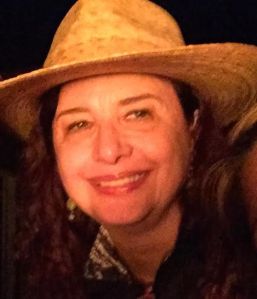 Cynthia Gallaher, a Chicago-based poet and playwright, is author of three poetry collections and two chapbooks. Most recently, she made a 10-city book tour with her nonfiction guide & memoir Frugal Poets’ Guide to Life: How to Live a Poetic Life, Even If You Aren’t a Poet, which won a National Indie Excellence Award. The Chicago Public Library lists her among its “Top Ten Requested Chicago Poets.”
 with my most recent effort being Omnivore Odes: Poems About Food, Herbs and Spices, a chapbook published by Finishing Line Press. The book was the result of studying, researching and working with a variety of spices, herbs, fruits, vegetables and sustainable animal foods.




 Jamie Dedes' THE POET BY DAY Webzine